 Go Back

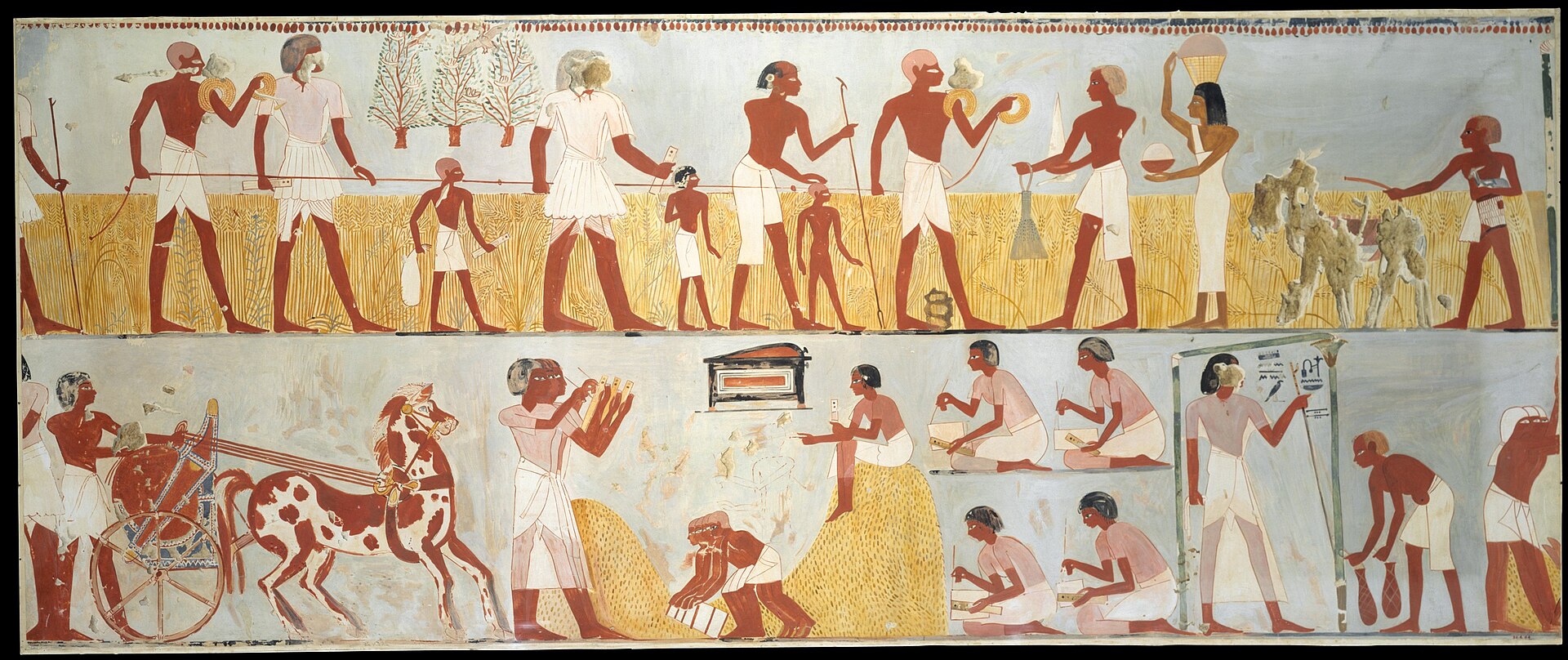
Agriculture Across Civilizations. Every civilization in this course began in a field. Farming produced the surplus that fed the priest, the scribe, the soldier, and the pyramid builder, and the great civilizations rose exactly where farming was easiest: along the Nile, between the Tigris and Euphrates, and along China's Yellow and Yangtze rivers. Egypt was the luckiest. The Nile flooded every summer with a reliability that astonished visitors, covering the fields with water and rich black silt. Egyptians organized their whole year around the river: Akhet, the flood season; Peret, when the waters fell and sowing began; Shemu, the harvest. Wheat and barley were the staple crops, turned into bread and beer, the daily food of everyone from farmer to pharaoh, while flax provided linen, and gardens produced onions, beans, dates, and grapes.
Iraq's rivers were less kind. The Tigris and Euphrates flooded unpredictably and sometimes destructively, and the soil of the south was fertile but dry, so Mesopotamian farmers mastered irrigation: canals, dikes, and reservoirs that carried river water to the fields, dug and maintained by organized labor on a massive scale. Their laws made canal maintenance a legal duty, because a broken dike could starve a city. In China, villagers of the northern river valleys first farmed millet, the drought-resistant grain that anchored East Asia's earliest agriculture, with wheat joining much later, while the wetter south built its farming on rice, a crop that can yield two or even three harvests a year in the right conditions.
Lifting water from river to field drove centuries of invention. The simplest device was the shaduf, a long beam balanced on a post with a bucket at one end and a counterweight of mud or stone at the other; one person could raise water with a pull, using nothing but the principle of the lever. The saqia went further: a wheel fitted with pots, turned by an ox walking in a circle, lifting a continuous stream of water day after day. And the tanbur, known in the West as the Archimedes screw, raised water inside a rotating spiral tube, a machine invented in the ancient world and still manufactured today. These devices look simple, but each is applied physics: levers, gears, and inclined planes put to work in the service of the harvest.
Farming also built the calendar. The Egyptians discovered that the flood came when the star Sirius reappeared just before sunrise, and from this they created a 365-day year, the ancestor of the calendar the world uses now. Twelve months of thirty days, plus five extra days, marched through flood, sowing, and harvest. That calendar never died: Egyptian farmers still name their working months by the old Coptic names, and the curriculum singles out Baramhat and Amshir, the late-winter and spring months of the growing season, as living proof that a four-thousand-year-old invention still organizes rural life in Egypt.
The state organized agriculture because its life depended on it. In Egypt, officials measured the flood with the nilometer, a graduated well or stairway that predicted the harvest, and assessed taxes in grain accordingly; granaries stored the surplus against bad years, exactly the policy the Quran's account of Joseph describes. In the Faiyum, Middle Kingdom kings ran great land-reclamation projects, turning marsh into farmland with channels, dikes, and canals, in the same depression that is still farmed today. When the system worked, civilization flourished; when the inundation fell short, famine followed, and nilometer records show how often the flood came in weaker than hoped.
The lesson carries into the present. Agriculture taught humans to manage water, measure time, store surpluses, and cooperate in large numbers, and modern Egypt still treats the same Nile and the same crops as national security. The curriculum's point about green energy and making the best use of resources is not new: the shaduf, the saqia, and the solar calendar were the sustainable technologies of their age, machines that ran on muscle, water, and sunlight. A civilization that wastes its land and water declines; one that studies its farmers' wisdom can keep its fields green for millennia, as Egypt has.
 Britannica: Nile River
 World History Encyclopedia: Egyptian Agriculture
Britannica: Egyptian calendar
Britannica: Irrigation