 Go Back

Assyria. In the rain-fed hills of northern Iraq, around the cities of Ashur, Nineveh, Nimrud, and Khorsabad on the upper Tigris, rose one of the dominant military powers of the ancient Near East. Ashur began as a merchant city: in the early second millennium BC its traders ran caravan networks deep into Anatolia, exchanging tin and textiles for silver, and leaving thousands of business letters in the trading colony of Kanesh. The Middle Assyrian kings, from about 1360 BC, turned the city into a kingdom, taking advantage of Babylon's weakness to conquer northern Mesopotamia, and kings like Tukulti-Ninurta I even captured Babylon itself. After a period of decline under pressure from Aramean migrations, Assyria rebounded in the Neo-Assyrian Empire, beginning with Ashurnasirpal II around 883 BC, who moved the capital to Nimrud and advertised his power in palace reliefs and inscriptions that describe conquest in terrifying detail. Assyria's strength was organizational.
Its kings fielded a professional standing army, with iron weapons, siege engines that battered city walls, cavalry, engineers who diverted rivers, and an intelligence and supply system that could move armies hundreds of miles. Tiglath-Pileser III, who seized the throne in 745 BC, built an empire in the administrative sense: conquered lands were annexed as provinces under Assyrian governors, and subject peoples were deported in mass resettlements, moved across the empire to break their unity and repopulate devastated regions. His successors Sargon II, Sennacherib, Esarhaddon, and Ashurbanipal extended rule from Egypt, conquered by Esarhaddon in 671 BC, to Elam and the Persian Gulf. Sennacherib destroyed rebellious Babylon in 689 BC, an act of religious shock even to his own people; his son Esarhaddon rebuilt it. Ashurbanipal presided over the empire's cultural peak and its last conquests.
Then, with startling speed, it all collapsed: a coalition of Babylonians under Nabopolassar and Medes under Cyaxares destroyed Assyria between 616 and 609 BC, sacking Nineveh in 612. The empire had ruled so harshly and extracted so much that almost no one mourned it: the biblical prophet Nahum rejoiced that none would grieve for Nineveh, and later travelers found its capitals as buried mounds. The empire's wars are documented in an unmatched archive: royal annals that list campaigns year by year, letters from spies and governors, and the palace reliefs that narrate sieges and deportations scene by scene. Ashurbanipal's campaign against Elam ended with the sack of Susa in 647 BC; that city was also where an Elamite king had carried off the stele of Hammurabi's laws as booty from Babylon some five centuries earlier, which is why it stands in the Louvre today.
Assyrian policy toward Babylon was the empire's unsolvable problem: the ancient holy city could not be treated like a conquered town, yet it would not stop conspiring with Elam, and the kings alternated between ruling it directly, placing their brothers on its throne, and, in Sennacherib's case, razing it in fury, an act his own successors treated as sacrilege. The empire also met the west: Sargon II crushed a revolt at Ashdod, received tribute from Cyprus, and corresponded with the kingdom of Judah, and Sennacherib's siege of Jerusalem in 701 BC is recorded both in his annals and in the Bible, one of the rare ancient events we can read from both sides.
Assyrian kingship fused warrior and priest: the king campaigned almost every year of his reign, consulted the sun god's oracle before battles, and described himself as the shepherd of his peoples even while boasting of mountains of corpses. That contradiction, terror as policy and order as ideal, was the empire's genius and its doom, for it built a state that could conquer everything and reconcile nothing.
Assyria's reputation for cruelty was deliberate policy: royal inscriptions and palace reliefs described flaying, impalement, and mass deportation to spread terror in advance of the army, so that cities would surrender without a siege. Yet Assyria was far more than a war machine, and its daily civilization was sophisticated. The Assyrians were superb organizers: provincial governors reported to the king by fast courier, a relay postal system covered the empire, and standard weights, measures, and calendars kept taxation predictable. Mass deportation, brutal as it was, moved skilled craftsmen, farmers, and scribes across the empire, mixing peoples and spreading technologies; many deportees were settled as state farmers rather than enslaved. Religion remained Mesopotamian: the national god Ashur led the pantheon, and the king ruled as his priest and deputy, consulting diviners before campaigns. Assyrian scribes preserved Mesopotamian learning deliberately.
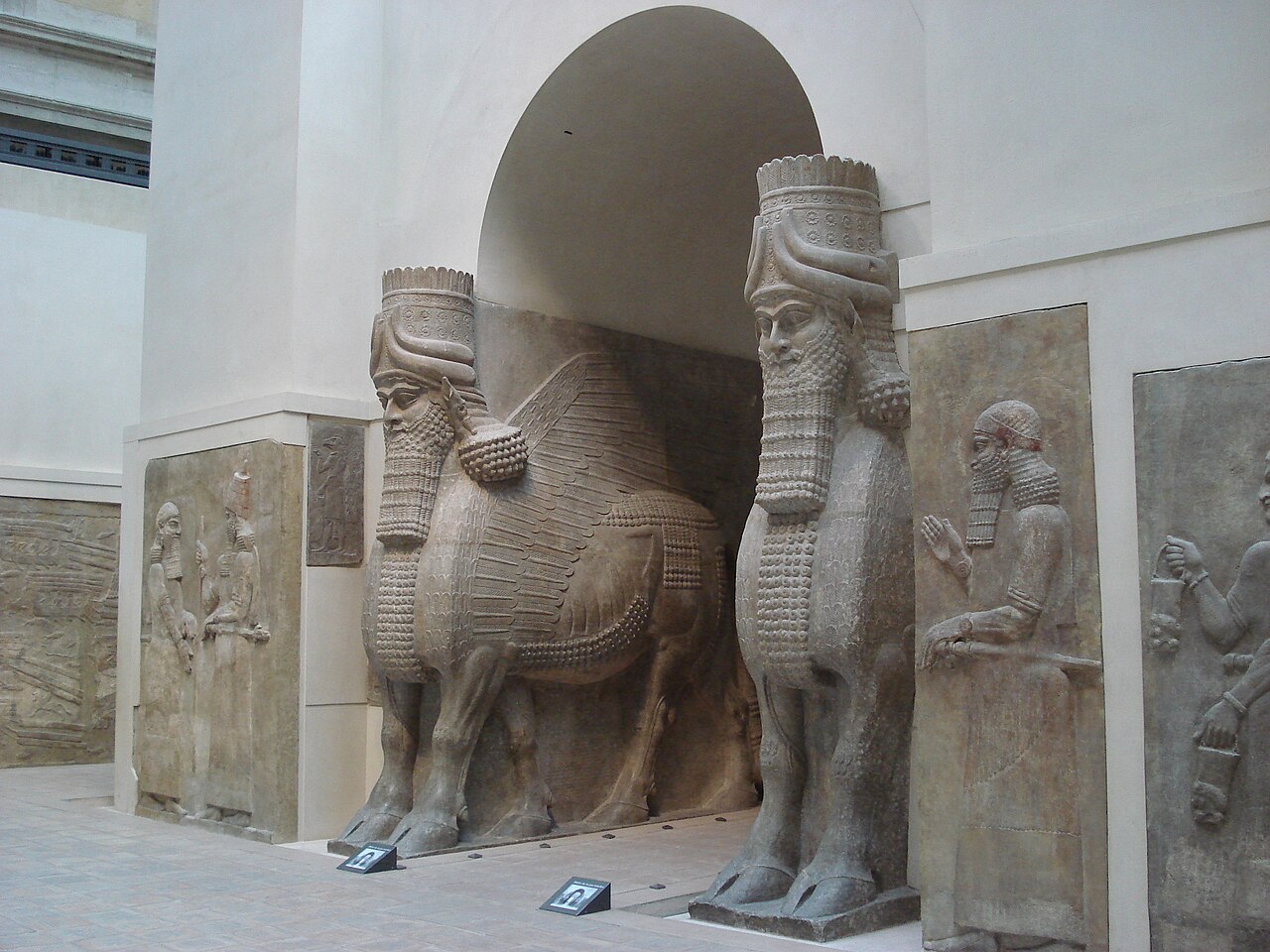
In his palace at Nineveh, Ashurbanipal assembled the ancient world's first systematically collected library, sending scholars across the land to copy tablets of omens, hymns, medical texts, and literature; his library grew to more than thirty thousand tablets, among the greatest archaeological finds ever made, including the best-preserved copy of the Epic of Gilgamesh, and modern knowledge of Sumerian and Babylonian literature rests largely on it. Assyrian art reached a peak of narrative power: the alabaster reliefs of the palaces show the king hunting lions with bow and spear, armies storming cities, prisoners marched into exile, and banquets in gardens, carved with an eye for animal suffering that still moves viewers. Winged bull colossi with human heads guarded palace gates. The economy mixed agriculture in the northern rain zone with the tribute and trade of empire, and Assyrian law, preserved in the Middle Assyrian code, was notably severe, especially toward women, whose veiling it regulated by class.
Assyria bequeathed to the region its imperial model: provinces, deportation, courier roads, and royal ideology were inherited by Babylon, then Persia, and through them shaped how empires worked for a thousand years. The king lists, chronicles, and eponym calendars of Assyria also give modern historians the backbone of ancient Near Eastern chronology.
 Britannica: Assyria
 World History Encyclopedia: Assyria
World History Encyclopedia: Ashurbanipal
World History Encyclopedia: Assyrian Empire