 Go Back

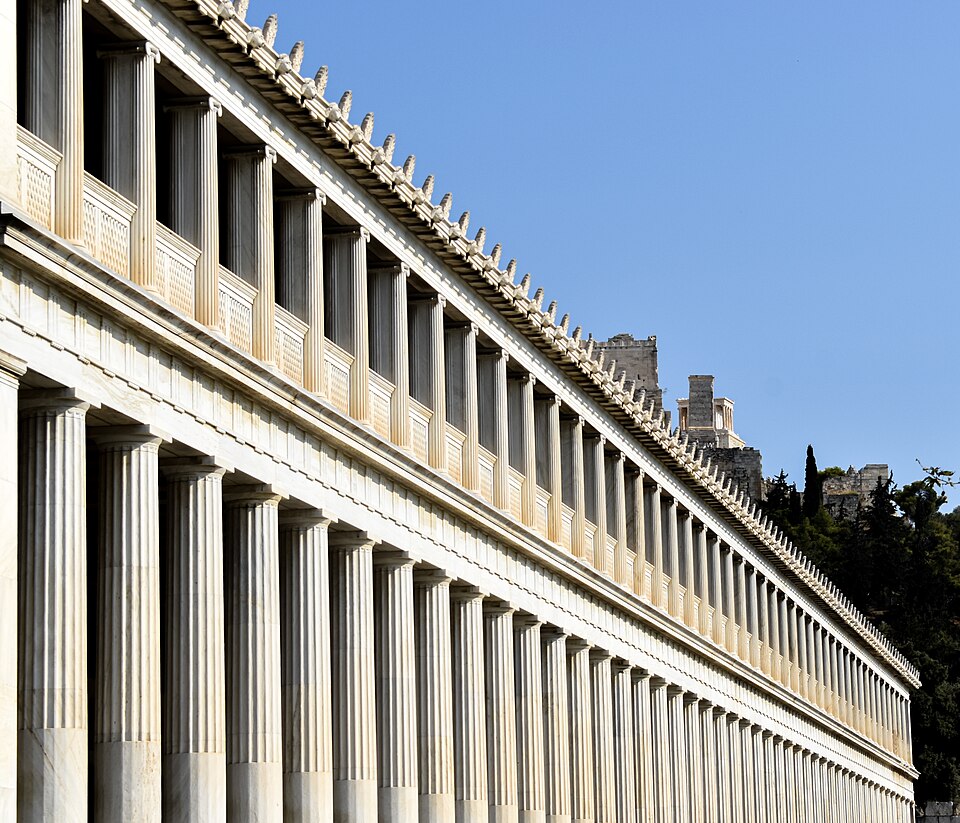
Classical Athens. In the fifth century BC, a small Greek city-state produced an explosion of political experiment, art, and thought that has shaped the world ever since. Athens had already pioneered reform: Solon's laws in 594 BC canceled debts and ended debt slavery, and Cleisthenes in 508 BC reorganized the citizens into new tribes and created the Council of Five Hundred, laying the foundation of democracy. The Persian Wars made Athens a great power. When the Persian Empire invaded Greece, the Athenians defeated Darius at Marathon in 490 BC, and ten years later, under Themistocles, their new fleet destroyed Xerxes' navy at Salamis, the decisive battle of the war.
Afterward Athens led the Delian League, a voluntary alliance of Greek cities formed to keep fighting Persia, but gradually turned the alliance into an empire: the treasury was moved from Delos to Athens, allies who tried to leave were forced back, and tribute paid for Athenian ships and buildings. Under Pericles, the dominant statesman from about 461 to 429 BC, democracy reached its fullest form. Every male citizen could speak and vote in the Assembly, which met about forty times a year; juries of hundreds, chosen by lot and paid for their service, judged cases; most officials were selected by lottery rather than election, on the principle that any citizen could govern. Pericles used league funds to rebuild the Acropolis, crowned by the Parthenon between 447 and 432 BC, a temple to Athena of perfect proportions filled with sculpture directed by Phidias.
Democracy and empire together funded the golden age of Athenian culture. But imperial arrogance bred enemies, and in 431 BC the long rivalry with Sparta erupted into the Peloponnesian War. Pericles' strategy of withdrawing behind the city walls packed refugees into Athens, where plague killed perhaps a quarter of the population, including Pericles himself. The war ground on for twenty-seven years, marked by the disastrous Sicilian expedition of 415 to 413 BC, in which Athens lost an entire army and fleet. In 404 BC Athens surrendered to Sparta, its walls demolished and its empire gone, though its democracy, twice overthrown by oligarchic coups, was twice restored, and its cultural influence only grew after its political fall. The democracy's machinery deserves close attention, because it was perhaps the most participatory government of the ancient world.
The Assembly met on the Pnyx hill, and any citizen could speak; decrees required thousands of votes; the Council of Five Hundred, chosen by lot for a single year, prepared business and ran daily administration; and the courts, with juries of hundreds chosen by lot each morning, were the final guardians of the law, since no appeal and no professional judiciary stood above them. Citizens could even vote once a year to exile, without trial, any man they judged too powerful: the ostracism, for which votes were scratched on potsherds that archaeologists still find.
The empire paid for this system and for the fleet that defended it, and the tension between democracy at home and domination abroad runs through everything Athens did: the allies became subjects, the treasury moved to Athens, and Pericles frankly told the Assembly that the empire was like a tyranny, perhaps unjust to take but dangerous to let go. The golden age was also the age of construction: besides the Parthenon, the Propylaea gateway, the Erechtheum with its maidens, and the temple of Nike rose on the Acropolis in a generation, while the fleet of some two hundred triremes, rowed by the poor citizens who thereby gained political weight, made Athens mistress of the sea.
The Peloponnesian War revealed the system's flaws and strengths alike: the Assembly could vote the catastrophic Sicilian expedition in a surge of enthusiasm and condemn its own generals in a fit of anger, yet it also sustained the war effort for a generation and twice restored democracy after oligarchic coups. Athens fell, but its argument, that ordinary citizens can govern themselves, never died.
Athenian democracy was direct, not representative: the Assembly of adult male citizens made every major decision, from declaring war to taxing the rich, and power rotated so widely that a citizen might serve on the Council, judge in the courts, and preside over the Assembly within his lifetime. Yet the citizen body was a minority of the population. Women were excluded from politics and lived largely in domestic seclusion; resident foreigners, the metics, paid taxes and served in the army without citizenship; and a large enslaved population, including the wretched miners of Laurion whose silver paid for the fleet, did much of the hard labor. The democracy was also a school of speech and thought. In the agora, the marketplace and civic heart, citizens debated, shopped, and argued philosophy.
Socrates walked there questioning everyone about justice and virtue until the democracy, shaken by war, condemned him to death in 399 BC for impiety and corrupting the young; his student Plato founded the Academy and wrote dialogues that made Socrates immortal, and Plato's student Aristotle founded the Lyceum and systematized logic, ethics, politics, and biology, becoming the teacher of Alexander the Great and the authority of later ages. Athens invented tragedy and comedy: Aeschylus, Sophocles, and Euripides staged dramas of fate, pride, and suffering at the festival of Dionysus, while Aristophanes mocked politicians and philosophers in savage comedies. Herodotus, who lived in Athens, wrote the first history, an inquiry into the Persian Wars, and Thucydides followed with a ruthlessly analytical account of the Peloponnesian War that remains a manual of power politics.
Athenian potters painted the red-figure vases found from Etruria to the Black Sea, and Athenian architects and sculptors set the classical standard of balanced, idealized form. When modern republics deliberate in assemblies, when courts use citizen juries, when we stage plays or ask what justice is, we are walking paths first cut in classical Athens, whose people, as Pericles' funeral speech claimed, made their city an education to Greece.
 Britannica: Athens
 World History Encyclopedia: Athens
Britannica: Ancient Greece
World History Encyclopedia: Classical Greece