 Go Back

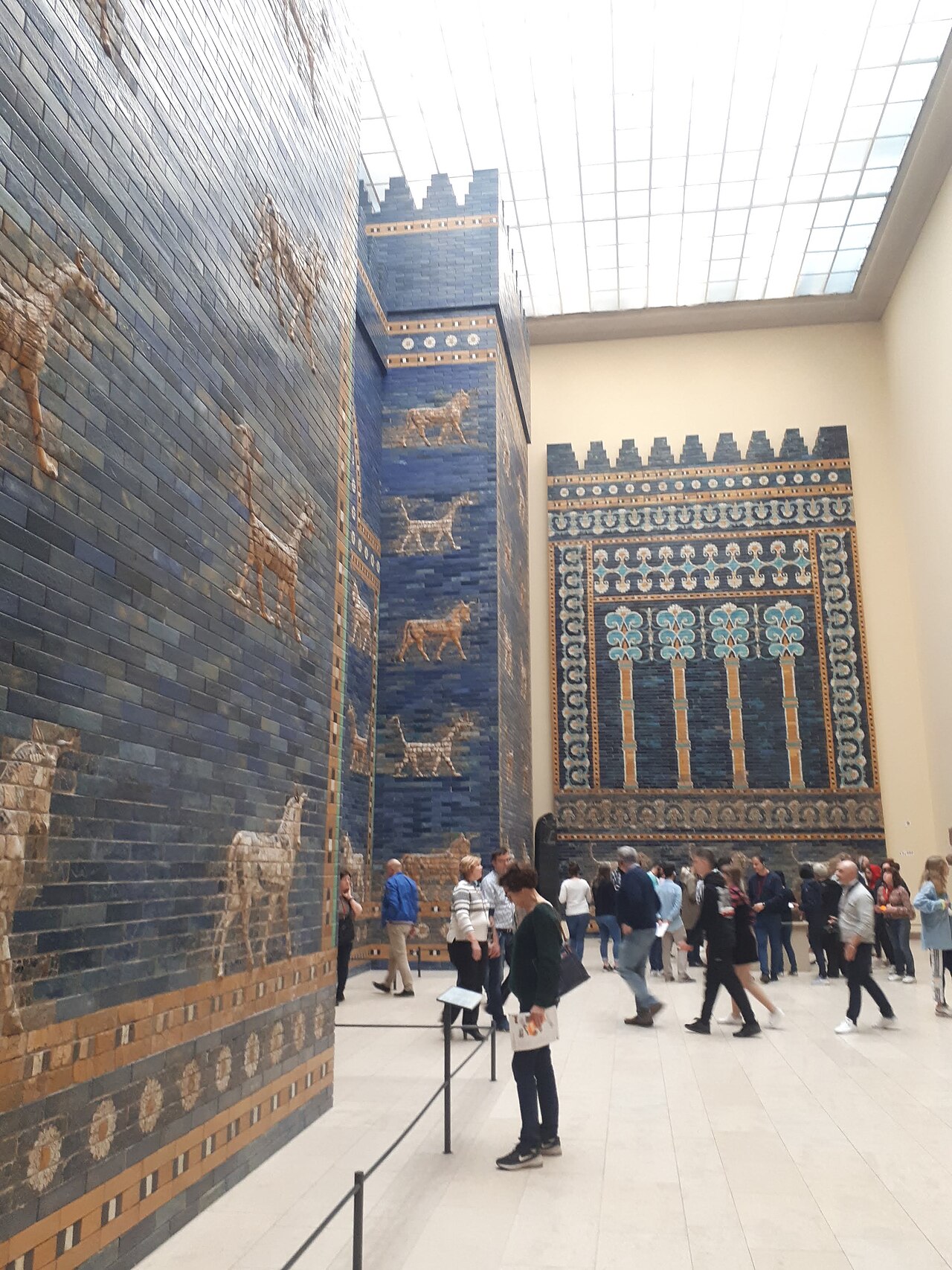
Babylon. After the fall of Ur around 2004 BC, southern Iraq fragmented among competing Amorite dynasties, and for two centuries no power dominated. The city of Babylon, on the Euphrates where the two rivers run closest together, was just one modest Amorite kingdom among rivals like Larsa, Eshnunna, Mari, and the great northern power of Assyria. Everything changed under Babylon's sixth king, Hammurabi, who reigned from about 1792 to 1750 BC. For three decades he governed patiently, building canals, temples, and alliances, defeating enemies one at a time rather than all at once. Then, in the last fourteen years of his reign, he struck: he defeated his former ally Rim-Sin of Larsa, conquered Mari and destroyed its magnificent palace, humbled Eshnunna, and forced even Assyria to submit, uniting all of Mesopotamia under Babylon for the first time since Ur.
Hammurabi is remembered above all for his law code, nearly three hundred laws carved in cuneiform on a black stone stele topped by a scene of the king receiving authority from Shamash, the sun god and god of justice. The code regulated prices, wages, marriage, inheritance, slavery, medicine, building standards, and agriculture, and it famously scaled punishments by social class: an injury to a noble cost more than the same injury to a commoner. It was not the first law code, but it was the most complete to survive, and its principle that the state publicly declares the law, so that the strong may not oppress the weak, echoes through all later legal history. After Hammurabi his empire slowly shrank, and around 1595 BC the Hittites marched down the Euphrates, sacked Babylon, and withdrew, leaving the Kassites, a people from the Zagros mountains, to rule Babylon for four centuries.
Babylon rose again under Nebuchadnezzar I around 1125 BC, then endured long Assyrian domination until the Chaldean Nabopolassar and his son Nebuchadnezzar II destroyed Assyria, with the Medes, between 616 and 609 BC. Nebuchadnezzar II rebuilt Babylon into a city that awed the ancient world: the blue-glazed Ishtar Gate, the Processional Way, the great ziggurat Etemenanki, and, by later tradition, the Hanging Gardens. His empire fell in 539 BC when Cyrus the Persian entered Babylon without a battle. The reign of Hammurabi is documented not only by his law code but by hundreds of his letters, which show a king managing everything personally: assigning fields, investigating corrupt judges, ordering the repair of canals, and reminding governors that the water must flow. Irrigation was the state's first duty, and the code itself sets penalties for the farmer who neglects his dikes and floods his neighbor's field.
The stele's prologue declares that Hammurabi was chosen by the gods to cause justice to prevail and to destroy the wicked, so that the strong should not oppress the weak, a statement of the purpose of law that still reads as a charter of government. After the Kassite centuries, when Babylon was respected as the ancient holy city even by its foreign rulers, the Assyrian period tested Babylonian identity: the city rebelled again and again, was destroyed by Sennacherib and rebuilt by Esarhaddon, and finally led the coalition that destroyed Assyria itself. Nebuchadnezzar II's rebuilt capital, with walls wide enough, said the Greeks, for chariots to pass on top, was the marvel that travelers like Herodotus described; it was also the city of the Jewish exile, whose prophets and scholars, sitting by the rivers of Babylon, wrote some of the Bible's most famous words.
When Cyrus entered in 539 BC, his cylinder proclaimed in Babylonian tradition that he had come at Marduk's call to restore the sanctuaries and free the captives, and the exiles went home: Babylon had become the measure by which conquerors proved their worth.
Babylonian civilization was heir to Sumer and teacher to everyone after. Babylonian scholars studied the Sumerian language the way later students studied Latin, copying the Epic of Gilgamesh and the creation epic Enuma Elish, recited every New Year in honor of the city god Marduk. Religion centered on great temple households, and the temple of the city god Marduk, with its seven-story ziggurat, dominated the capital. Temple scholars kept nightly records of the heavens for centuries, believing the stars held signs, and from this long observation came Babylon's most influential science: astronomy. Its scholars discovered that eclipses and planetary motions repeat in calculable cycles, and invented mathematical astronomy so precise that Greek astronomers later borrowed its methods and data.
The Babylonian base-sixty number system, with place value and an early placeholder for zero, let them solve quadratic equations, calculate compound interest, and produce the tablet known as Plimpton 322, which lists what we now call Pythagorean triples a thousand years before Pythagoras. Our sixty-minute hour and 360-degree circle are Babylonian inheritance. The economy rested on irrigated barley and date palms, managed by temples and palaces but increasingly also by private merchant families like the Egibi, whose surviving archives show them financing trade, farming, and tax collection across generations. Society was stratified into free citizens, a dependent class, and slaves, with law fixing the rights and obligations of each; women could own property, run businesses, and appear in court, especially if they were priestesses or widows.
When Cyrus captured Babylon, he presented himself not as a destroyer but as Marduk's chosen restorer, and the city's temples, scholars, and astronomical diaries continued under Persian, Greek, and Parthian rule, making Babylon one of the intellectual capitals of the ancient world for fifteen hundred years.
 World History Encyclopedia: Babylon
 Britannica: Hammurabi
World History Encyclopedia: Code of Hammurabi
World History Encyclopedia: Hammurabi