 Go Back

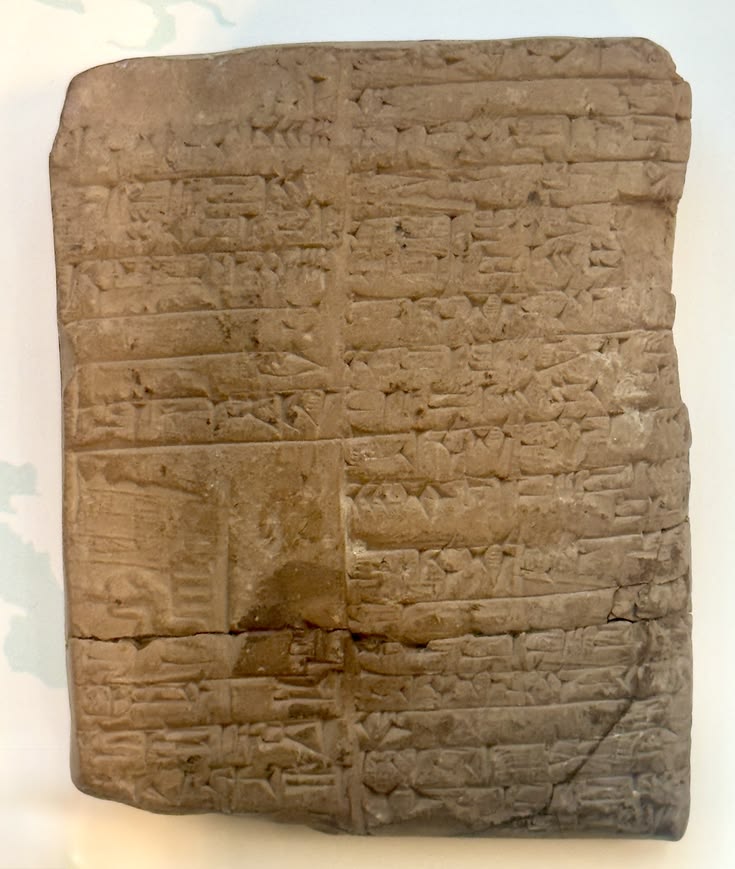
Cultural & Intellectual Life Across Civilizations. Writing is the invention that made everything else in this course possible, and each civilization wrote differently. Sumerians pressed wedge-shaped marks into wet clay with a cut reed, creating cuneiform, used for three thousand years to write Sumerian, Akkadian, Babylonian, and Assyrian. Egyptians painted and carved hieroglyphs on temple walls and wrote the same language in a fast cursive script, hieratic, on papyrus. The most consequential script of all came from a small trading people: the Phoenicians reduced writing to about two dozen simple signs for sounds, and that alphabet passed to the Greeks, who added vowels, and from the Greeks to the Romans, whose letters you are reading now.
The materials mattered as much as the marks. Clay tablets were heavy but nearly indestructible, which is why we can read a Sumerian schoolboy's homework from four thousand years ago. Egyptian papyrus was light and portable, and exporting it spread Egyptian influence across the Mediterranean. The Chinese invented paper, and the craft traveled west: paper was being made in Samarkand by 751, in Baghdad by 793, and it reached Europe through Islamic Spain. Cheap paper is what allowed the great age of Islamic book production: Baghdad's paper-sellers' market alone held more than a hundred shops, and manuscripts were copied on a scale Europe would not match until printing.
Literature grew up beside administration. Iraq produced the Epic of Gilgamesh, one of the earliest surviving works of literature, a king's search for eternal life that ends with acceptance of death. Egypt gave the world wisdom literature, instructions in how to live justly, tales like Sinuhe, and love songs that read like they were written yesterday. Greece invented tragedy and comedy and produced Homer, whose Iliad and Odyssey were the shared education of every Greek. Rome followed with Virgil and Cicero. In the Islamic world, poetry was the supreme art, from the odes of pre-Islamic Arabia to al-Mutanabbi, alongside the maqama stories, One Thousand and One Nights, and travelers' accounts like that of Ibn Battuta, who crossed most of the known world.
Behind the books stood institutions. Young Sumerians learned cuneiform in the edubba, the tablet house, copying lists and proverbs under a strict master. Egyptian scribes trained in temple schools and the House of Life, where texts were copied and composed. The Greeks moved learning into the open: Plato's Academy and Aristotle's Lyceum were schools where everything could be questioned, and Athens' theaters were a kind of public education in themselves.
The greatest research center of the ancient world was the Library of Alexandria, where scholars were paid by the Ptolemies to collect, copy, and study every book they could find, in Greek and in the languages of Egypt and Asia. There Euclid organized geometry, Eratosthenes measured the Earth, and Callimachus compiled the Pinakes, its great catalog of Greek literature. Islamic civilization carried the tradition further: Baghdad's Bayt al-Hikma, the House of Wisdom, founded by the caliph al-Ma'mun to translate and study Greek science, became the symbol of the translation movement that rendered Greek, Persian, and Syriac learning into Arabic, while the kuttab taught children reading and the Quran, and the madrasa, from Cairo's al-Azhar to Baghdad's Nizamiyya, became the standard college of the Islamic world.
When scholars in Islamic Spain later translated these Arabic libraries into Latin, Europe rediscovered its own classical past and the Renaissance became possible. The chain is the lesson: Sumerian clay taught Egypt, Phoenician letters taught Greece, Greek books taught Baghdad, and Baghdad's books woke up Europe. Knowledge is a relay race between civilizations, and the baton is whatever a culture writes down, preserves, and hands on.
 Britannica: Writing
Britannica: Cuneiform
Britannica: Library of Alexandria
Britannica: Bayt al Hikmah