 Go Back

Early Japan. The Japanese islands were settled in the Ice Age, and by about 14,500 BC their inhabitants were making some of the oldest pottery in the world, the cord-marked vessels of the Jomon people, hunter-gatherers who lived in settled villages of pit houses for thousands of years, an unusually stable Stone Age culture. Everything changed around 300 BC, when rice farming arrived from the Asian mainland, probably through Korea, bringing the Yayoi period. Wet-rice agriculture demanded cooperation to build and maintain paddies and channels, and with it came bronze bells, iron tools, social ranking, and warfare between small chiefdoms. Chinese chronicles of the third century AD describe a land of many small countries, some ruled by queens, including the shaman-queen Himiko of Yamatai, who sent tribute missions to China.
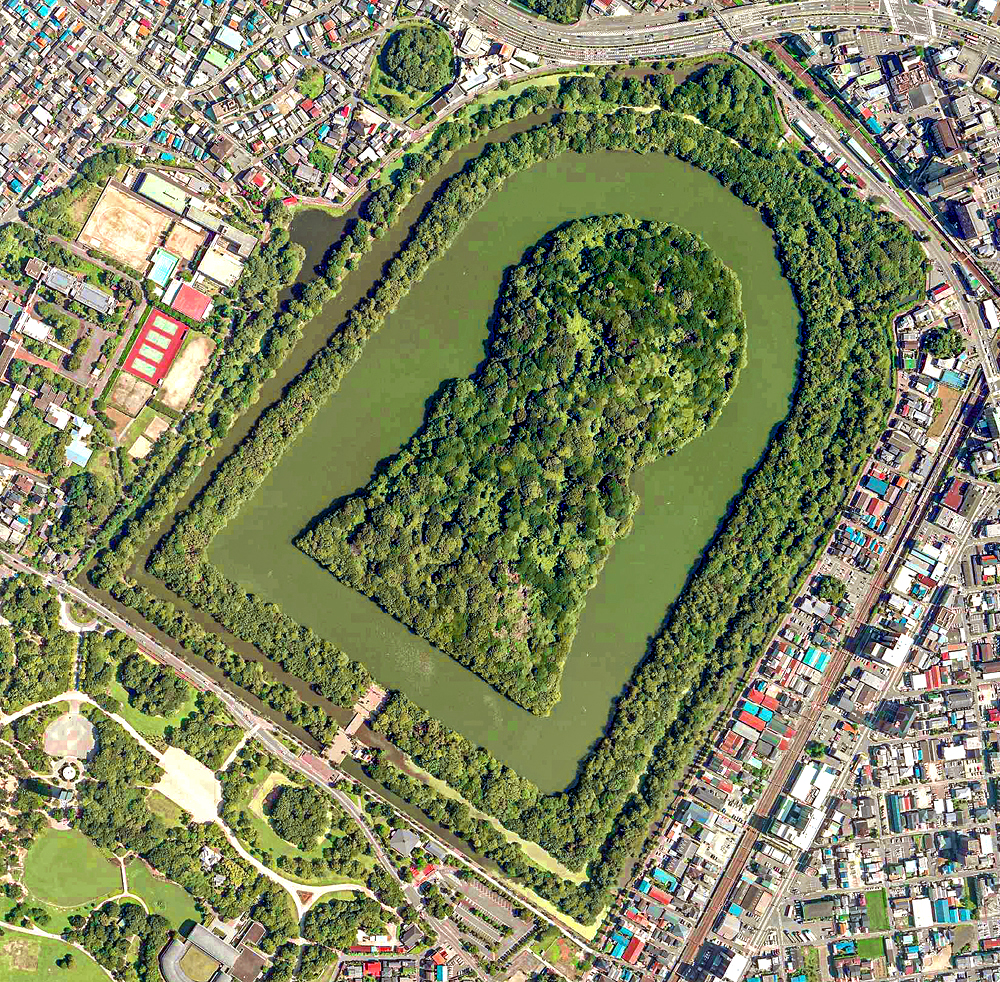
In the following Kofun period, roughly 250 to 600 AD, power gathered in the Yamato plain, where rulers built enormous keyhole-shaped burial mounds surrounded by moats and lined with clay figures, the largest, attributed to Emperor Nintoku, covering more ground than the Great Pyramid of Giza. From these tombs, and from Chinese records, we see a warrior aristocracy of horse-riding clans, organized into hereditary guilds, gradually unifying the islands under the Yamato court, from which Japan's imperial line claims unbroken descent to this day. The sixth and seventh centuries brought deliberate transformation. Buddhism arrived from Korea in 538 or 552, championed by the Soga clan against conservative rivals, and with it came Chinese writing, calendar science, medicine, and statecraft.
Prince Shotoku, regent from 593, issued the Seventeen-Article Constitution, a set of moral and administrative precepts modeled on Chinese ideals of centralized, virtuous rule, and sent embassies directly to China's Sui court, famously addressing the Chinese emperor as an equal, from the land of the rising sun to the land of the setting sun. In 645 the Taika Reforms abolished private clan control of land and people, declaring all land the emperor's, and established Chinese-style taxation and provinces. Japan was deliberately remaking itself as a centralized state on the Chinese model, though always adapting what it borrowed to its own conditions. The sources for this age are unusually revealing, because Japan enters history through foreign eyes.
Chinese dynastic histories record the tribute missions of the third century and describe the Yamatai kingdom of Queen Himiko, who ruled through shamanic trance and was buried, the chronicle says, in a great mound with a hundred sacrificed attendants, a detail matched by the keyhole tombs then rising in Japan. The kofun themselves, built from the third to the sixth century, mark the growth of royal power: the largest mounds required the labor of thousands, and their contents, armor, horse gear, mirrors, and jewels from Korea and China, show both a horse-riding warrior elite and deep ties to the mainland. Korea was the bridge: the Yamato court kept a foothold on the peninsula, and waves of Korean and Chinese immigrants, scribes, weavers, smiths, and potters, brought the skills of the continent and were organized into the service guilds of the court.
The sixth century decided Japan's direction: when the Soga championed Buddhism against the Mononobe and Nakatomi, who defended the native gods, the victory of the Soga at the battle of Shigisan in 587 opened the road to continental civilization on a grand scale. Prince Shotoku's constitution ordered officials to prize harmony and to obey the imperial will, and his embassies to Sui China brought back students who spent decades studying the Chinese state and returned to run the reforms. The Taika coup of 645 destroyed the Soga, and the reform edicts that followed abolished private ownership of people and land, established registers and taxes on the Chinese model, and built a capital in imitation of the Chinese grid. Japan had remade itself by deliberate imitation, and it would do so again, on a far larger scale, after 1868.
Early Japanese society was built on clans, the uji, each claiming descent from a divine or heroic ancestor, each controlling its own lands and its hereditary corporations of farmers, weavers, potters, and soldiers. The Yamato ruler was first among clan chiefs rather than an absolute emperor, and legitimacy came from sacred descent: the imperial line traced itself to the sun goddess Amaterasu, whose shrine at Ise became the holiest site of Japan's native religion. That religion, later called Shinto, honored the spirits of nature and ancestors at shrines across the land, and Japan's first written histories, the Kojiki of 712 and the Nihon Shoki of 720, placed the imperial house at the center of its myths, giving the throne sacred legitimacy.
When Buddhism arrived from the mainland, it blended with these older practices rather than replacing them, and temples and shrines stood side by side, a pattern that still defines Japanese life. The economy centered on rice, which was wealth itself: taxes were assessed in sheaves, and control of wet-paddy land was the foundation of every clan's power. Iron tools, Chinese and Korean immigrant craftsmen, and new techniques spread silk weaving, glazed pottery, and roof tiles. Japan in this period had no cities on the mainland scale, no coinage in daily use, and no writing of its own; it imported all three. Chinese characters were adapted to write Japanese, a complex marriage of two utterly different languages that produced the mixed script Japan still uses.
The great achievement of the age was selective borrowing: Japan took Chinese law codes, bureaucracy, Buddhism, city planning, and writing, but left out the Chinese examination system and the idea that heaven transfers the mandate to rule between dynasties; in Japan the imperial line was eternal, a flexibility that let real power pass to regents and shoguns in later centuries while the throne endured. The Kofun and Asuka ages thus laid the foundations on which Nara, Heian, and all later Japan would build.
 Britannica: Asuka period
 World History Encyclopedia: Asuka Period
World History Encyclopedia: Kofun Period
Britannica: Japan