 Go Back

Economic Projects Through History. Some projects are so large that only a state can build them, and history's greatest states measured themselves by them. The oldest is Egypt's dream of joining the Red Sea to the Mediterranean. Ancient tradition credited the canal to pharaohs of the Middle Kingdom, remembered as Sesostris; the first attempt we can date belongs to Necho II around 600 BC, whose work was left unfinished. The Persian king Darius I completed the waterway from the Nile to the Red Sea, and said so proudly in his Suez inscriptions. Ptolemy II improved the canal with locks, Trajan restored it as the Amnis Traianus, and Amr ibn al-As reopened it in 641 or 642 after the Arab conquest. It silted up and was closed for good in 767, but the idea never died until the Suez Canal realized it in 1869, this time joining the seas directly.
Rome built with stone instead of water. The Roman road network eventually covered some 80,000 kilometers of paved highway, beginning with the Via Appia in 312 BC, laid out by engineers who drained marshes, bridged rivers, and cut through hills so that legions, officials, and merchants could move at a steady pace in any weather. Roads were economics as much as strategy: they cut the cost of moving grain, pottery, and metal, tied distant provinces to Roman markets, and carried the cursus publicus, the imperial post. Their straight lines still shape the map of Europe, and some, repaved, still carry traffic today.
The Islamic world inherited and extended these arteries, then outgrew them with the caravans and sea-lanes that linked Spain to India: the Silk Road across Asia, the incense routes of Arabia, and the monsoon highways of the Indian Ocean. Along the Silk Road moved Chinese silk and paper westward, and glass, silver, horses, and ideas eastward, with cities like Samarkand and Baghdad growing rich as the exchanges of continents. When the sea routes rose under the Portuguese and the old land roads declined, whole regions felt the shift, proof that whoever holds the routes of trade holds a kind of power no fortress can give.
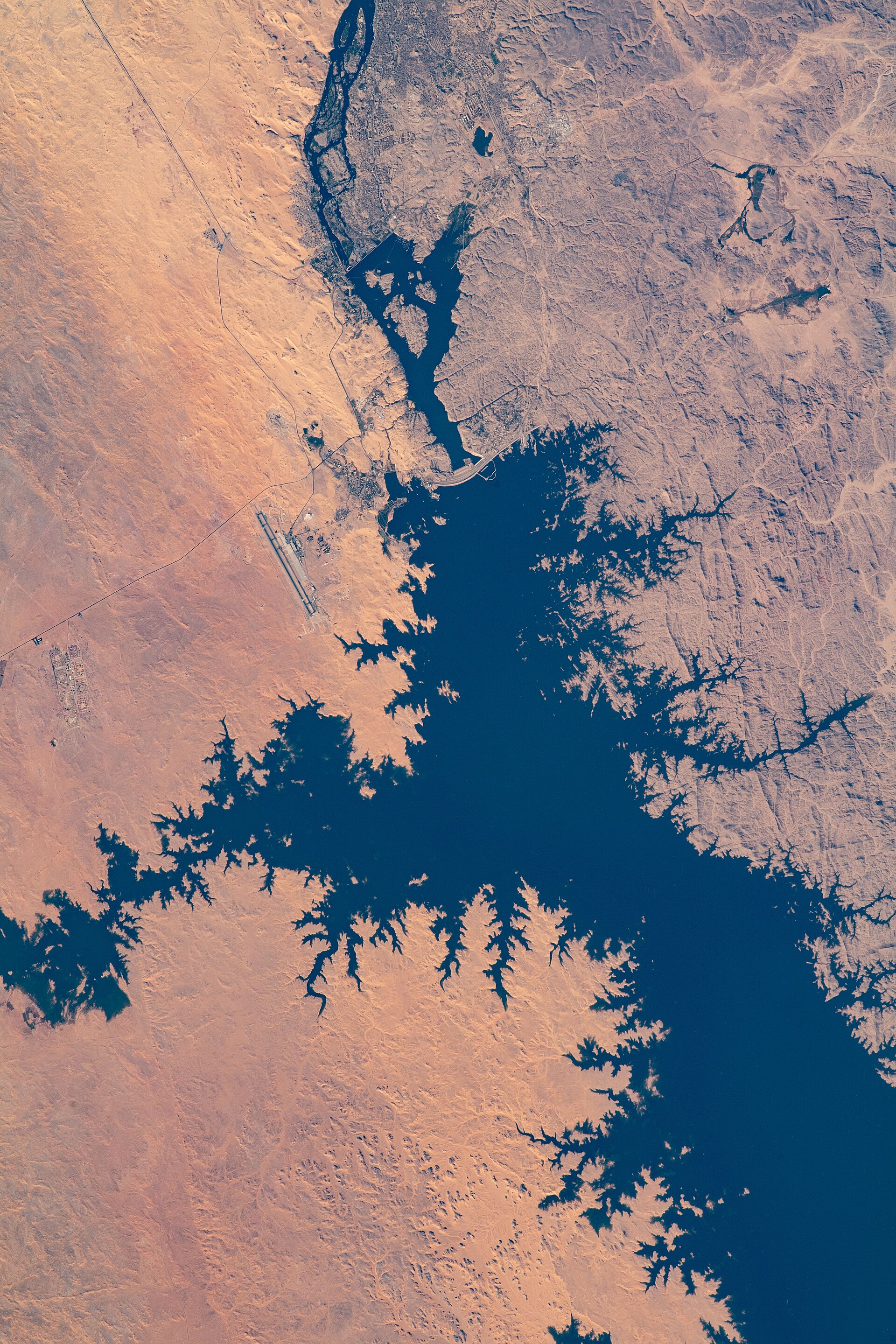
Egypt's own modern megaproject is the High Dam at Aswan, built between 1960 and 1970. For the first time in five thousand years, the Nile's flood was stopped completely: the dam ended the annual cycle of flood and drought, stored water in Lake Nasser for dry years, released it for irrigation all year round, and generated the electricity that powered Egypt's industry and lit its villages. It was as much a national statement as an engineering work, completed after the withdrawal of Western financing pushed Egypt to build it with Soviet help.
The dam also shows that megaprojects have real costs. The rising waters of Lake Nasser threatened the monuments of Nubia, and the world responded with what UNESCO describes as the greatest archaeological rescue operation of all time: UNESCO's campaign moved Abu Simbel itself, cutting the temples into blocks and reassembling them above the waterline, while other temples were dismantled and gifted to the nations that helped. Downstream, the silt that had renewed Egypt's fields for millennia now settles in the lake, so farmers turned to fertilizer, and the delta's coastline no longer receives the river's load of mud.
The newest chapter of this story is the revival of the Silk Road. China's Belt and Road Initiative, announced in 2013, is rebuilding the old network with railways, ports, and highways linking Asia, Africa, and Europe, and Egypt sits on its maritime route through the Suez Canal. The pattern across four thousand years is the same the curriculum asks students to see: the Red Sea canal, the Roman roads, the caravan cities, the High Dam, and the new Silk Road are one subject. States that invest in connection prosper, and geography, Egypt's oldest asset, rewards those who build on it.
 Britannica: Suez Canal
Britannica: Aswan High Dam
Britannica: Silk Road trade route
Britannica: Appian Way