 Go Back

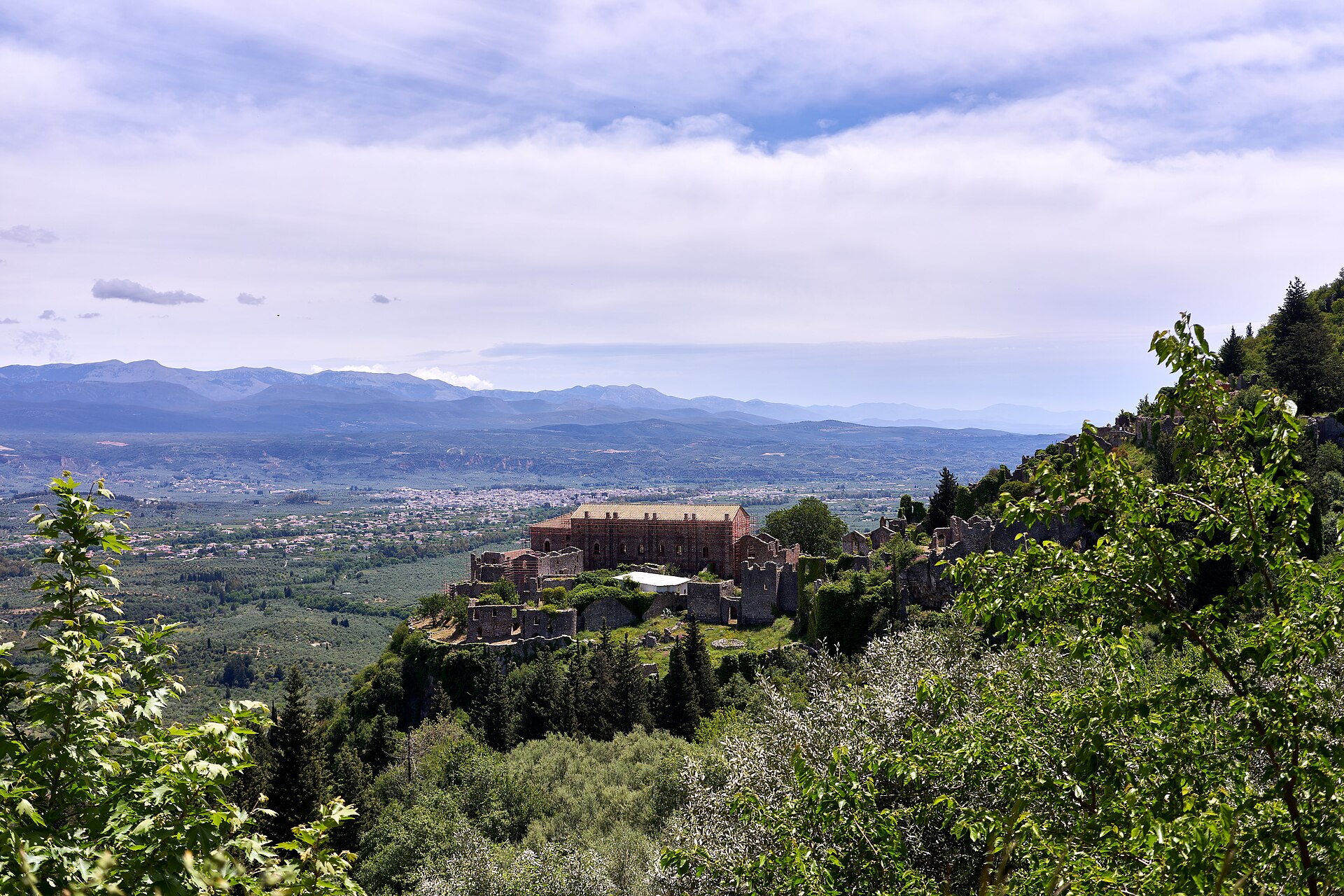
Medieval Greece. When we speak of medieval Greece we mean the Byzantine centuries, the thousand years in which the eastern Roman Empire, Christian and Greek-speaking, ruled the Greek lands from its capital Constantinople. The empire was Rome's continuation: Constantine had founded his New Rome on the Bosphorus in 330, and when the western empire fell in the fifth century, the east endured. Under Justinian in the sixth century, imperial armies briefly recovered Italy, North Africa, and part of Spain, his lawyers codified Roman law in the Corpus Juris Civilis, the foundation of European legal tradition, and his cathedral Hagia Sophia, built in less than six years, was the largest church in Christendom for nearly a thousand years. But overextension, plague, and then the Arab conquests of the seventh century stripped away Syria, Egypt, and Africa, and reduced the empire to Anatolia and the Balkans.
Greece itself became a quiet, partly Slavic-settled provincial land, until Byzantine power reasserted itself. The empire fought for survival against Arab fleets, Bulgars, and later Turks, defending itself behind Constantinople's triple walls and with Greek fire, a secret incendiary weapon sprayed from ships' siphons. The Macedonian dynasty from 867 brought revival: missionaries carried Orthodox Christianity and the Cyrillic alphabet, devised from Greek letters, to the Slavs; and Basil II, the Bulgar-Slayer, destroyed the Bulgarian empire in 1014 and extended Byzantine rule over the whole Balkans, the medieval empire's height. Decline followed through court intrigue, aristocratic land-grabbing, and the fateful defeat at Manzikert in 1071, which lost Anatolia to the Seljuk Turks and forced the emperor to beg western help. The answer, the Crusades, proved deadlier than the enemy: in 1204 the Fourth Crusade, diverted by Venice, stormed Constantinople and divided the empire among Crusader states.
Greece was partitioned among Frankish dukes, Venetian ports, and Catalan companies, an era remembered in Greek memory as the Frankish rule. Byzantine exiles recovered Constantinople in 1261, but the restored empire was a shadow, and the Ottoman Turks closed in. Constantinople fell to Mehmed II in 1453, the Peloponnese and the last Greek lands by 1460, and medieval Greece passed under four centuries of Ottoman rule, remembered by Greeks as the Tourkokratia. The machinery of Byzantine survival deserves attention, because Greece lived under it for a millennium.
The empire was defended not only by walls and armies but by administration: the themes, provinces governed by generals and settled by soldier-farmers, replaced the old civilian provinces after the Arab onslaught; the tax and postal systems of Rome were kept running in Greek; and diplomacy, subsidizing one enemy against another, marrying princesses to khans and kings, was practiced as a high art, described in the emperor Constantine Porphyrogennetos' manual On the Administration of the Empire, which reads today like a textbook of statecraft. Greece within this system was quiet but not negligible: Corinth and Thebes produced the silks that were the empire's industrial crown, the Peloponnese exported oil and wine, and Athens, shrunk to a country town around its ancient temples, still drew pilgrims of learning, while the Parthenon served as a church for nearly a thousand years, which is why it survived.
The empire's religion shaped every institution: the emperor was crowned by the patriarch and governed as God's vicegerent; monasteries held vast estates and ran hospitals, orphanages, and schools; and the liturgical calendar, with its fasts and feasts, marked the year for every Greek. The Iconoclast controversy, the century-long struggle over the veneration of icons that convulsed the eighth and ninth centuries, was fought in Greece's villages as in the palace, and ended with the victory of the icons, the Triumph of Orthodoxy still celebrated every Lent. The catastrophe of 1204 broke the empire's spine: for two generations Constantinople was a Latin city, and Greece's plains were fought over by Frankish barons whose castles still crown its hills.
The restored empire of the Palaiologoi was too poor to defend the Greeks of Anatolia and too divided to resist the Ottomans, who took Thessaloniki for good in 1430, Athens in 1456, and the Peloponnese by 1460, closing the Byzantine chapter of Greek history.
Byzantine Greece kept the ancient inheritance alive through the medieval millennium. Constantinople preserved the libraries of antiquity: while western Europe read almost no Greek, Byzantine scholars copied Homer, Plato, Thucydides, and the mathematicians, and when the empire fell, refugee scholars carried these texts to Italy, helping ignite the Renaissance. Education in the capital taught grammar, rhetoric, and philosophy on the classical syllabus, and law and administration ran on Roman principles, in Greek. Christianity gave the civilization its public identity: the emperor ruled as defender of the faith, the Church ran schools, hospitals, and poor relief, and monasteries such as Hosios Loukas in Greece and Mount Athos became centers of learning and art, their illuminated manuscripts and frescoed churches among the glories of medieval art. The schism of 1054, when the Greek east and Latin west finally divided, fixed the split of Christendom that lasts to this day.
Provincial Greece lived from the land: wheat and vines on the plains, olives and transhumant herds in the hills, and the silk industry of Thebes, whose workshops were famous enough to be looted to Sicily by the Normans. Trade flowed through Thessaloniki, the empire's second city, and through Venetian and Genoese merchants who increasingly controlled Byzantine commerce. Society was hierarchical but permeable: the church offered the poor a path to dignity, and the empire's identity was Roman and Christian rather than ethnic; Greeks called themselves Romans, Romioi, a name they kept into the modern age. Daily life centered on the village, the parish church, and the great festivals of the Orthodox calendar, Easter above all, which knit Greek communities together through the centuries of foreign rule.
When Constantinople fell in 1453, grief-stricken Greeks mourned the city in laments sung for generations; but the language, the faith, and the memory of Byzantium survived the conquest, and four centuries later furnished the imagination of a new Greek nation.
 Britannica: Byzantine Empire
Britannica: Fourth Crusade
 World History Encyclopedia: Byzantine Empire
World History Encyclopedia: Mystras