 Go Back

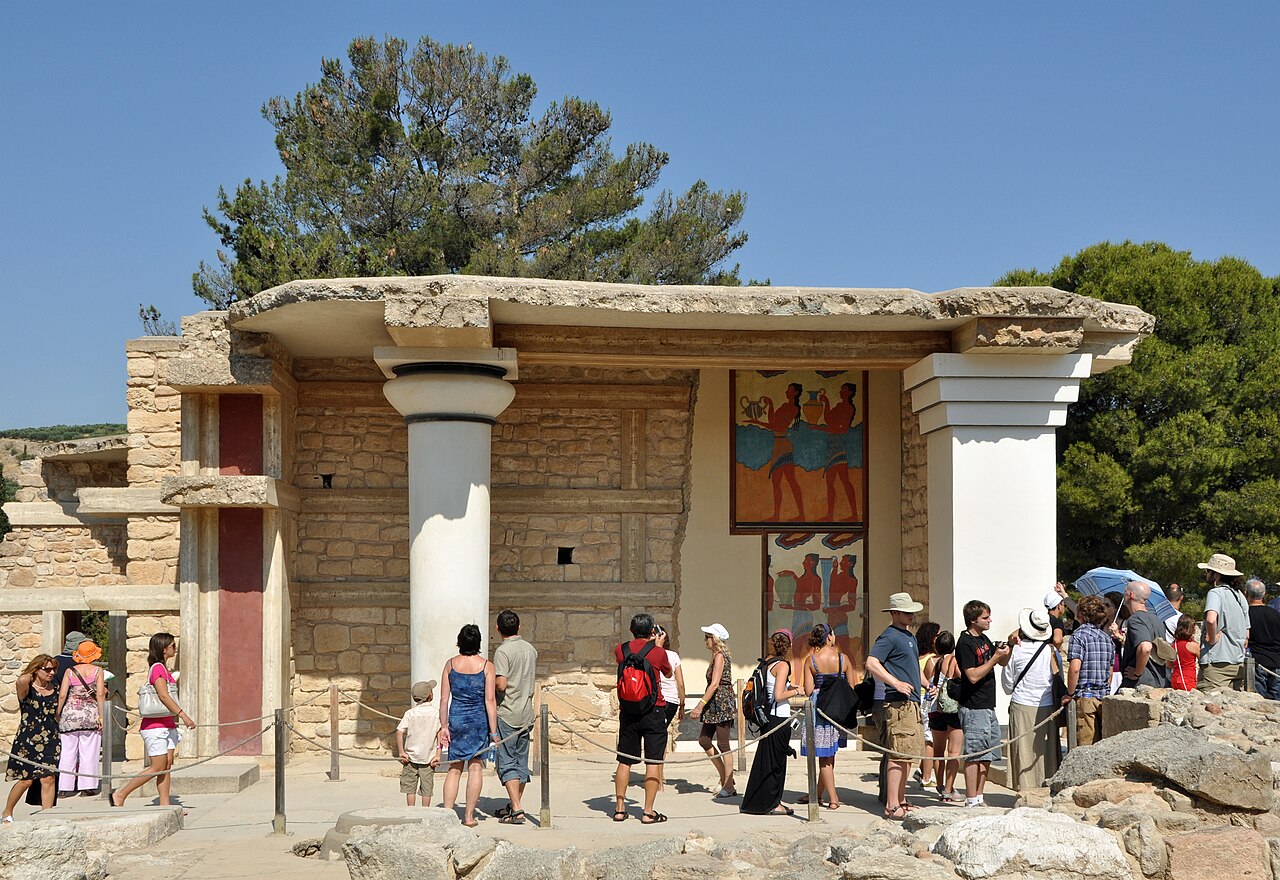
Minoan Crete. On the island of Crete, positioned in the eastern Mediterranean between Greece, Egypt, and Asia, Europe's first civilization flourished during the Bronze Age, from about 2000 to 1450 BC. We know it not from its own readable texts, since its main scripts remain undeciphered, but from its ruins and from later Greek legend, which remembered Crete as the realm of King Minos, his labyrinth, and the Minotaur. Around 2000 BC the Cretans began building great complexes that archaeologists call palaces, at Knossos, Phaistos, Malia, and Zakros. These were not royal fortresses but sprawling, unfortified centers of storage, craft production, ceremony, and administration, arranged around central courts, with light wells, colonnades, painted plaster, and extensive drainage systems of a sophistication unmatched elsewhere in Europe at the time.
The palace at Knossos covered some thirteen thousand square meters, a maze of rooms that may have inspired the labyrinth legend. Around 1700 BC an earthquake destroyed the old palaces, but the Cretans rebuilt them grander than before, and the following century and a half was the Minoan golden age. Cretan ships dominated Aegean trade, carrying olive oil, wine, wool, and fine painted pottery to Egypt, where tomb paintings show Cretan envoys bearing gifts, to Syria, Cyprus, and the Greek mainland, where Minoan influence was so strong that later Greeks remembered paying tribute to Minos. Minoan settlers and trading posts spread across the Aegean islands, most spectacularly at Akrotiri on Thera, a town preserved in volcanic ash like a Bronze Age Pompeii, its houses decorated with frescoes of ships, fishermen, and saffron gatherers.
Around 1600 BC the volcano of Thera erupted cataclysmically, burying Akrotiri and sending tsunamis against Crete's north coast. The palaces survived, but the blow weakened the island. Around 1450 BC most Cretan palaces were destroyed by fire, and Greek-speaking Mycenaeans from the mainland took over Knossos, ruling it until the final collapse of the palace system around 1200 BC, when the whole Bronze Age world of the eastern Mediterranean came apart. The man who revealed this world was Arthur Evans, who began digging at Knossos in 1900 and named the civilization after the legendary king. Evans rebuilt parts of the palace in concrete, and his restorations, whatever their faults, fixed the world's image of Minoan Crete: grand staircases, light wells, red columns tapering downward, and walls brilliant with frescoes.
The palace archives show the system's workings: Linear A tablets record contributions of wine, oil, figs, and wool to the palace stores, and the great magazines, lined with jars taller than a man, held the agricultural wealth of the countryside, from which the palace fed workers, supplied feasts, and financed trade. Crete's position made it the natural middleman of the eastern Mediterranean: Egyptian scarabs and stone vessels reached Knossos, and Minoan pottery has been found from the Nile Delta to Syria, Cyprus, and mainland Greece, while Keftiu, as the Egyptians called the Cretans, appear in Theban tomb paintings carrying metal ingots and elaborate vessels.
Society seems to have been organized around the palaces and their festivals rather than around warrior kings: there are no royal portraits, no boasting inscriptions, and almost no fortifications, which suggests either an unusual peace among the Cretan cities or a thalassocracy, a sea-power, that kept enemies away. The Thera eruption, whose exact date remains disputed, was among the largest volcanic events of the last ten thousand years, and some have linked its memory to Plato's tale of Atlantis; whether or not that is true, the blow to Cretan shipping and harvests opened the door to the Mycenaean Greeks, whose takeover is visible in the sudden appearance of Linear B, warrior graves, and Greek names in the last century of Knossos.
Minoan society remains mysterious because we cannot yet read its main scripts, Cretan hieroglyphic and Linear A, though the later Linear B, used by the Mycenaean rulers of Knossos, was deciphered as early Greek and reveals a palace bureaucracy tracking flocks, grain, oil, and workers in meticulous detail. What the art shows is a culture strikingly different from its warlike neighbors: Minoan walls carry almost no scenes of battle or kings. Instead the frescoes glow with leaping dolphins, flowering lilies, octopuses coiling across pottery, and elegant figures in flounced skirts.
The most famous images show the bull-leaping ritual, in which young men and women grasped the horns of a charging bull and somersaulted over its back, perhaps a religious ceremony, perhaps a sport, probably both; the bull's importance may echo in the Minotaur legend, and the massive bull's-head rhyta and horns of consecration found at the palaces confirm the animal's sacred status. Religion centered on goddesses and sacred symbols such as the double axe and the bull, worshipped at mountaintop shrines, caves, and palace sanctuaries; strikingly, no statues of rulers have been found. Priests or priestesses seem to have led the ceremonies. The economy rested on the palace storage system: giant jars held oil, wine, and grain collected as dues from the countryside and redistributed to workers and craftspeople. Minoan craftsmen made exquisite seal stones, gold jewelry, carved stone vases, and the eggshell-thin Kamares pottery traded across the Mediterranean.
Women appear prominently in Minoan art and ritual, leading some scholars to suggest they held unusually high status, though without readable texts we cannot know how the society was governed or whether a king like the legendary Minos ever existed. When the Mycenaean Greeks conquered Crete, they absorbed Minoan art, religion, and administrative methods, and through them Minoan influence flowed into Greek civilization: in a real sense, the story of European civilization begins on Crete.
 Britannica: Minoan civilization
 World History Encyclopedia: Minoan Civilization
World History Encyclopedia: Knossos
World History Encyclopedia: Minoan Religion