 Go Back

Modern Germany (Rise & Lessons for Egypt). For most of its history, Germany was not a single country but a patchwork of more than three hundred kingdoms, duchies, free cities, and church lands in the heart of Europe, loosely gathered under the Holy Roman Empire. The road to unity ran through Prussia, the largest of these states, whose kings had built a disciplined army and an efficient civil service. In 1862 King Wilhelm I appointed Otto von Bismarck as his minister-president, and Bismarck declared that the great questions of the day would be settled not by speeches and votes but by iron and blood. He meant it. In three short wars, against Denmark in 1864, Austria in 1866, and France in 1870, Prussia defeated its rivals one at a time, always isolating the enemy before striking. In January 1871, in the Hall of Mirrors at the conquered palace of Versailles, the princes of Germany proclaimed Wilhelm the first Kaiser of a united German Empire.
The new empire then astonished the world less by its army than by its factories. Germany industrialized later than Britain but faster. The Ruhr district turned coal and iron into steel on a giant scale; German chemists, working in firms like BASF and Bayer, invented synthetic dyes and medicines and created the modern chemical industry; Siemens and AEG made Germany a leader in electrical engineering. Behind this stood an education system that other nations came to study: compulsory schooling, a network of technical universities, and research laboratories where science was tied directly to industry. Germany also built the world's first modern welfare state: in the 1880s Bismarck's government introduced health insurance, accident insurance, and old-age pensions, partly to win workers away from socialism. By 1900 Germany had passed Britain in steel production and stood at the front of the second industrial revolution.
The twentieth century tested this achievement almost to destruction. Defeat in the First World War brought down the monarchy; the Weimar Republic that followed was battered by reparations, hyperinflation, and political violence, and in 1933 it collapsed into the Nazi dictatorship, whose aggression and genocide ended in 1945 with Germany in ruins and occupied by the victors. The country was then split in two: the Federal Republic in the west, tied to the democracies, and the German Democratic Republic in the east, under Soviet control. The West rebuilt so quickly that the recovery was called the economic miracle, while the Berlin Wall, raised in 1961, became the symbol of a divided nation. When the Wall fell in 1989, Germans reunified within a year, and the reunited Germany became the largest economy in Europe, a country whose exports of cars, machines, and chemicals reach every continent.
German society rests on institutions that visitors are often surprised to learn are deliberately engineered. Education is the clearest case. Most universities charge no tuition, and the dual training system lets teenagers split their week between a vocational school and paid apprenticeship inside a real company, which is one reason German industry never runs short of skilled technicians. Research is organized through famous institutes, including the Max Planck Society, whose scientists have won dozens of Nobel Prizes. The country's cultural foundation was laid long before unification: the music of Bach and Beethoven, the poetry of Goethe and Schiller, the philosophy of Kant and Hegel all came from the patchwork states, proof that political division never stopped cultural unity.
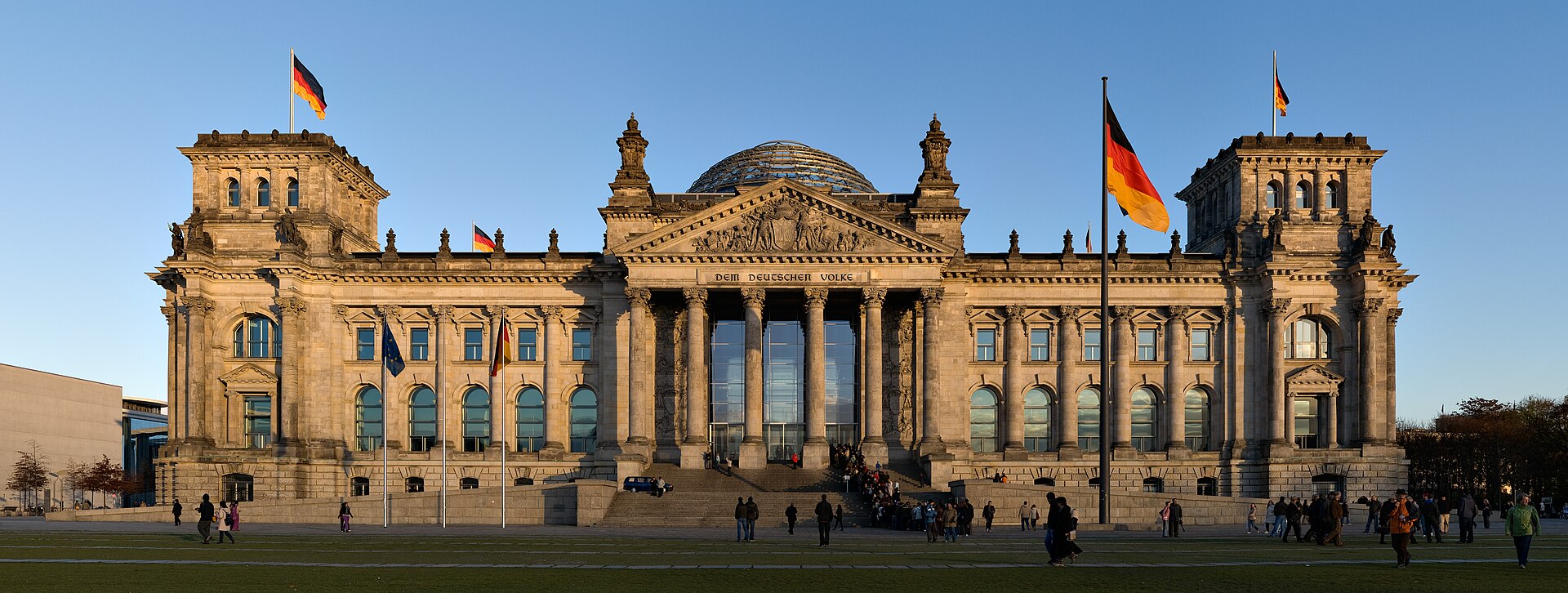
The monuments tell the same story of rupture and rebuilding. The Brandenburg Gate in Berlin, once closed inside the Wall's death strip, is now the national symbol of unity; the Reichstag parliament, burned in 1933 and shattered in 1945, was rebuilt with a glass dome open to the public above the debating chamber, transparency made into architecture. Cologne Cathedral, finished only in 1880, six centuries after its foundation stone was laid, was badly damaged in the bombing of its city in the Second World War and fully restored by 1956.
For a student in Egypt, the curriculum pairs Germany with Japan for a reason. Both were late starters, divided or closed societies that caught up with the early industrial powers within a single generation. The German lesson is not the wars, which ended in catastrophe, but the machinery of development underneath: universal education, applied science, disciplined administration, social insurance that binds the whole nation into one system, and an economy built on making things well. A country that invests in schools, laboratories, and skilled work can rise from division and even from ruin, and that is the lesson modern Germany offers every developing nation, including Egypt.
 Britannica: Germany
Britannica: Otto von Bismarck
Britannica: Max Planck Society for the Advancement of Science