 Go Back

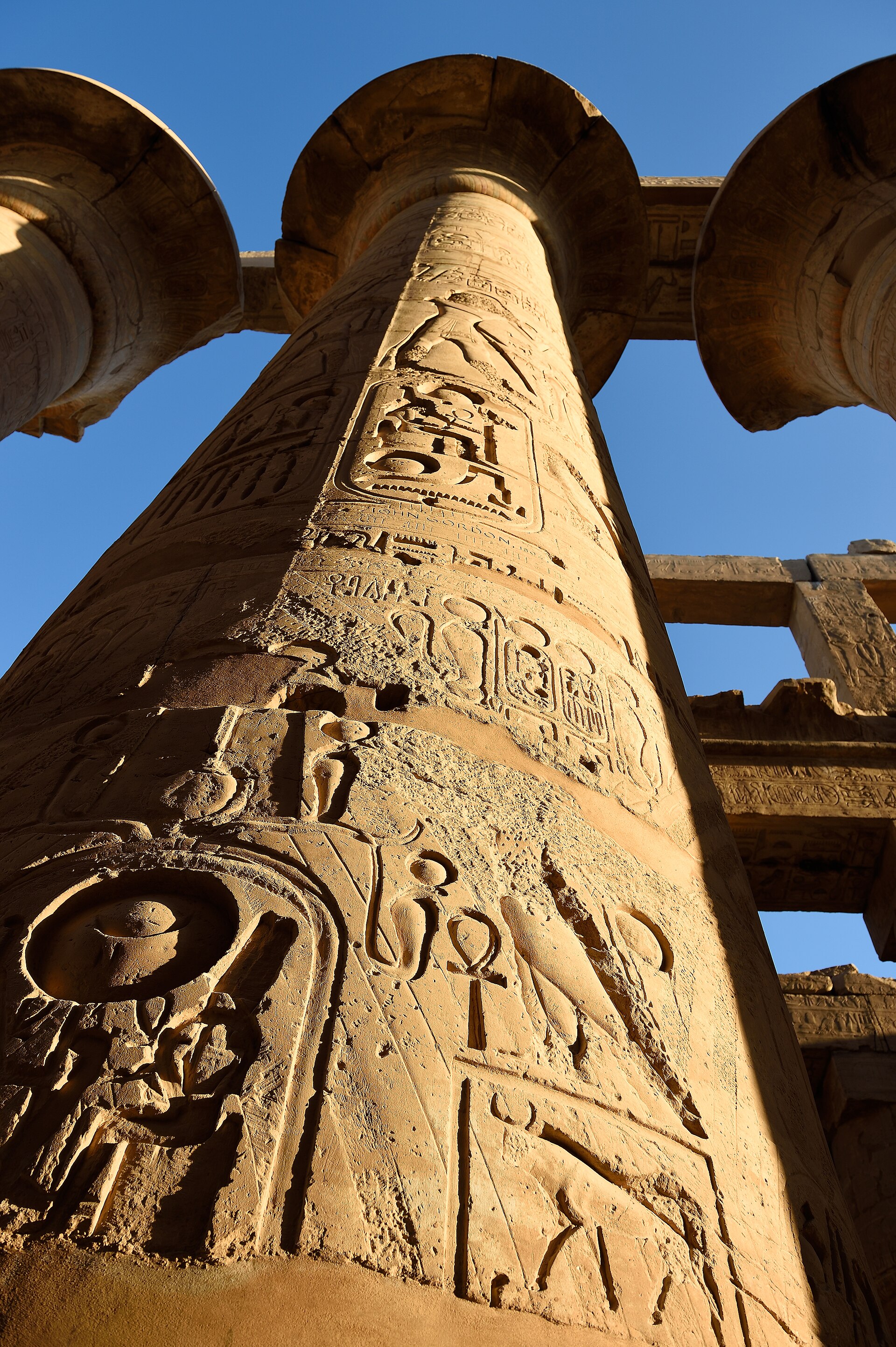
Religious Life Across Civilizations. In the ancient world, religion was not a private matter set apart from life; it was woven into government, law, the calendar, and the layout of cities. In Egypt, the great temples were the country's largest institutions after the palace itself. The temple of Amun at Karnak was a city within a city, the largest religious structure ever built, and its priests managed festivals that marked the year for everyone. Egyptians imagined a world ordered by ma'at, the principle of balance and justice that the king was bound to uphold, and their many gods, Amun of Thebes above all in the imperial age, stood behind every part of that order.
Iraq's cities each belonged to a patron god: Anu the sky god at Uruk, Enlil at Nippur, Marduk at Babylon. At the center of the city rose the ziggurat, a vast stepped platform of mud brick faced with baked brick, lifting the god's shrine toward heaven, part temple, part symbol of the city's bond with its protector. Greece tied religion to the city-state as well: every polis honored its patron, Athena at Athens, and the calendar was a cycle of festivals, processions, and sacrifices, while the oracle at Delphi was consulted by statesmen and farmers alike. Rome treated correct worship as a contract with the gods on which the safety of the state depended, placing Jupiter Best and Greatest at the head of its pantheon and turning its calendar into a schedule of public rites.
Islamic civilization organized religious life around the mosque, which was far more than a prayer hall. The mosque was the community's gathering place, court, school, and welfare center, and the five daily prayers gave the whole society a shared rhythm. The Friday sermon linked worship to public affairs, and the institution of waqf, charitable endowments, funded mosques, schools, hospitals, fountains, and hostels for travelers for centuries. Where the ancient temples belonged to the gods and their priests, the mosque belonged to the community.
The houses of worship themselves teach the comparison the curriculum asks for. The Egyptian temple was a closed, mysterious building, its inner sanctuary open only to priests, its courts filling with the public only on festival days. The ziggurat dominated the Mesopotamian skyline as a man-made mountain between earth and heaven. The Greek temple, by contrast, was a public monument standing in the open, its sculpture visible to all, the backdrop to civic festivals. The mosque was designed from the start to gather the whole community, men and women, in one hall facing Mecca. Each building is a society's idea of worship turned into stone.
Ritual gave these beliefs daily form. Egyptians and Mesopotamians offered food and incense to the cult statues of their gods and carried them in procession on festival days; the Greeks and Romans made sacrifices at open-air altars and consulted omens before great decisions. In the Islamic world, the call to prayer, the fast of Ramadan, the alms given to the poor, and the pilgrimage to Mecca structured the year and the life of every believer.
Historians also ask what religion did to a people's character, and the answer is visible in the record. Religious duty in Egypt reinforced ma'at, honesty and justice as cosmic obligations; in the Islamic world, charity was not optional but a pillar of the faith, and it built a safety net of endowments that served the poor for a thousand years. The curriculum's conclusion is a modern one: across these civilizations, religion at its best taught communities tolerance, honesty, justice, and cooperation, and understanding other people's beliefs, without hostility, is part of reading history honestly.
 Britannica: Ancient Egyptian religion
 World History Encyclopedia: Amun
Britannica: Ziggurat
Britannica: Greek religion