 Go Back

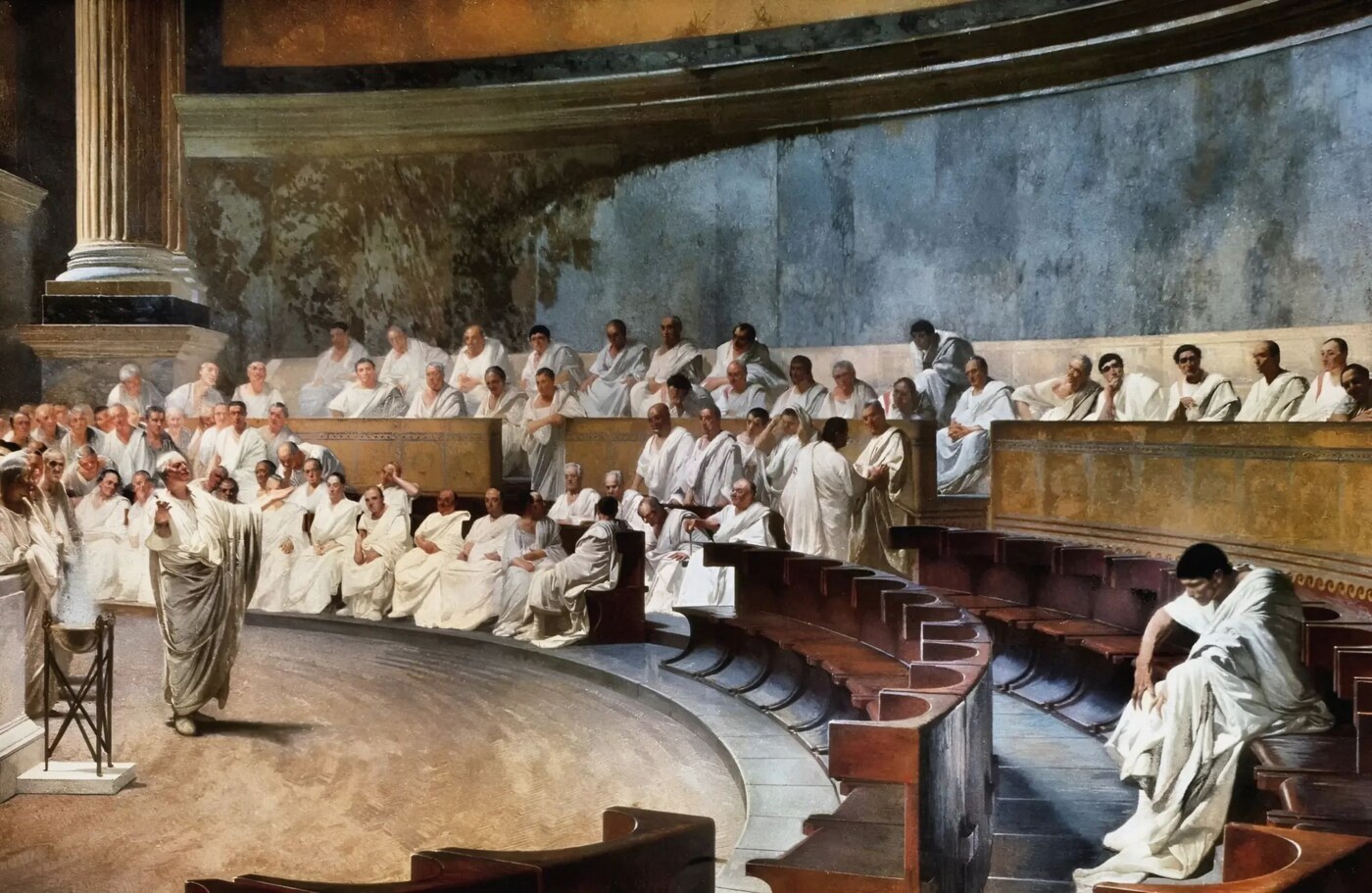
Rome. On the hills above the Tiber in Italy, a small city grew into the largest empire the ancient world had seen. Roman tradition dated the city's founding to 753 BC, and for its first two and a half centuries Rome was a monarchy: the king held the highest religious, judicial, political, and military authority, ruled for life, and was advised by the Senate, a council of about three hundred elders from the leading families, and by an assembly of the citizens. In 510 BC the aristocracy expelled the last king, Tarquin, and swore never again to be ruled by one man. The state that followed, the Republic, lasted nearly five centuries and made Rome master of the Mediterranean.
The Republic divided power on purpose. Two consuls, elected for a single year, led the armies and presided over the government. The Senate, some three hundred former officials drawn from the aristocracy, controlled finance and foreign policy and gave the state continuity. Citizen assemblies voted on laws and elected officials, and the tribunes of the plebs, created after the common people threatened to secede, carried their complaints to the state and could veto harmful acts. This was not a democracy in the Athenian sense: the wealthy families dominated office, and the assemblies were organized so that property counted. Yet the long struggle between patricians and plebeians was fought mainly with boycotts and votes, not civil war, and it gradually won the common citizens published laws and a share in power.
Rome grew by war and by a genius for absorbing the defeated. By about 270 BC it controlled the Italian peninsula, binding its allies to itself with partial citizenship in return for soldiers. Then came the struggle with Carthage, the Phoenician trading power of North Africa: three Punic Wars spread over more than a century, from 264 to 146 BC. Hannibal's march over the Alps with his elephants and his crushing victories in Italy nearly broke the Republic, but Rome refused to surrender, carried the war into Africa, and destroyed Carthage itself in 146 BC, taking the western Mediterranean and northwest Africa. In the same years its legions moved east: Macedonia became a Roman province in 146 BC and Greece with it, Syria followed in 64 BC, and in 30 BC Egypt, the richest land of all, fell to Octavian.
Conquest on this scale broke the Republic's institutions, and generals with loyal armies turned politics into civil war. After Julius Caesar's assassination, his heir Octavian defeated Antony and Cleopatra, and in 27 BC the Senate named him Augustus, the revered one, making him the first Roman emperor. He kept republican forms but held every real power, ending the divisions among the military commanders, restoring security to the empire, preserving its lands, and giving its citizens social justice. For two centuries, the Pax Romana, the Mediterranean world knew peace, secure frontiers, common laws, roads, aqueducts, and trade from Britain to the Red Sea. In AD 395 the empire was divided into a western half, ruled from Rome, and an eastern half, ruled from Constantinople. The West fell to Germanic kings in 476, closing the ancient world; the East survived another thousand years as the Byzantine Empire, until 1453.
Roman society was divided into clear classes. At the top stood the wealthy class, including the equites, the knights who supplied the army's officers; they held all the political rights and owned the money and the great estates. Below them came the merchants and craftsmen, a large part of society whose economic life was hard and who suffered in Rome's frequent wars; many entered the peaceful struggle against the aristocracy and won real gains for their class. At the bottom stood the enslaved, prisoners of Rome's wars, who had lost every legal and political right and formed a permanent crisis inside Roman society, rising in great revolts like that of Spartacus in 73 BC.
Roman religion was public and practical, centered on Jupiter, greatest of the gods, and on rituals that bound the state together; emperors such as Augustus and Tiberius were worshipped, a practice that fell away as Christianity spread through the empire in later centuries. The Romans were tolerant of foreign gods when it served order, and Egyptian deities like Serapis and Isis had their temples in Rome itself. Rome's deepest gifts to later ages were Roman law, the model for most later European codes; engineering, in roads, concrete, aqueducts, and arches; and the Latin language, which carried its civilization into the medieval and modern worlds. When modern states write law codes, build domes, or name their months, they are walking paths first cut by Rome.
 Britannica: Ancient Rome
Britannica: Roman Republic
 World History Encyclopedia: Ancient Rome
World History Encyclopedia: Roman Empire