 Go Back

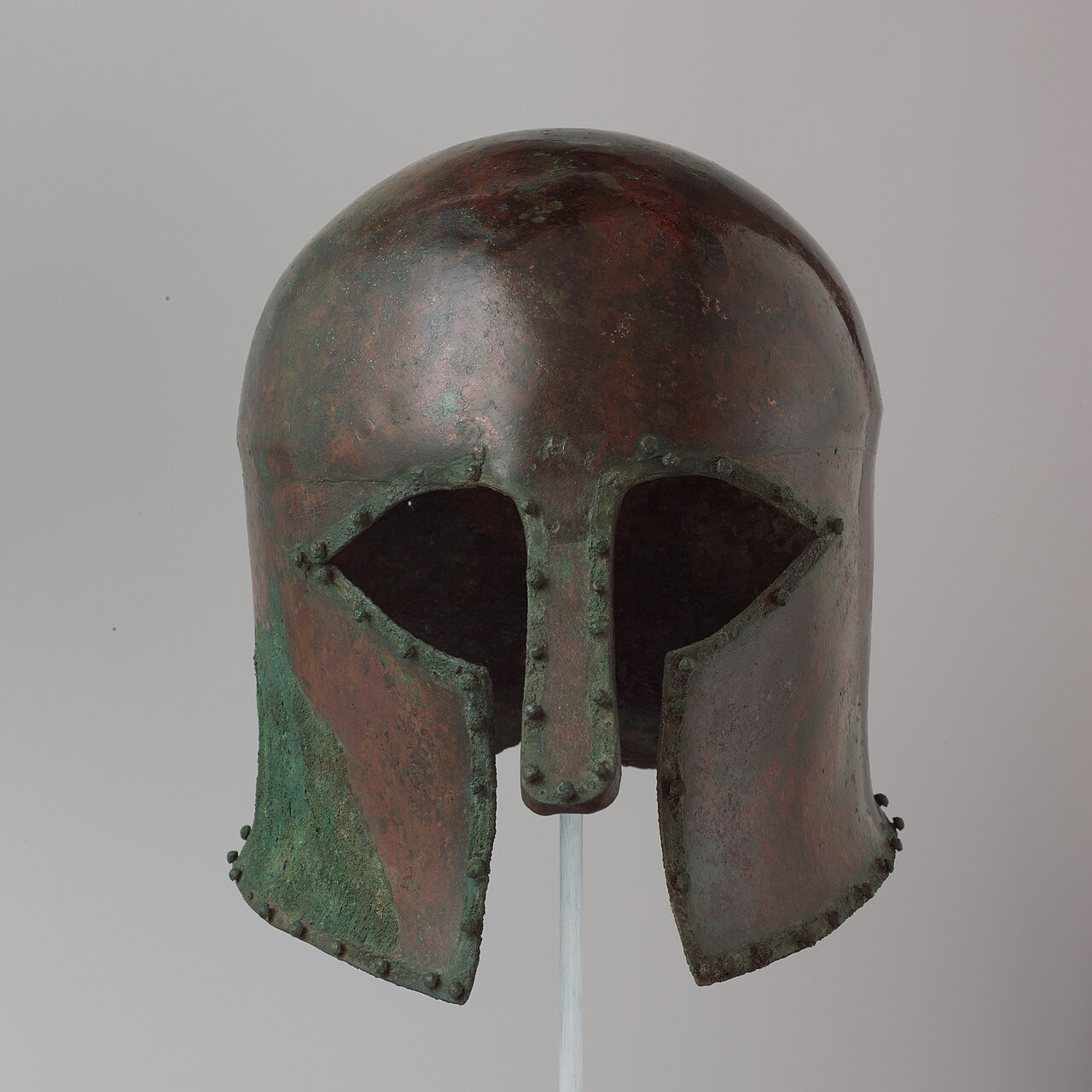
Sparta. In the Eurotas valley of Laconia, in the southern Peloponnese, the Greeks built a society unlike any other: a citizen body of full-time soldiers ruling over a conquered population many times its size. The system emerged after the Spartans conquered neighboring Messenia in the eighth and seventh centuries BC and reduced its people to helots, state-owned serfs bound to the land, who farmed to feed their Spartan masters. Fear of helot revolt shaped everything. According to tradition the lawgiver Lycurgus remade Sparta into a military camp: land was divided into equal lots worked by helots, wealth display was banned, iron bars served as money to discourage trade, and the whole male citizenry lived for war.
Government balanced several powers: two hereditary kings led the army, a council of elders over sixty proposed laws, the assembly of citizens voted, and five overseers, the ephors, chosen annually from the citizens, wielded enormous power, including the right to declare war on the helots each year so they could be killed without religious pollution. Spartan education, the agoge, took boys from their families at seven and raised them in herds, deliberately underfed and underclothed, taught to steal food but punished savagely if caught, hardened by endurance contests and ritual floggings, and trained above all in obedience and fighting. The result was the finest infantry in Greece, the heavy-armed hoplites whose unbreakable shield line won battle after battle.
At Thermopylae in 480 BC, King Leonidas and three hundred Spartans, with some seven hundred Thespian allies, held the pass against the Persian army to the death, a sacrifice that became Greece's legend of courage; the next year Sparta led the allied victory at Plataea that ended the invasion. After the Persian Wars, Spartan power and suspicion of Athens produced the Peloponnesian War, which Sparta finally won in 404 BC with Persian money and the admiral Lysander's fleet. But victory destroyed Sparta's balance: garrisons and governors spread across Greece bred corruption and resentment, the citizen body shrank as land concentrated in few hands, and after the defeat by Thebes at Leuctra in 371 BC, the helots of Messenia were liberated and Sparta's economic base was gone. It lingered for centuries as a museum of its own customs, but its real history ended there. Sparta's origins explain its later shape.
The Spartans were Dorian-speaking Greeks who settled Laconia and, unlike other city-states, solved their land hunger not by sending out colonies but by conquering their neighbors and enslaving them wholesale, first in Laconia and then in Messenia. The result was a permanent state of siege disguised as a constitution: every institution was bent to keep a few thousand citizens dominant over a helot population perhaps seven times their number. The famous laconic speech, the Spartans trained boys to answer briefly and pointedly, and the word survives in our language, was the style of men who feared saying too much. Their army's superiority was real and systematic: where other Greeks farmed and drilled occasionally, Spartans drilled constantly, marched in step to the flute, and maneuvered formations no amateur phalanx could match, so that for two centuries a Spartan army in the field was assumed invincible.
Thermopylae became the myth of that system at its best: Leonidas, knowing the oracle that Sparta must lose a king or fall, stayed to die with his three hundred, and the inscription over their graves, telling the passerby to report that they died obeying Sparta's laws, is still quoted after two and a half thousand years. Yet the system consumed itself: citizenship depended on contributing to the common mess from one's land, and as land concentrated through inheritance and marriage, whole families fell out of the citizen body until Sparta, about eight thousand citizens strong in 490 BC, could muster barely seven hundred by the time of Leuctra. Thebes' victory freed Messenia after three centuries, and the liberated helots built their own city at Messene, whose walls still stand: the foundation of Sparta's power was removed, and no reform ever replaced it.
Spartan society was divided into three rigid orders. At the top stood the Spartiates, the full citizens, perhaps eight thousand men at their peak, forbidden to farm, trade, or work with their hands, their lives devoted to exercise, drilling, and the common messes where they dined together on the famous black broth. Below them were the perioikoi, the dwellers-around, free inhabitants of Laconia's towns who conducted the trade and craftwork the citizens scorned and served in the army without political rights. At the bottom were the helots, who vastly outnumbered their masters and were treated with calculated brutality; the young men of the secret police, the krypteia, were sent out to kill the strongest of them. The system worked because it made Sparta a permanently armed camp: every citizen was a soldier from seven to sixty, and the army's discipline was legendary.
Yet the same system carried the seeds of decline. Citizens who lost their land lots lost their status, so the citizen body steadily shrank until the army could no longer be replaced. Spartan women were unusual in Greece: they trained in running and wrestling, could inherit and control land, and were famous for their plain speech; a Spartan mother was said to hand her son his shield with the words, with it or on it. Because men spent their lives in barracks and campaigns, women managed estates, and by the fourth century BC much of Sparta's land was in female hands. Culture in the wider sense was deliberately rejected: Sparta produced no philosophers, no historians, almost no art after the austere early centuries, and its oracle-bound religion and moon-timed campaigns sometimes paralyzed its strategy.
What Sparta did produce was a political idea that has fascinated the world ever since: the mixed constitution balancing kings, elders, and people, which Greeks like Plato and Aristotle studied as a model of stability, and which later thinkers saw as a forerunner of balanced government. Athens showed what freedom and talent could create; Sparta showed what discipline and equality of sacrifice could endure, and the tension between the two models has never ceased to shape political debate.
 Britannica: Sparta
 World History Encyclopedia: Sparta
Britannica: Peloponnesian War
World History Encyclopedia: Thermopylae