 Go Back

The Islamic Financial System. Every state must answer the same questions: where does its money come from, where is it kept, and what is it spent on? The early Islamic state answered them with an institution called the bayt al-mal, the house of wealth. Under the Prophet Muhammad and the first caliph Abu Bakr there was no formal treasury: revenues were distributed quickly, and agents were sent out to collect the dues, as when Abu Bakr sent Amr ibn al-As to gather the sadaqat of Oman. The great conquests of the caliph Umar ibn al-Khattab changed everything. Wealth poured in from Iraq, Syria, and Egypt, and Umar gave the state a permanent financial administration: a central bayt al-mal in Medina with branches in the provinces, written registers, and trusted officials over the money, such as Abdullah ibn Mas'ud, whom he placed over the treasury of Kufa. Umar also separated financial administration from political and military command, so that the governor and his treasurer watched each other.
The revenues of the bayt al-mal came from seven sources: zakat, kharaj, ushr, jizya, ghanaim, fai', and mukus. Zakat, one of the pillars of Islam, was a fixed religious levy collected by the state on Muslim wealth: on money and merchandise, on grazing livestock, and on crops and fruits, and it was reserved for the categories named in the Quran, above all the poor and the destitute and those who worked to gather it. The kharaj was the tax on agricultural land. When Muslim armies took land by force, Umar's policy left the land in its owners' hands rather than dividing it: the owners kept, worked, and inherited their fields and paid the kharaj each year, in kind or in cash, assessed on what the land could bear. Land that submitted by treaty, or land owned by Muslims, paid only the lighter ushr, a tithe, and kharaj land could never lawfully be turned into ushr land. Mu'awiya separated the assessment of the kharaj from its collection, giving each to different officials with full knowledge of the work.
The ushr also meant a customs duty on trade, taken from merchants crossing into the lands of Islam. The jizya was a personal tax paid by non-Muslim men of military age, in return for the state's protection of their lives and property and exemption from military service; women, children, the elderly, and the poor paid nothing, and the sum was modest, a dinar a year in the Prophet's time and about four dinars under the Umayyads. The idea was older than Islam: the Byzantines had levied such a tax on the coasts of Asia Minor against Phoenician raids, and the Persians and Romans had long taken tribute from subject peoples. The ghanaim were spoils taken in battle: four-fifths went to the fighters and one-fifth to the bayt al-mal, for the Prophet's kin, orphans, the needy, and the stranded traveler. The fai' was property gained without battle, spent on the same public purposes. Finally the mukus were the secondary dues: customs on the goods of non-Muslim traders, the yield of state lands, mines, and fisheries, and the estates of those who died without heirs.
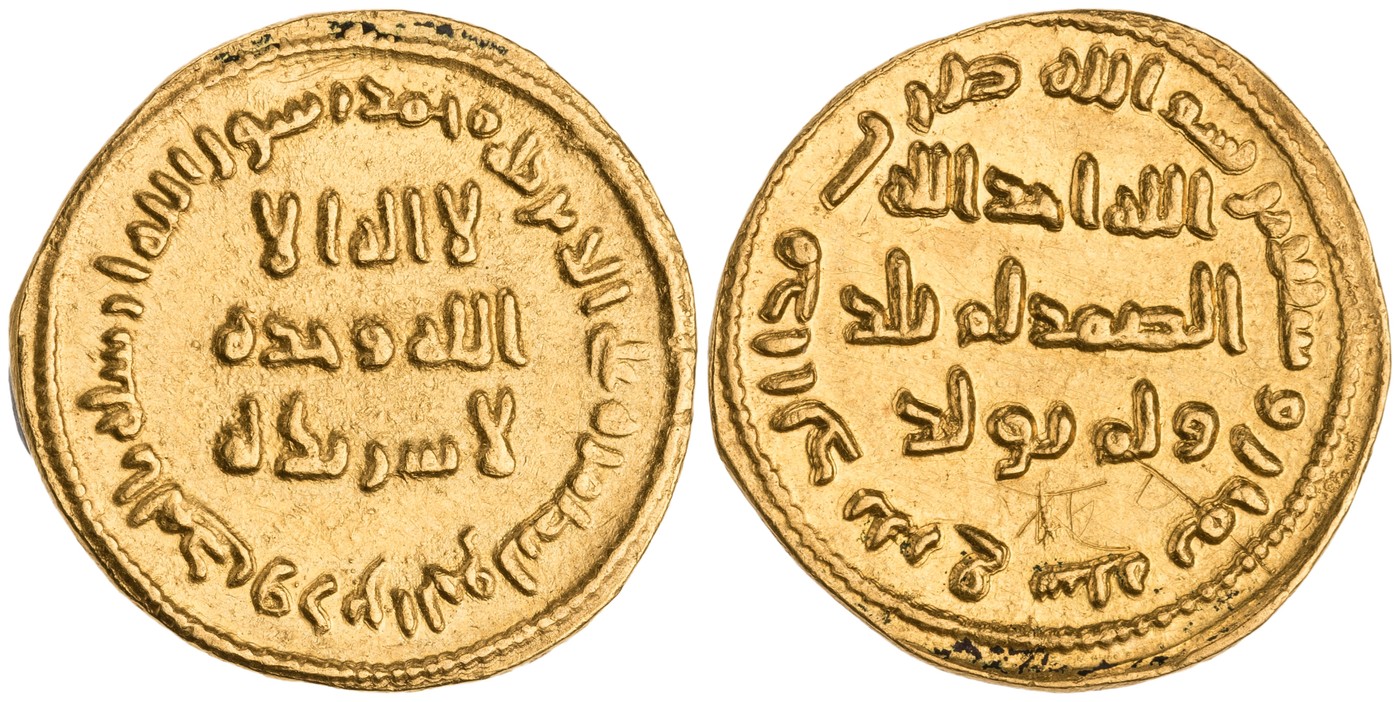
The bayt al-mal's expenditures matched its revenues in purpose: the stipends of the caliph, governors, judges, and officials; the pay and equipment of the armies; public works such as mosques, roads, and bridges; and social spending on hospitals and on regular relief for the poor, the widows, and the orphans. Under the Umayyads the treasury's revenues grew, and Umar ibn Abd al-Aziz used them for social justice, forbidding his agents to sell the kharaj lands; under the early Abbasids, in the days of Harun al-Rashid, the state's income reached heights no one could reckon. This financial order rested on a real economy: farming fed by irrigation from the Nile to Iraq, busy markets in Fustat, Damascus, Baghdad, and Cordoba, long-distance trade that carried spices, textiles, and gold between the Mediterranean and the Indian Ocean, and a stable coinage of gold dinars and silver dirhams, unified by the caliph Abd al-Malik at the end of the seventh century. For centuries the dinar was the reserve currency of its world.
 Britannica: Kharaj
Britannica: Jizyah
Wikipedia: Bayt al-mal
Wikipedia: Zakat