 Go Back

The Umayyad Caliphate. When Muawiya ibn Abi Sufyan became caliph in 661, he moved the capital from Medina to Damascus, his longtime power base as governor of Syria, and founded Islam's first dynasty, ruling until 750. Muawiya governed with patient pragmatism: he kept the experienced Arab tribal armies of Syria loyal, left the old Byzantine tax administration in place, and built the caliphate into a durable state. His most fateful act came at the end: he secured the succession for his son Yazid, turning the caliphate into a hereditary monarchy. Yazid's reign was scarred by the event that has echoed through Islamic memory ever since. In 680, Husayn, the Prophet's grandson, set out to claim the caliphate and was intercepted at Karbala in Iraq, where he and his small band of relatives and followers were killed by Umayyad forces.
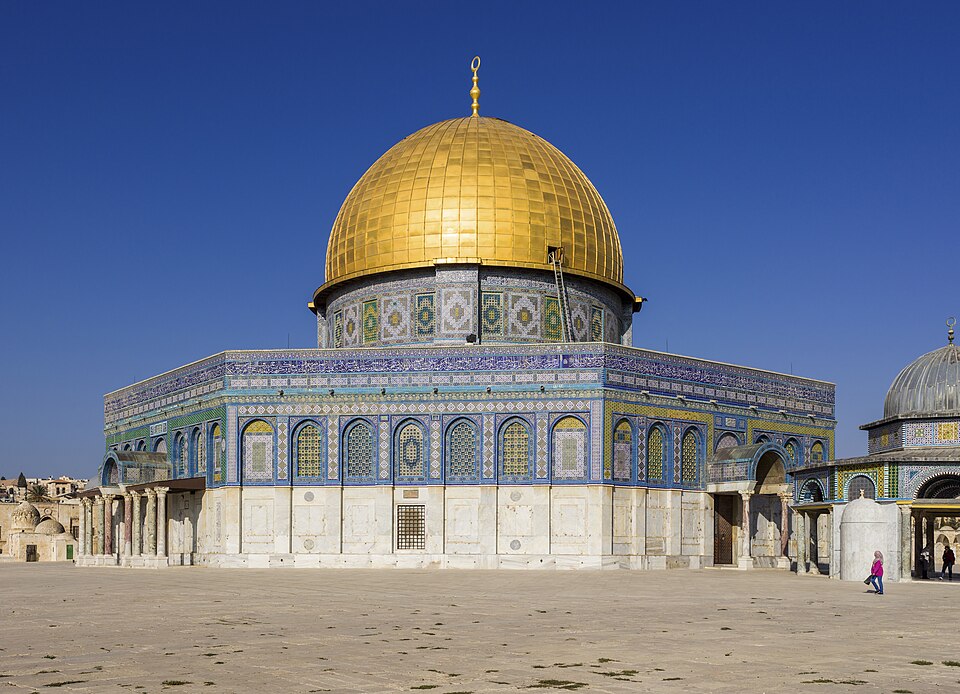
The martyrdom of Husayn became the founding grief of Shia Islam, mourned to this day. After a second civil war, the Umayyads recovered under Abd al-Malik, caliph from 685 to 705, the true organizer of the empire. He made Arabic the language of administration, replacing Greek and Persian; minted the first distinctively Islamic coinage, bearing Quranic verses instead of images; and crowned Jerusalem with the Dome of the Rock, completed in 691, the oldest surviving monument of Islamic architecture, built over the rock sacred to Jews and Muslims. His son al-Walid carried the empire to its greatest extent. Between 711 and 718 Muslim armies conquered most of Spain, crossed the Pyrenees, took Transoxiana beyond the Oxus river, and reached the Indus valley in Sind.
In barely a century the caliphate had grown from Arabia into the largest empire the world had yet seen, stretching from the Atlantic to the borders of China. But expansion carried its own undoing. The empire was run by and for the Arab Muslim military aristocracy, while the growing numbers of non-Arab converts to Islam, the mawali, found themselves treated as second-class Muslims, still taxed like subjects. Resentment burned hottest in Iraq and Iran, and Umayyad armies were worn down fighting Berbers in North Africa and Byzantines on the Anatolian frontier. In 750 the Abbasid revolution, launched from eastern Iran under the black banners, destroyed the dynasty; only one prince, Abd al-Rahman I, escaped, fleeing across North Africa to found a new Umayyad emirate in Spain, which would flourish there for centuries.
The dynasty's politics ran through two rival centers: Medina, where the memory of the Prophet and the grievances of the old families lived, and Damascus, where Muawiya had built a Syrian army loyal to his house. The second civil war after Muawiya's death nearly destroyed the dynasty: Ibn al-Zubayr ruled Mecca and much of the empire for a decade, Kharijite rebels burned through Arabia and Iraq, and Shia risings, first the Tawwabun mourning Husayn, then the revolt of al-Mukhtar avenging him, convulsed Iraq, until Abd al-Malik's general al-Hajjaj reconquered the province and governed it for twenty years with an iron hand, becoming the very type of the harsh governor in Arabic memory.
The conquests under al-Walid were the work of a generation of brilliant commanders: Tariq crossed the strait that bears his name, Gibraltar, in 711 and broke Visigothic Spain; Qutayba carried Arab rule to Samarkand and Bukhara; Muhammad ibn al-Qasim conquered Sind. The empire these men built faced a problem no earlier state had solved: how to rule peoples who vastly outnumbered the conquerors and who were now converting to the conquerors' faith. The pious caliph Umar II, who reigned briefly from 717, tried to equalize converts and Arabs and to govern justly, and is honored as the fifth rightly guided caliph, but the fiscal logic of empire defeated him.
The Abbasid movement exploited exactly this: preaching in Iran that the dynasty had betrayed the equality of Islam, it drew Arab settlers, Persian converts, and Shia sympathizers into one coalition, and the armies from Khurasan that took Iraq in 749 were the instrument of that coalition. The Umayyads fell because they ruled a Muslim society as an Arab kingdom, a lesson their successors professed to have learned.
Under the Umayyads, Islam became the civilization of a world empire rather than the faith of Arabian conquerors. Damascus, ancient and rich, gave the caliphs a palace court very different from the austere circle of Medina: poets praised the caliph and lampooned his enemies, secretaries ran bureaus of taxation and correspondence, and the desert palaces that survive in Jordan, with their frescoes, baths, and hunting scenes, show rulers enjoying wine, music, and the chase in ways pious critics condemned as worldly. Yet this was also the age that gave Islam its enduring visual identity.
With Arabic as the single language of government and the Quran as its sacred text, and with figural images excluded from religious settings, artists developed the characteristic Islamic repertoire of calligraphy, geometric pattern, and arabesque, most gloriously in the Dome of the Rock, whose golden dome and mosaic splendor proclaimed the new faith in the city Jews and Christians also held holy, and in the Great Mosque of Damascus, with its glittering mosaics of paradise. Society was layered. At the top stood the Arab Muslim elite of the garrison cities, registered for stipends; below them the mawali, non-Arab converts attached to Arab tribes as clients; then the protected peoples, Christians, Jews, and Zoroastrians, who paid tribute and kept their own religious law; and at the bottom the enslaved, many captured in the wars.
Most people farmed as before, in Egypt's Nile valley, Syria's plains, and Iraq's great irrigation works, and the caliphs invested in canals and land reclamation to raise revenue. Greek, Syriac, and Persian learning flowed into Arabic, beginning the translation tradition that would flower under the Abbasids. Controversies of the age still shape Islam: the legitimacy of dynastic rule versus merit, the status of converts, and above all Karbala, which fixed the Shia identity around loyalty to the Prophet's family and the sacred duty of mourning injustice. The Umayyads proved an empire could be built on Islam; their fall proved that an empire of Muslims had to do justice to all of them.
 Britannica: Umayyad dynasty
 World History Encyclopedia: Umayyad Caliphate
Britannica: Dome of the Rock
Britannica: Damascus