 Go Back

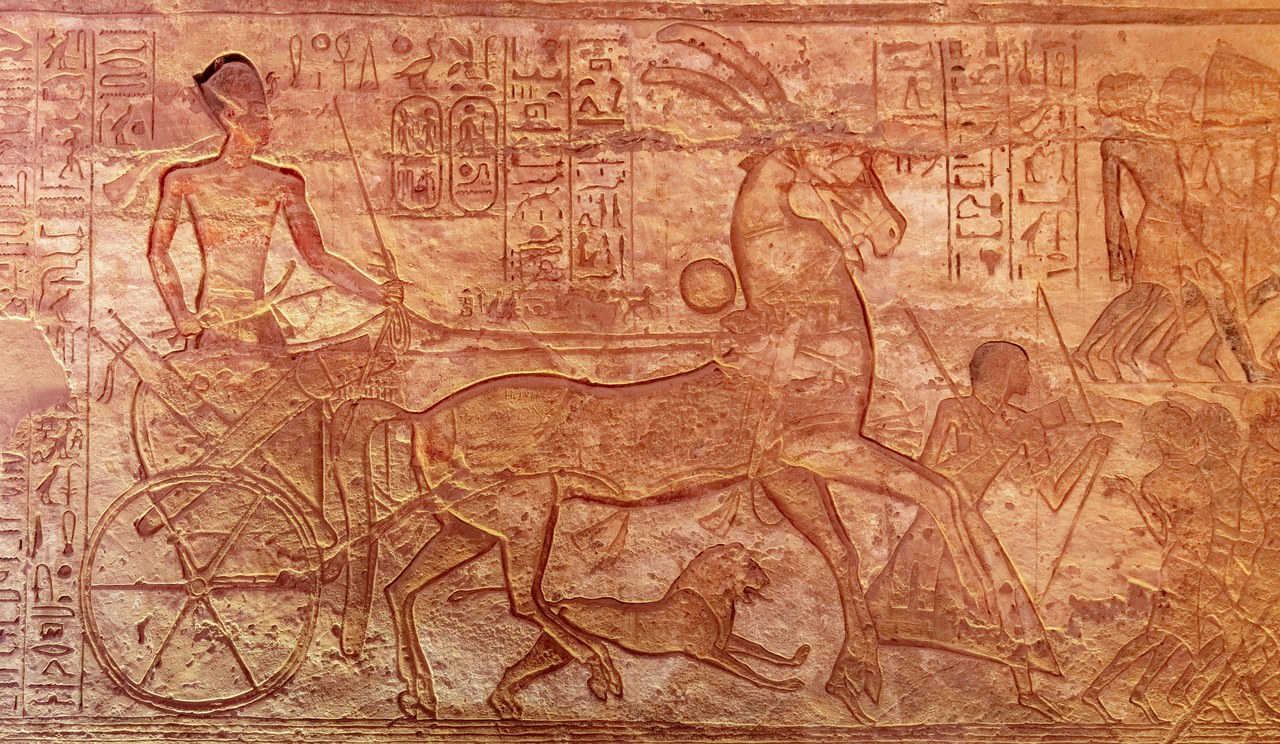
Ramesses II and the Late Bronze Age Collapse. Ramesses II (reigned 1279-1213 BC), third king of the Nineteenth Dynasty, ruled Egypt for sixty-six years and became the very model of a pharaoh. He built on a scale few rulers have ever matched: a new capital at Pi-Ramesses in the Delta, the mortuary temple known as the Ramesseum at Thebes, the rock-cut temples of Abu Simbel in Nubia, and additions at Karnak and Luxor, covering Egypt with colossal statues of himself.
Early in his reign Ramesses marched into Syria to contest the Hittite Empire, and around 1274 BC he fought the Battle of Kadesh against King Muwatalli II. Ramesses was nearly trapped when Hittite chariots ambushed his marching columns, but he rallied his forces and held the field. He proclaimed the battle a great victory on temple walls across Egypt, yet the strategic situation barely changed, and years later Egypt and the Hittites concluded a formal peace treaty under Hattusili III. A copy of that treaty survives and is often called the earliest international peace agreement in history.
Ramesses outlived most of his many sons and was succeeded by his thirteenth son, Merneptah, under whom Egypt defeated an invasion of Libyans allied with groups of the Sea Peoples. His grandson in turn, Ramesses III of the Twentieth Dynasty, fought the Sea Peoples again around 1178 BC, destroying their ships and armies in battles depicted at Medinet Habu. Egypt survived these invasions, but the strain was enormous and the empire in Asia gradually slipped away.
These wars belonged to a wider catastrophe known as the Late Bronze Age Collapse (c. 1200-1150 BC). Within a few generations the Hittite Empire vanished, the city of Ugarit was burned, the Mycenaean palaces of Greece were destroyed, and trade networks across the eastern Mediterranean broke down. Scholars debate the causes, pointing to migrating peoples, drought and famine, earthquakes, and the fragility of palace economies. Egypt endured as a state, but the world of Bronze Age great powers was gone, and the Iron Age that followed belonged to new peoples.
 Britannica: Ramses II
 World History Encyclopedia: Bronze Age Collapse
World History Encyclopedia: Sea Peoples
 Princeton University Press: 1177 B.C.: The Year Civilization Collapsed