 Go Back

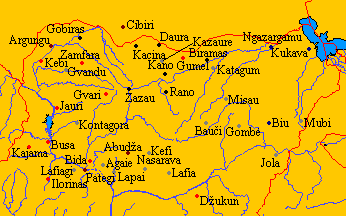
The Hausa Kingdoms were a family of city-states spread across the savanna of what is now northern Nigeria: Kano, Katsina, Zaria, Daura, Gobir, Rano, and Biram, the seven true Hausa states, ringed by seven outlying sisters. Never united under one ruler, they nevertheless shared a language, a culture, and a destiny, and they matter because their markets, crafts, and scholars made the central Sudan one of the busiest commercial regions of West Africa for five centuries.
Each walled city was a world of its own, with its own king, its own specialties, and its own rivalries: Kano grew famous for its leather and indigo dyed cloth, Katsina for scholarship and trade, Zaria for its warriors and the slave raiding that fed its markets. The cities flourished through trade, crafts, and agriculture, their merchants carrying goods from the forest edge to the desert caravans and back again.
The cities and their ruling houses were already centuries old when, from the 14th century, the kingdoms began linking into the wider world: Islam arrived with missionaries and merchants from Mali, and the new faith gradually took root in the courts and towns, though older beliefs lived on in the countryside. Because the seven states never combined, they often fell under the shadow of greater neighbors, Songhai to the west and Kanem-Bornu to the east, yet their cities kept growing richer.
In the early 19th century the Fulani jihad swept away the old Hausa kings and organized their lands into emirates of the Sokoto Caliphate, and at the beginning of the 20th century the British took over the region as the Northern Region of Nigeria. Hausa culture never faded: today the Hausa language is one of the most widely spoken in Africa, and the old cities still trade, dye, and craft as they have for centuries.
 Britannica: Zaria
 World History Encyclopedia: Hausaland
 BBC: The Story of Africa
Britannica: Hausa states