 Go Back

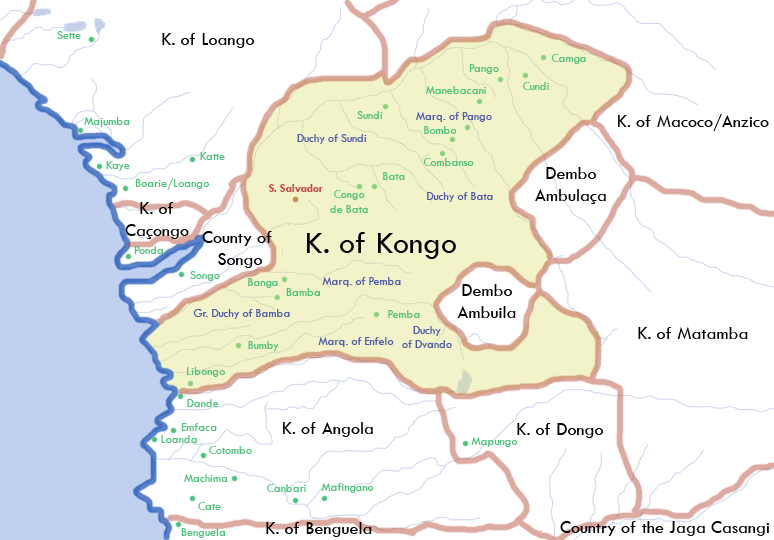
The Kingdom of Kongo was a powerful Central African state on the coast of modern Angola and the Democratic Republic of Congo, flourishing from the 14th to the 19th century. Born from an alliance of principalities in the late 1300s, it grew into the strongest power in west central Africa, ruling over two million people at its height from its hilltop capital, Mbanza Kongo. It matters because its story, of a sophisticated African kingdom that engaged Europe as an equal and was slowly consumed by the slave trade, is one of the great tragedies of the Atlantic age.
Kongo was highly organized: a single king appointed provincial governors, who collected tribute of ivory, millet, and leopard skins at lavish annual ceremonies, and commanded a standing army of up to twenty thousand men. Its markets sold copper, salt, cattle hides, and its famous raffia cloth, and it even had its own money: the spiral nzimbu shells gathered from the island of Luanda, used like coins across the kingdom.
In 1491 the Kongo king was baptized a Christian by Portuguese priests, and his son Afonso I, ruling from 1506, made Catholicism a royal faith, corresponding with the king of Portugal as brother monarch and sending his own son to be a bishop. But the partnership curdled: Portuguese traders, hungry for slaves for the plantations of Brazil and Sao Tome, ignored the king's laws, and the slave trade drained the kingdom's people and poisoned its politics.
Kongo faced growing civil wars, Portuguese interference, and defeats by rival neighbors, and the old centralized state collapsed in the early 18th century, though its kings limped on in name into the 1800s. Its culture never died: Kongo language, art, and religious traditions survived the crossing to the Americas, where they echo still in the music and faith of the Atlantic world.
 Britannica: Afonso I
 World History Encyclopedia: Kingdom of Kongo
 Humanities LibreTexts: 1.5: West Central Africa, 14th – 18th Centuries
 UNESCO World Heritage Centre: Mbanza Kongo, Vestiges of the Capital of the former Kingdom of Kongo