 Go Back

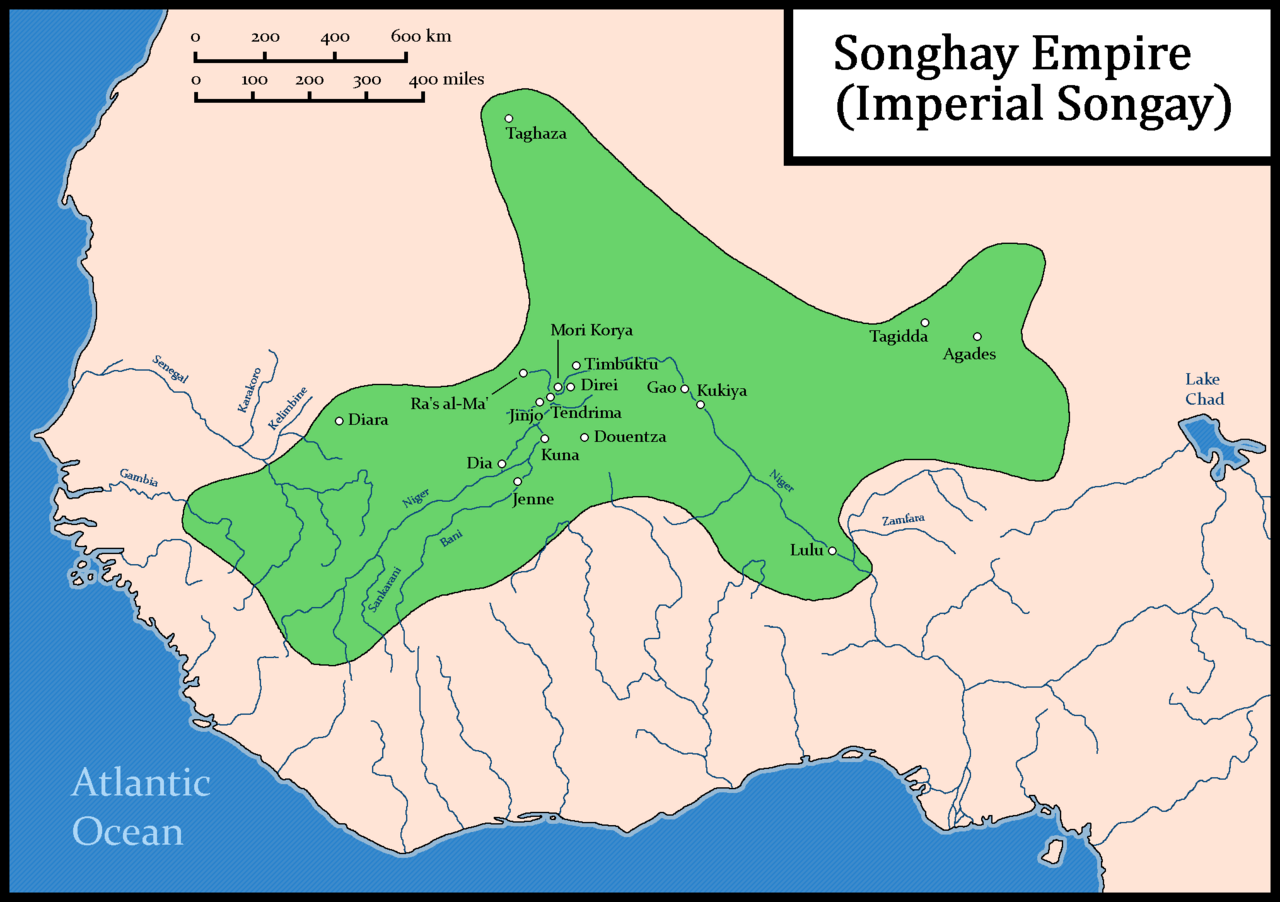
The Songhai Empire was a major West African state centered on the bend of the Niger River, the last and largest of the great Sudanese empires. It flourished in the 15th and 16th centuries under rulers like Sunni Ali and Askia Muhammad, who welded the river cities of Gao, Timbuktu, and Djenne into a single realm. It matters because it carried the West African tradition of empire, trade, and scholarship to its height before gunpowder weapons reached the desert's edge.
Sunni Ali, who ruled from 1464 to 1492, built the empire by force of arms: his armored cavalry and river canoe fleet took Timbuktu in 1468 and starved Djenne into surrender, while his reputation as a ruler of uncanny powers kept subjects in awe. After his death his general Askia Muhammad seized the throne in 1493, founding a new dynasty and giving the empire its most celebrated government.
Askia Muhammad reorganized the realm into provinces under appointed governors, standardized weights and measures, and made a grand pilgrimage to Mecca that announced Songhai's wealth to the wider Islamic world. Timbuktu itself had been founded around 1100 by Tuareg nomads, where the bend of the Niger met the starting point of the trans-Saharan caravans, and through it flowed ivory, textiles, horses, glassware, weapons, sugar, and kola nuts. Under his rule Timbuktu became a center of Islamic learning and trade at its peak: the scholars of the Sankore quarter taught law, astronomy, and medicine, and the city's book trade was its most famous industry.
The empire fell with stunning speed: in 1591 a Moroccan expedition armed with muskets crossed the Sahara and shattered the Songhai host at the battle of Tondibi. Its collapse fragmented the region; smaller states and local trade networks replaced the old empire, and the Niger bend never again saw a power of its scale.
 Britannica: Songhai empire
 World History Encyclopedia: Songhai Empire
 Humanities LibreTexts: 3.3: The Songhai Empire
 Smarthistory: Songhai Empire