 Go Back

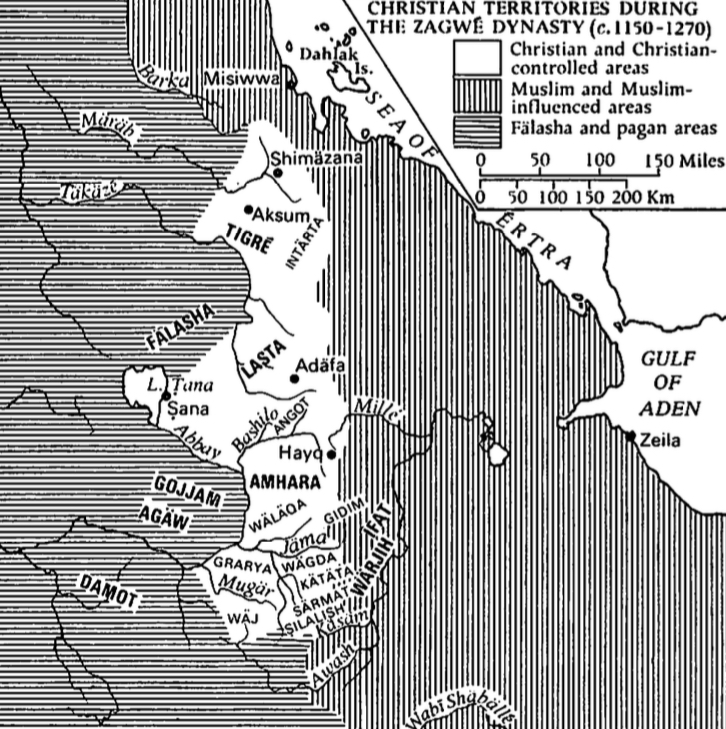
The Zagwe Dynasty ruled the highlands of Ethiopia from about 1137 to 1270, a line of kings from the Agaw people who took the throne from the last heirs of ancient Aksum. They matter because their century and a half produced one of the wonders of the medieval world: the rock hewn churches of Lalibela, whole buildings carved downward into living stone.
The Zagwe kings moved their capital to Roha, safe in their native Lasta Mountains, and won the church's blessing for their shaky claim to the crown by showering it with royal endowments. Their claim rested on a legendary marriage to a daughter of one of the last Aksumite kings, and their writ ran over much of northern and central Ethiopia, though the hill country east of the Shewa Plateau slipped away to rising Muslim states such as Ifat and Hadya. Their faith was not quiet piety: they combined a hard, mobile military life with a burning desire to build monuments to Christianity, and their realm kept Ethiopia Christian while Muslim states rose on its eastern flank.
The dynasty's crowning glory came under King Lalibela at the start of the 13th century: eleven monolithic churches, cut from the rock of his capital so perfectly that tradition holds angels worked beside the masons by night. The town was later renamed for him, and the churches remain a living place of pilgrimage eight centuries on.
The Zagwe were overthrown around 1270 by Yekuno Amlak, an Amhara prince whose rebellion drove out and killed the last Zagwe king, founding the Solomonic dynasty, which claimed descent from King Solomon and the Queen of Sheba. Later church tradition smoothed the usurpation into a willing abdication, but the Zagwe legacy, in stone and faith, needed no smoothing.
 Britannica: Zagwe dynasty
 World History Encyclopedia: Kingdom of Abyssinia
 Humanities LibreTexts: 11.3: Ethiopia and Eritrea
 The Metropolitan Museum of Art: Eastern and Southern Africa, 1000–1400 A.D.