 Go Back

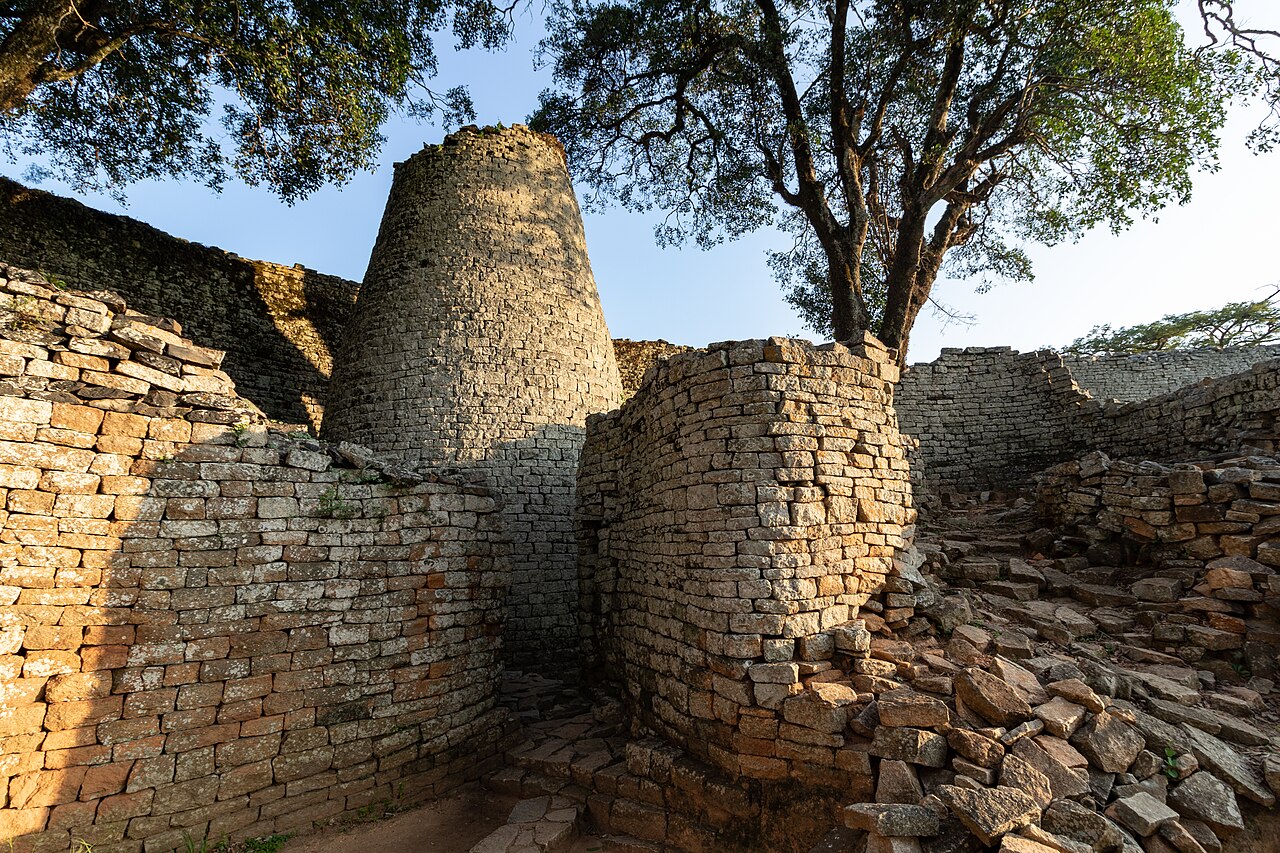
Great Zimbabwe was a major medieval city and trading state in southeastern Africa, flourishing from about 1100 to 1450 as the capital of a Shona kingdom. It matters because its stone walls and towers, raised from granite blocks without a drop of mortar, are the largest ancient structures in sub Saharan Africa, proof, for a world that once doubted it, that medieval Africa built civilizations of the first rank.
The very word zimbabwe means houses of stone, and the greatest of them, the Great Enclosure, wraps a space 250 meters around in walls up to eleven meters high, guarding a mysterious conical tower. Kings ruled from the hilltop citadel above, and the finest treasures, gold bangles, imported glass and Chinese porcelain, and the famous soapstone birds, were buried in these royal precincts. Clusters of such stone buildings, zimbabwe in the Bantu tongue, gave both the city and the kingdom their name.
The city's wealth came from the land and the long trade: cattle and farming fed it, gold from the plateau mines enriched it, and caravans carried gold and ivory to the Swahili coast, where ships took them to Arabia, Persia, India, and China. At its height perhaps twenty thousand people lived in and around the stone walls.
Great Zimbabwe was abandoned in the 15th century, probably as its gold gave out and its fields could no longer feed its people, and the Shona rulers moved north to found new powers like Mutapa. But its memory endured: the soapstone bird found in its ruins flies today on the flag of Zimbabwe, the modern nation that took its name, and its pride, from these stones.
 UNESCO: Zimbabwe
 UNESCO World Heritage Centre: Great Zimbabwe National Monument
 Wikipedia: Kingdom of Great Zimbabwe
 World History Encyclopedia: Great Zimbabwe