 Go Back

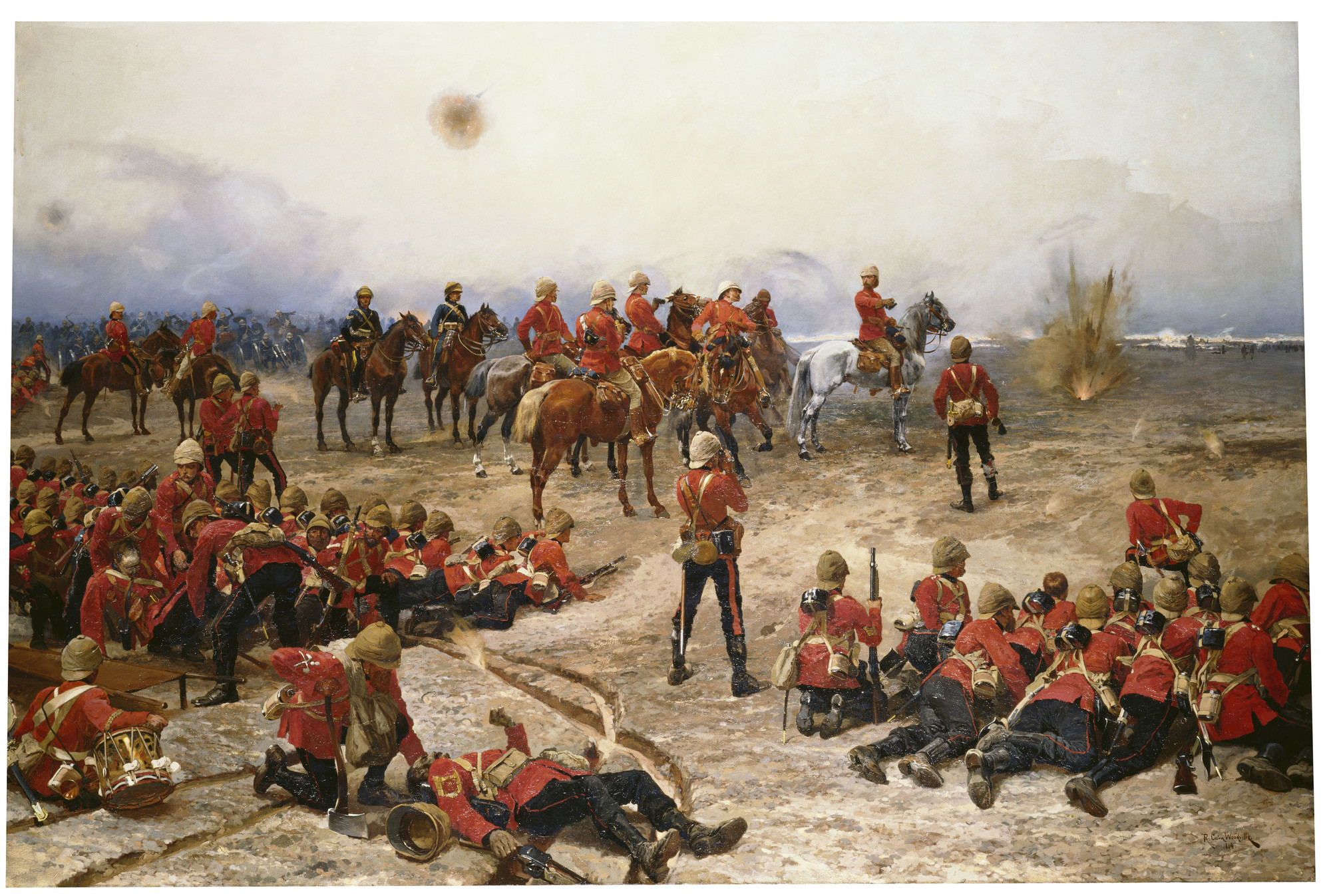
Egypt under British Occupation. In 1882 British troops occupied Egypt, promising to stay only temporarily; British military and political influence remained extensive through 1924. Egypt in these years matters because it became the hinge of the British Empire east of Suez, the guarded road to India, and the ground on which Egyptians built a modern national movement.
The occupation grew out of debt and revolt. The khedives who succeeded Muhammad Ali had borrowed enormously from European banks, and by 1876 Egypt was bankrupt, its finances placed under an Anglo-French control. Resentment of foreign privilege and of injustice in the army produced the revolt of Colonel Ahmed Urabi in 1881, whose movement demanded an Egypt for the Egyptians. When crisis gave Britain its pretext, the Royal Navy bombarded Alexandria in July 1882, and General Wolseley destroyed Urabi's army at Tel el-Kebir that September.
For a generation the country was ruled in all but name by one man, Evelyn Baring, Lord Cromer, the British agent and consul-general. Behind the khedive's throne he rebuilt the finances, extended irrigation, raised the great Aswan Dam in 1902, and kept Egypt a vast cotton estate supplying the mills of Lancashire. British-led forces from Egypt reconquered the Sudan in 1898, brushing aside France at Fashoda. But the hanging of villagers after the Denshawai incident of 1906, and the everyday humiliations of occupation, fed a new nationalism voiced by Mustafa Kamil and the young lawyers of the cities.
The First World War stripped away the fiction. Britain declared a protectorate in 1914, deposed the khedive, and requisitioned crops, animals, and laborers, and in 1919 the exile of the nationalist leader Saad Zaghlul set off a revolution of strikes and risings across the country. Conceding the inevitable, Britain unilaterally declared Egypt independent in 1922, while reserving imperial communications, defence, foreign interests and minorities, and the Sudan for future settlement. By 1924 Egypt had a constitution, a parliament, and a king, but the struggle over those reserved points defined its politics.
 Britannica: Egypt - The British occupation and the Protectorate, 1882-1922
 National Army Museum: Egypt and Sudan
 Encyclopedia.com: 'Urabi Rebellion
 Wikipedia: Anglo-Egyptian War