 Go Back

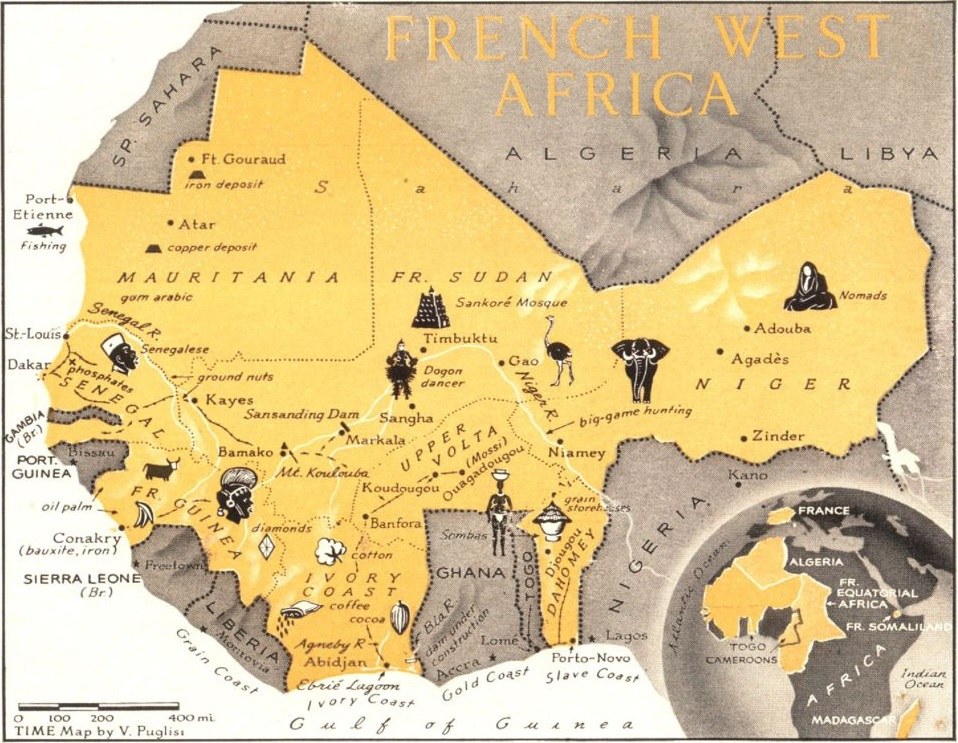
French West Africa. French West Africa (1895-1958) was the vast federation of French colonies that covered most of the western bulge of the continent, an area of nearly five million square kilometers. Created in 1895 and completed by conquest in the following years, it grouped eight territories: Mauritania, Senegal, French Sudan (now Mali), Guinea, Ivory Coast, Upper Volta (now Burkina Faso), Niger, and Dahomey (now Benin). The federation was ruled from Dakar by a governor-general who answered to the colonial ministry in Paris.
Colonial rule was built on extraction. The French demanded taxes payable in cash, which forced farmers into wage labor and cash-crop production: peanuts in Senegal, cocoa and coffee in Ivory Coast, cotton in the Sudan. Forced labor built railways, roads, and the new port of Dakar, and African soldiers, the tirailleurs senegalais, fought for France in both world wars. A small educated elite in the Four Communes of Senegal held French citizenship, but the vast majority of Africans were subjects without rights, governed under the arbitrary indigenat code.
After the Second World War the system changed. Reforms in 1946 abolished forced labor and granted citizenship, and African political parties, led by figures such as Felix Houphouet-Boigny and Leopold Sedar Senghor, pressed for self-government within a reformed French Community. In 1958 the territories of French West Africa voted in a referendum on General de Gaulle's constitution; all except Guinea chose to remain in the Community, and Guinea became independent at once. Two years later, in 1960, the remaining colonies became independent republics.
French West Africa left a deep legacy. Its borders became the boundaries of eight modern states, its language, legal systems, and infrastructure still shape the region, and the memory of colonial exploitation and of the long struggle against it remains central to West African political life.
 Wikipedia: French West Africa
 Encyclopaedia Universalis: Afrique Occidentale Francaise
 ACCORD: Mission to Civilise: The French West African Federation
 Routledge: French West Africa: The Structure of Government