 Go Back

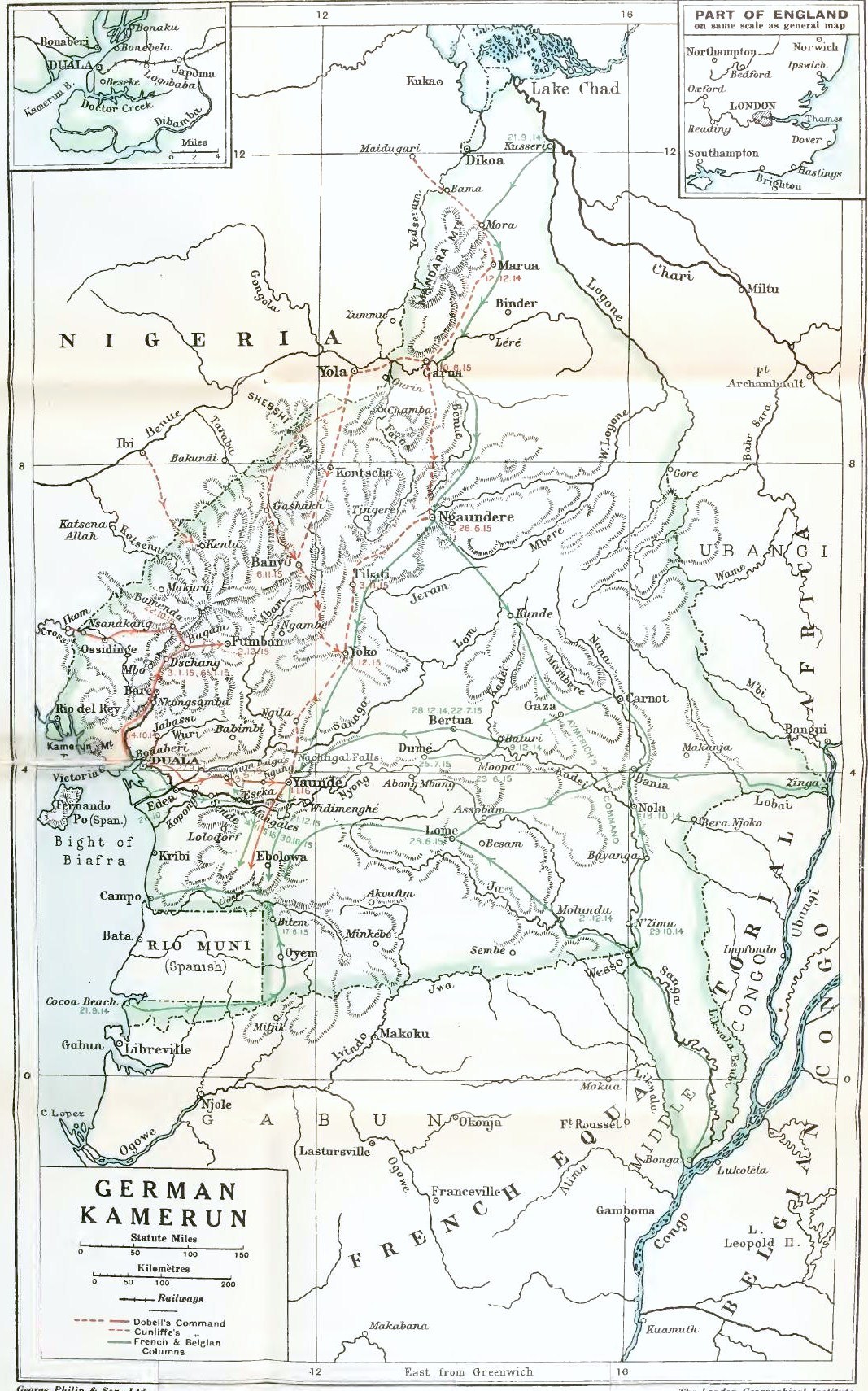
Kamerun was Germany's largest African colony on the continent's west coast, established during the Scramble for Africa and lost during the First World War. In July 1884, the German explorer Gustav Nachtigal arrived off the Cameroon coast and signed treaties with the Duala chiefs at the settlement then called Kamerunstadt, planting the German flag just ahead of British and French rivals who also coveted the region. The Berlin Conference of 1884-1885 confirmed German possession, and over the following decades the colony expanded far into the interior, eventually covering an area larger than Germany itself.
The German colonial administration ruled Kamerun from the coastal capital of Buea, at the foot of the towering volcanic Mount Cameroon. The colony's economy was built on plantations, and German companies established vast estates growing rubber, cocoa, palm oil, and bananas in the fertile coastal lowlands. Plantation agriculture depended on forced and poorly paid African labor, and conditions were often brutal. Resistance flared repeatedly: the Duala and other coastal peoples protested land seizures and taxes, while uprisings in the interior, including those of the Bafut and other highland peoples, were suppressed by German-led punitive expeditions.
Despite its harshness, German rule brought infrastructure and development to parts of the colony. Railways were built from the port of Douala into the interior, and a second line linked Yaoundé, the new inland capital, toward the highlands. Mission schools and medical stations spread, and German scientists conducted research in the colony's forests, which were among the most biologically rich in Africa. By 1914 Kamerun had a population of several million Africans and a few thousand German settlers, administrators, and soldiers.
The First World War ended German rule in Kamerun. In August 1914 British and French forces invaded from Nigeria and French Equatorial Africa, beginning the Kamerun campaign. The German Schutztruppe, outnumbered and cut off from resupply, conducted a fighting retreat into the mountainous interior and held out until February 1916, when the remaining garrison crossed into neutral Spanish Guinea and was interned. After the war the colony was divided between Britain and France as League of Nations mandates, with France taking the larger eastern share. These mandates became the independent nations of Cameroon and parts of Nigeria in 1960 and 1961.
 Wikipedia: German West Africa
 National Army Museum: West Africa campaign
 Deutsches Historisches Museum: Die deutsche Kolonie Kamerun (LeMO)