 Go Back

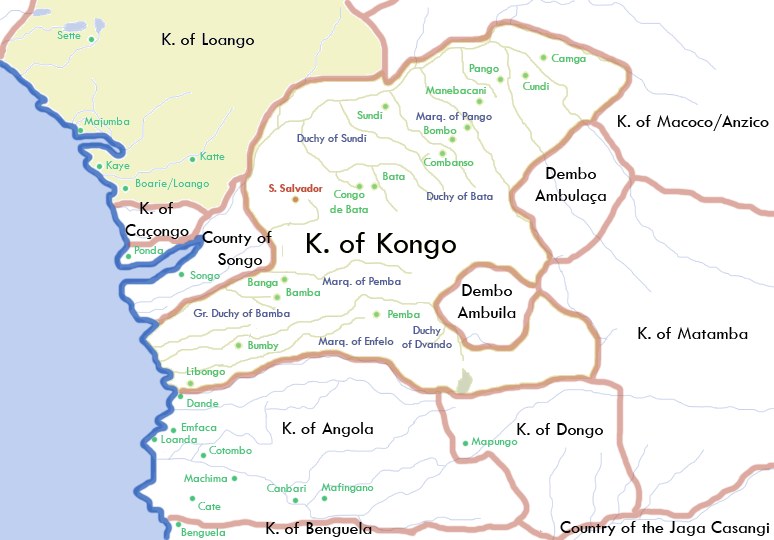
The Kingdom of Loango. The kingdom of Loango (c. 1550-1883) was a major state of the west-central African coast, ruling the shoreline north of the Congo River in what is now the Republic of Congo, Cabinda, and Gabon. The kingdom belonged to the Vili people, and its origins are tied to the broader Kongo world: tradition held that the founder of Loango was a kinsman of the first king of Kongo. By the sixteenth century the Loango king, the maloango, ruled from his capital at Buali and controlled a string of ports, including Loango Bay, that became famous in Atlantic trade.
Loango grew rich as a commercial power. Its merchants traded ivory, redwood, copper, palm cloth, and enslaved people with the Portuguese, Dutch, French, and English traders who visited the coast, and the kingdom's brokers carefully guarded their position between the European ships and the markets of the interior. The Vili were renowned as traders and craftspeople, and Loango cloth and ivory work circulated far beyond the kingdom. Unlike Kongo to the south, Loango's rulers long kept Christianity at arm's length and preserved their own royal and religious institutions.
The kingdom's political order was unusual. The maloango was a sacred ruler whose authority was balanced by powerful titled officials, and after the death of a king the throne passed among the great lineages in an elaborate system of rotation and election. In the late eighteenth and nineteenth centuries the Atlantic trade changed and then was suppressed, and Loango's ports, once centers of the slave trade, declined with it, though trade in ivory and other goods continued.
The kingdom ended with the colonial partition of Africa. In the 1880s France established its authority over the coast, and by 1883 the last independent maloango had been reduced to a figurehead. Yet the kingdom's legacy endured: the Vili kept their language and traditions, and the memory of Loango, whose kings once dealt with European powers as equals, remains central to the history of the Congo coast.
 Open Textbook (UTC): West Central Africa, 14th-18th Centuries
 1911 Encyclopaedia Britannica: Loango
 Journal of African History: Africans Championed Free Trade