 Go Back

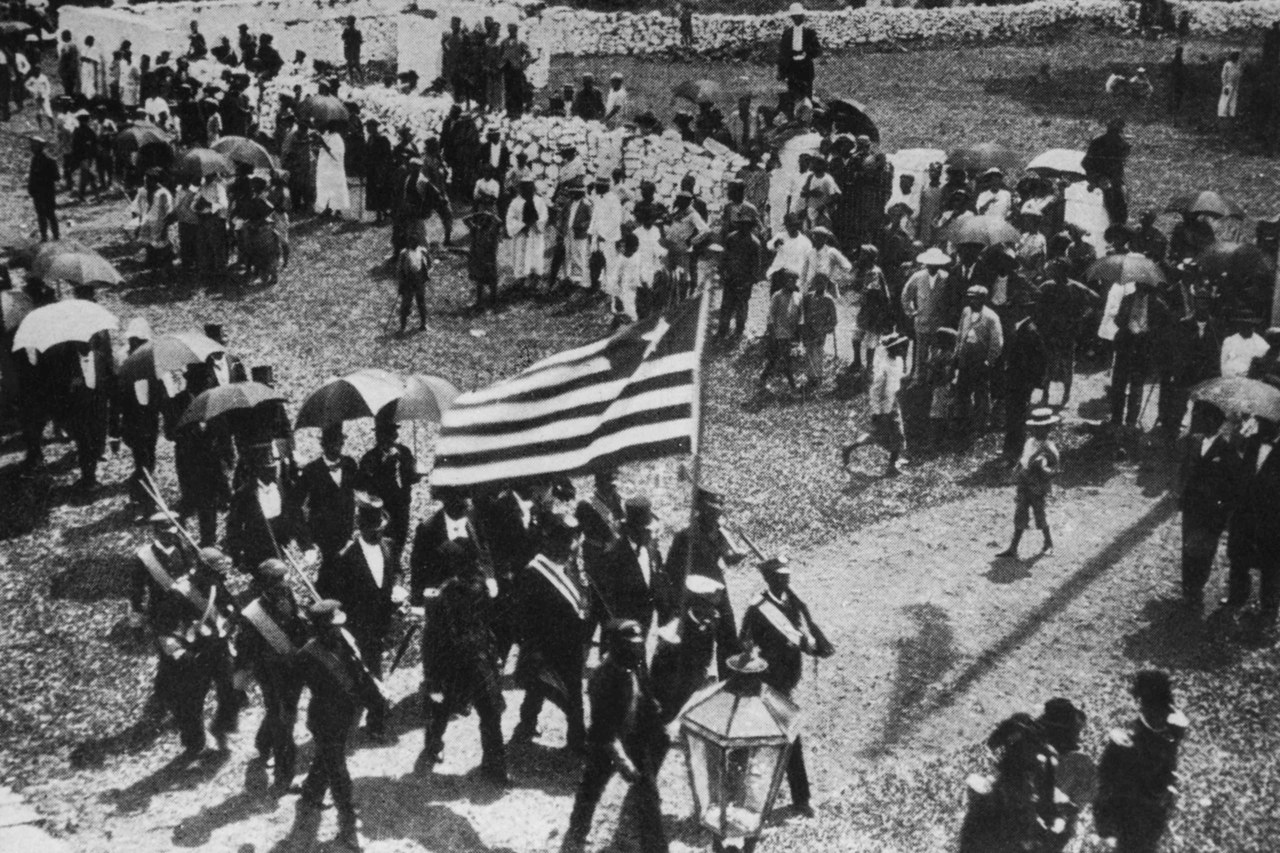
The Republic of Liberia. The Republic of Liberia (1847-present) is Africa's oldest modern republic, founded by free Black people from the United States. From 1820 the American Colonization Society, supported by slaveholders and abolitionists alike, settled freed African Americans on the Grain Coast of West Africa, where they founded Monrovia, named for President Monroe. The settlers, known as Americo-Liberians, established towns along the coast, and in 1847, pressed by Britain and France to assert sovereignty, the colony declared independence under its first president, Joseph Jenkins Roberts.
The young republic faced a difficult existence. Its people, never more than a small minority, ruled a coast of trading towns while the African peoples of the interior, including the Kru, Grebo, and Vai, resisted settler control for generations. Britain and France nibbled at its borders, and the government survived on customs revenue, foreign loans, and the flag of convenience it sold to foreign shipping. Only in the early twentieth century, with armed frontier forces, did Monrovia extend real control over the hinterland, imposing on its peoples taxes and forced labor that drew international scandal.
The republic's politics settled into the long dominance of the True Whig Party, and its finances into chronic crisis: foreign banks held the debt, European powers pressed for control of the customs that secured it, and a 1918 loan agreement pulled Monrovia deeper into the orbit of the United States. In the interior, the Liberian Frontier Force enforced a harsh rule, and reports of forced labor on roads and plantations drew growing international criticism.
By the mid 1920s Liberia stood in an uneasy position: Africa's oldest republic, proud of never having been colonized, yet dependent on foreign loans, ruled by a small settler-descended elite, and still struggling to turn its paper claim over the interior into a reality its own peoples would accept. Its history, born of freedom in America and forged through rule and resistance, remains unique on the continent.
 Library of Congress: History of Liberia, 1847-1871
 BlackPast: Americo-Liberians
 Smithsonian Magazine: Tumult and Transition in Little America
 Settler Colonial Studies: The History of Liberia's Formation