 Go Back

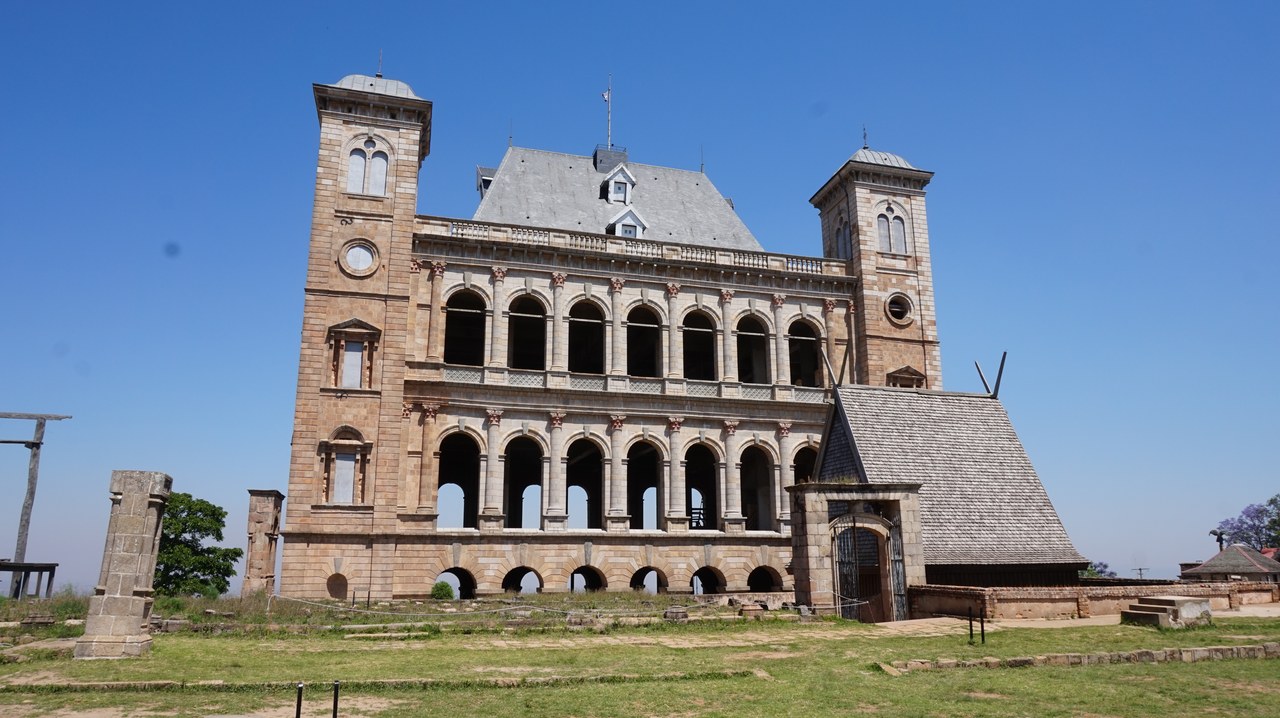
High in the cool central highlands of Madagascar, the Merina people built the kingdom that would eventually unite almost the entire island under one crown. Emerging around 1540 under King Andriamanelo, the Merina realm began as one of many small chiefdoms scattered across the Imerina plateau, where rice terraces climbed the hillsides and fortified hilltop towns crowned the ridges. The kingdom spent much of the seventeenth and eighteenth centuries divided among rival branches of the royal family, but that fragmentation ended when a gifted ruler named Andrianampoinimerina conquered the competing kingdoms one by one and reunited Imerina by about 1794.
Andrianampoinimerina organized his realm with remarkable care. He regulated rice cultivation, organized markets at set locations, codified laws, and famously declared that the sea would be the boundary of his rice field, announcing his ambition to rule the whole island. His son Radama I, who reigned from 1810 to 1828, made enormous progress toward that goal. With British military instructors, modern firearms, and an alliance with the British governor of Mauritius, Radama conquered the eastern port of Toamasina and then much of the island. Antananarivo, the capital, grew into a city of tens of thousands, and European missionaries arrived to set up schools and introduce a Latin alphabet for the Malagasy language.
The most famous Merina ruler was Queen Ranavalona I, who reigned from 1828 to 1861 and pursued a dramatic reversal of her husband's pro-European policies. Determined to protect Merina sovereignty and traditions, she expelled missionaries, banned Christianity among her subjects, and cut back foreign contacts while still expanding her armies and building industries with the help of the French artisan Jean Laborde. Her reign preserved Malagasy independence for a generation, though at the cost of international isolation and harsh internal campaigns that devastated parts of the island. Later monarchs, including Radama II, Rasoherina, and Ranavalona II, reopened the kingdom to outside influence and made Protestant Christianity the court religion.
The Merina kingdom's independence ended in the 1890s as French imperial ambitions in the Indian Ocean turned toward Madagascar. France invaded in 1883 and again in 1895, capturing Antananarivo in September of that year. Queen Ranavalona III was forced to accept a French protectorate, and in 1897 she was exiled to Algeria while the monarchy was abolished. The royal palace complex, the Rova of Antananarivo, still crowns the highest hill of the capital as a symbol of the kingdom. Today Madagascar's population is heavily descended from Merina and other Malagasy peoples, and the Merina dialect remains the basis of the national language.
 Wikipedia: Ranavalona I
 HistoryExtra: Queen Ranavalona I of Madagascar
 Monsoon: Journal of the Indian Ocean Rim: Ranavalona I and the Making of a Reputation
 JSTOR Daily: How Madagascar's Queen Ranavalona Helped Define Queen Victoria