 Go Back

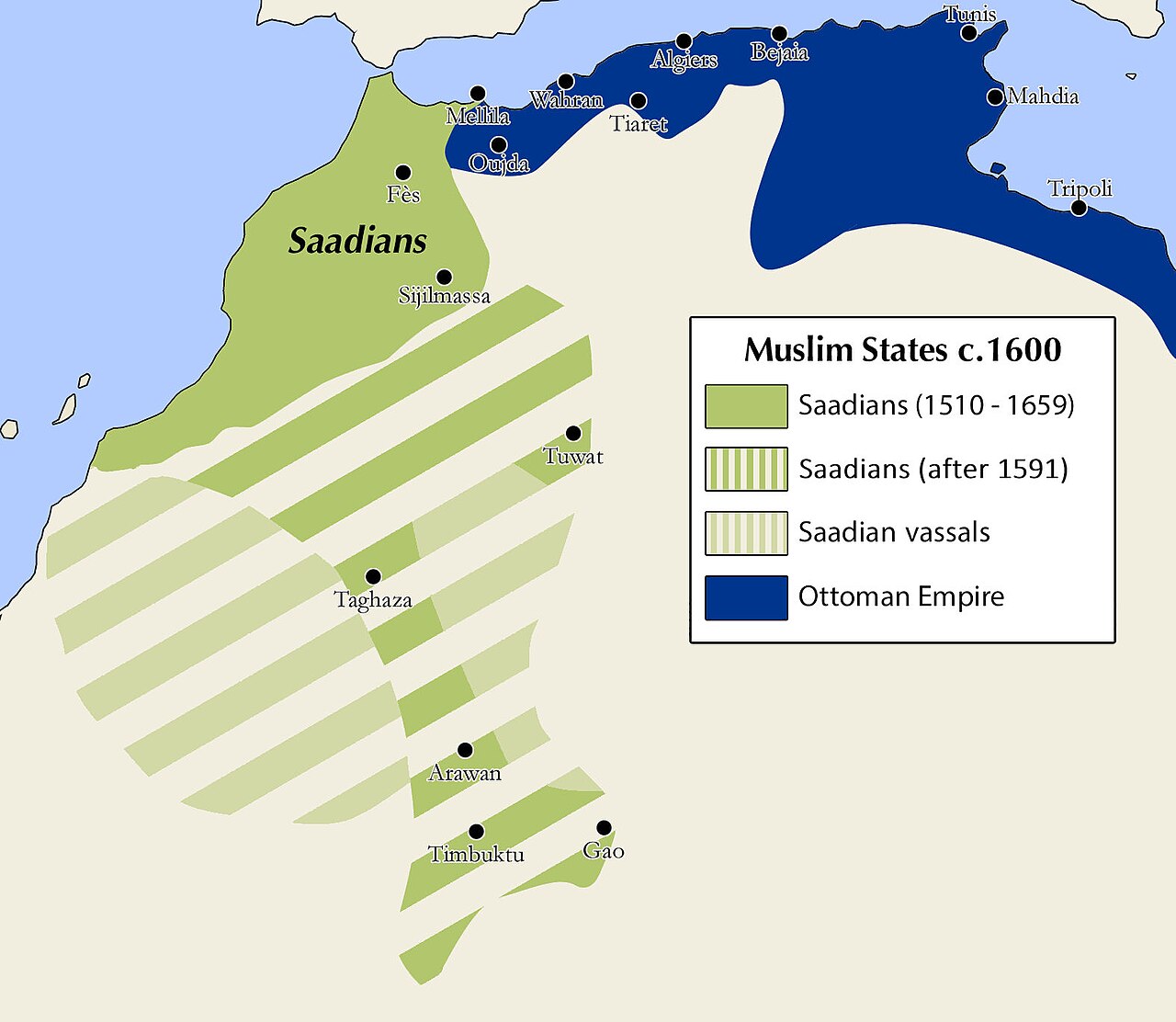
The Saadi Sultanate ruled Morocco from 1549 to 1659, a dynasty of sharifs, claimed descendants of the Prophet, who rose in the south as champions against Portuguese intrusion and the faltering Wattasid kings. They matter because they made Morocco a power of the first rank for one brilliant generation, resisted both Portuguese crusaders and Ottoman sultans, and left Marrakesh monuments that still draw the world.
The sharifs took Marrakesh, then Fez itself, uniting Morocco under their green banners and checking the Portuguese along the coast. Their finest hour came in 1578 at the Battle of the Three Kings, where the Saadi army destroyed a Portuguese invasion of Morocco and the young king Sebastian of Portugal died in the rout, a catastrophe that ended Portugal's African ambitions and reshaped Europe. Their capital still wears their splendor: the Saadian Tombs of Marrakesh rank among the city's wonders.
The dynasty's most famous ruler, Ahmad al-Mansur, the Golden, ruled from 1578 to 1603 and filled his treasury with ransoms and his court with splendor: he built the ruined palace of El Badi in Marrakesh, whose vast courtyard still amazes. In 1591 he sent an army of musket men across the Sahara itself, which captured Timbuktu and broke the Songhai Empire, seizing the desert gold trade for Morocco.
After al-Mansur's death the dynasty tore itself apart in civil wars between rival princes, and Morocco slid into half a century of division. Order returned only when another line of sharifs, the Alaouites, took power in 1666, but the Saadis had already fixed the mold: a Morocco united under sharifian rule, independent of the Ottomans, and reaching south across the desert sands.
 Britannica: Aḥmad al-Manṣūr
 Humanities LibreTexts: 11.9: kingdom of Morocco
 Wikipedia: Saadi Sultanate
Britannica: Morocco