 Go Back

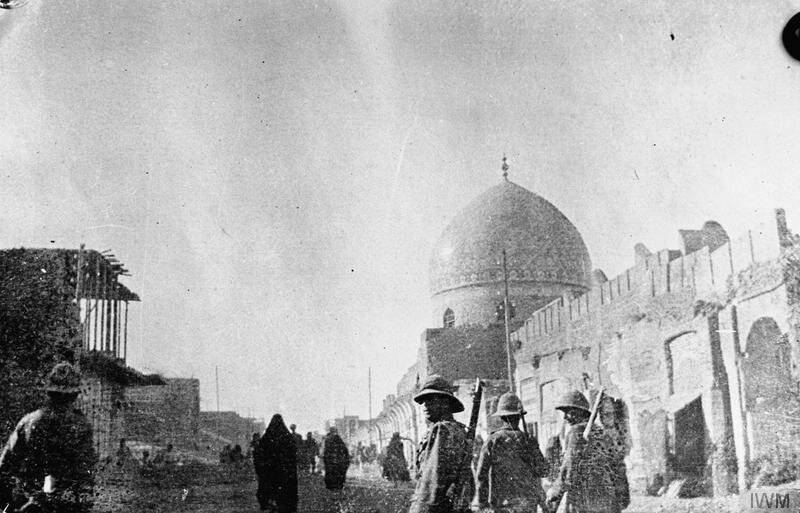
British Mandate Iraq and Palestine. Britain's mandates in Iraq and Palestine (1920-1948) were invented at the end of the First World War from three Ottoman provinces and a wartime promise. Britain had conquered Mesopotamia in a hard campaign against the Ottomans (1914-1918) and taken Jerusalem in 1917; at San Remo (1920) the League of Nations confirmed British mandates over Iraq, Palestine and Transjordan - just as Britain's contradictory wartime pledges (to the Arabs in the Hussein-McMahon correspondence, to the Zionists in the Balfour Declaration of 1917, and to France at Sykes-Picot) were coming due.
In Iraq, the great 1920 revolt against British rule - tribes and towns, Sunni and Shi'a together - was crushed at heavy cost, and Britain chose indirect rule: Faisal, the Hashemite expelled from Syria, was crowned King of Iraq (1921); a treaty relationship preserved British bases and oil interests, and in 1932 Iraq became the first mandate to join the League of Nations as an 'independent' kingdom - though British influence, bases and the Assyrian and Kurdish questions persisted, and Britain re-occupied the country in 1941 after Rashid Ali's pro-Axis coup.
In Palestine, the mandate administered the impossible: a Jewish national home growing under Zionist immigration - fleeing European antisemitism and then the Holocaust - within an Arab majority determined to prevent it. Communal violence (1920, 1921, 1929), the great Arab Revolt (1936-1939), Britain's 1939 White Paper restricting Jewish immigration just as Europe's Jews faced annihilation, and postwar Zionist insurgency and illegal immigration made the mandate ungovernable.
In 1947 Britain handed Palestine to the United Nations; on 14 May 1948 it left, Israel declared independence, and the first Arab-Israeli war and the Palestinian Nakba followed. Iraq's Hashemite monarchy lasted until the 1958 revolution. The mandates' borders, institutions and unfinished conflicts still define the Middle East.
 Britannica: Palestine
Britannica: Iraq
 Humanities LibreTexts: The Post-War Middle East