 Go Back

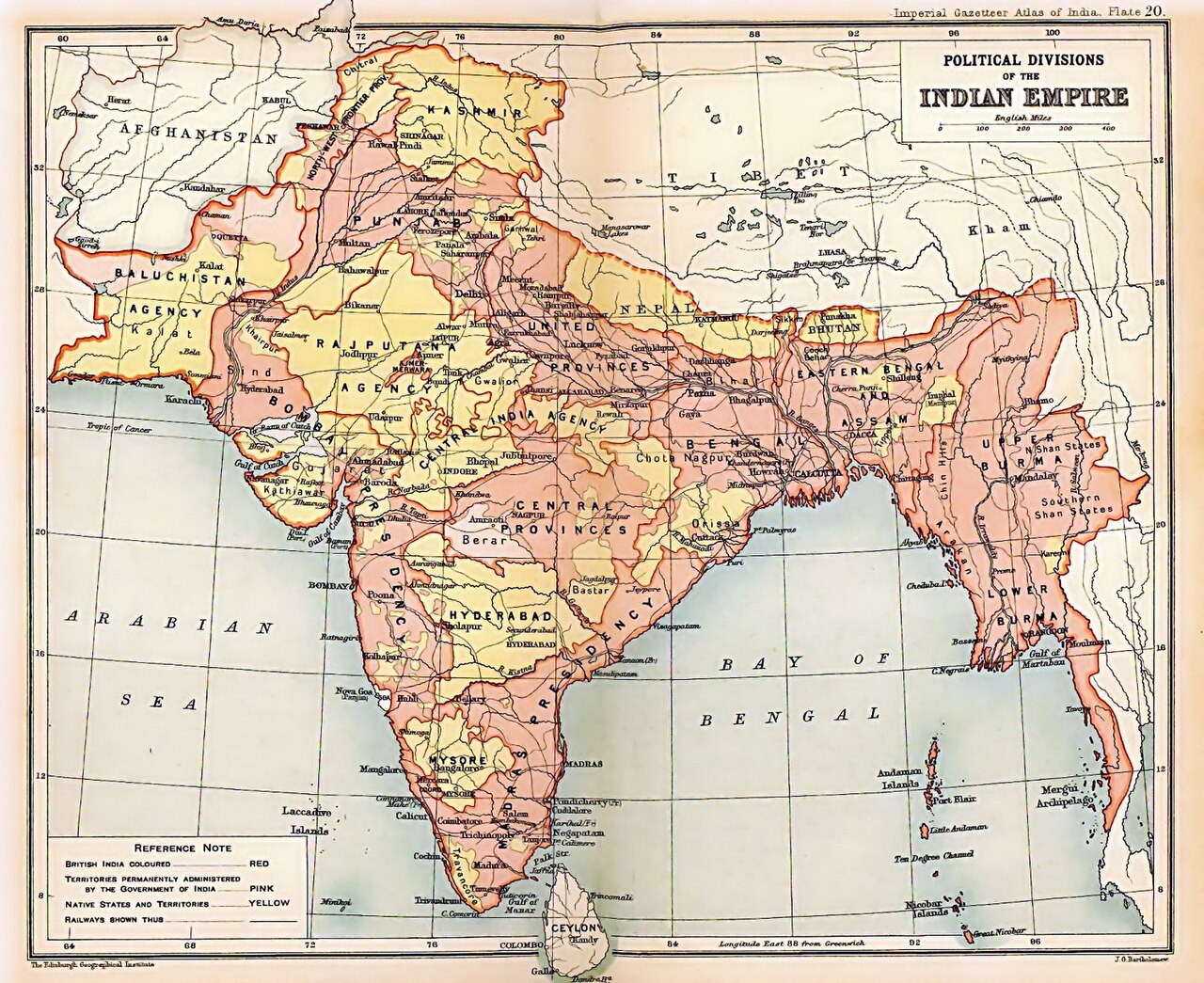
The British Raj began in 1858, when the British Crown took direct responsibility for government in India. It began after the great rebellion of 1857: by the Government of India Act of 1858, the East India Company's vast conquests passed to Queen Victoria, who in 1876 was proclaimed Empress of India. A viceroy governed from Calcutta - after 1911 from the new imperial capital at Delhi - ruling both the directly administered provinces of British India and, through 'paramountcy,' the hundreds of princely states whose maharajas kept their thrones under British suzerainty.
The Raj was an empire of superlatives and contradictions. It unified the subcontinent under one administration, one army, and one railway network; it also drained India's wealth to Britain - as Indian nationalists charged - through unfair trade, restraint of Indian industry, and taxes paying British salaries. At its greatest extent it embraced nearly all of today's India, Pakistan, Bangladesh, and Myanmar, with Aden and the Persian Gulf states attached at various times.
Indian nationalism grew up inside the Raj's own institutions: the Indian National Congress, founded in Bombay in 1885 by Western-educated professionals, moved from loyal petition to the demand for self-rule; the Muslim League followed in 1906; and after the First World War the freedom struggle became a mass movement that no viceroy could contain.
The First World War changed everything. India's soldiers and taxpayers had sustained Britain's war effort, and the reward - the Montagu-Chelmsford reforms of 1919, offering a limited share of power in the provinces - fell far short of self-rule. The same year the Rowlatt Acts authorized detention without trial, and in April 1919 General Dyer's troops fired on an unarmed crowd in Amritsar's Jallianwala Bagh, killing hundreds, a massacre that shattered Indian faith in British justice. Mohandas Gandhi, newly returned from South Africa, answered with non-cooperation: from 1920 to 1922 millions boycotted British courts, schools, titles and cloth, until Gandhi suspended the campaign after a crowd killed policemen at Chauri Chaura. The Raj had reached its greatest extent - but the age of mass nationalism had begun.
 Britannica: British raj
 World History Encyclopedia: Timeline: British Raj
 Humanities LibreTexts: 7.6: British Raj
Britannica: Jallianwala Bagh Massacre