 Go Back

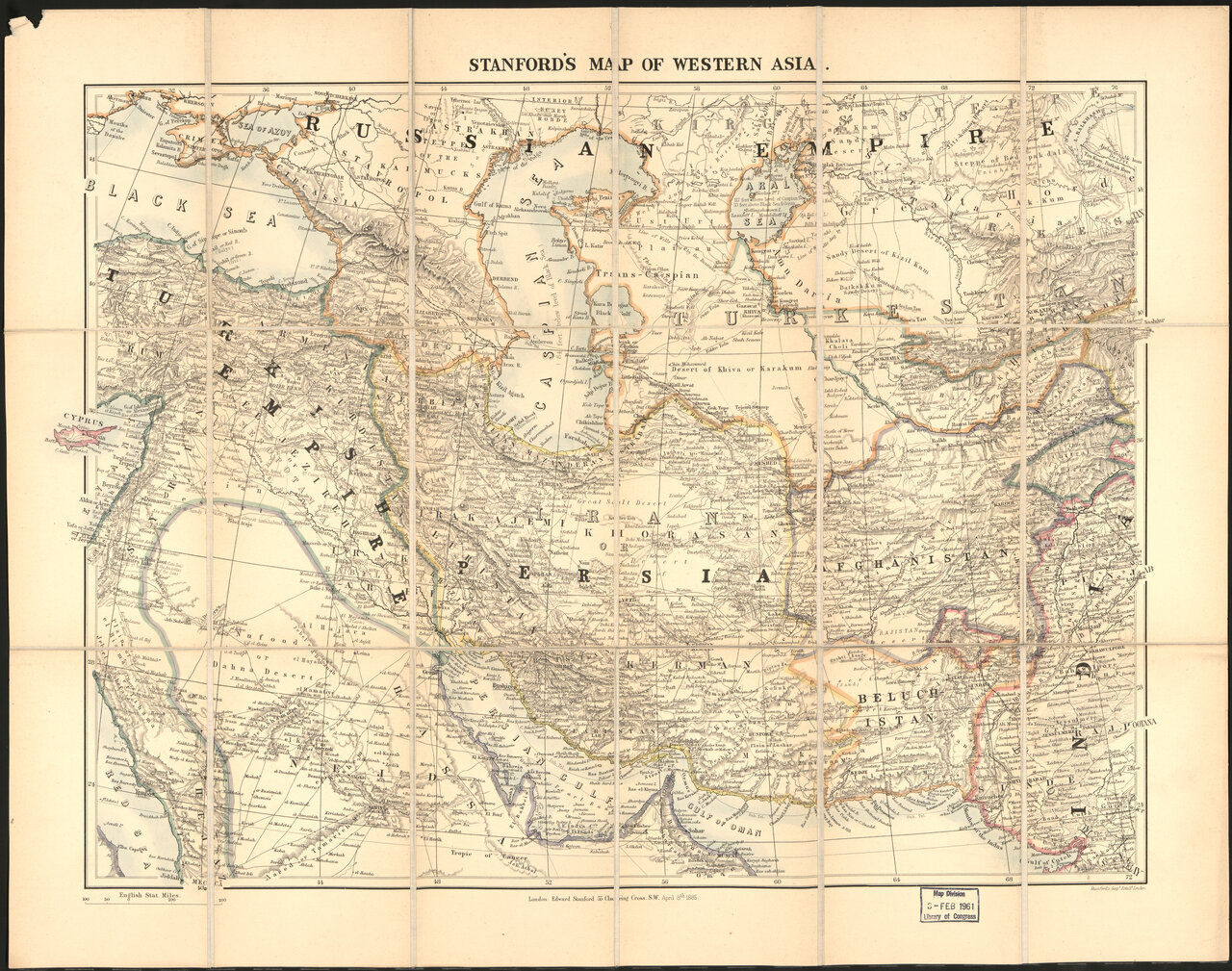
The Great Game. The Great Game (c. 1813-1907) was the 19th century's longest shadow-war: the rivalry of the British and Russian empires over Central Asia, from the Caucasus to Tibet. Its logic was the map: Russia's armies advanced a generation at a time - into the Kazakh steppe, to Tashkent (1865), Samarkand (1868), Khiva (1873), Kokand (1876) and Merv (1884) - and every Russian mile closer to the Hindu Kush raised British fears for India, the empire's jewel, while London probed north with missions, spies and two invasions of Afghanistan.
The Game was fought mostly by extraordinary men on both sides in disguise and on horseback: the 'pundits' - Indian surveyor-spies like Nain Singh, who measured Lhasa with prayer-wheel and rosary - the officers Burnes, Conolly and Stoddart (the last two executed at Bukhara in 1842), the Russian explorers Przhevalsky and Grombchevsky, and their counterparts, who mapped the Pamirs, dined with khans, and sometimes never came back. Its climaxes were crises: the siege of Herat (1837-38), the Afghan wars, the Penjdeh incident (1885), when Russian and Afghan troops clashed and Europe neared war.
The Game's tools were railways, loans and treaties as much as armies: Russia's Trans-Caspian line, Britain's Indian frontier railways, and finally the Anglo-Russian Convention of 1907, which divided the spoils - Persia into spheres of influence, Afghanistan in Britain's, Tibet neutral - ending the contest as both empires turned to face Germany.
The Game's legacy outlived it: Afghanistan's buffer-state survival, Central Asia's Russian borders, the Durand Line, and a romantic literature - Kipling's Kim gave the Game its name - that made 'Great Game' the shorthand for every later rivalry in Asia, from the Cold War to the 21st century.
 World History Encyclopedia: The Great Game
 Encyclopaedia Iranica: Afghanistan: Political History
 Britannica: Anglo-Afghan Wars