 Go Back

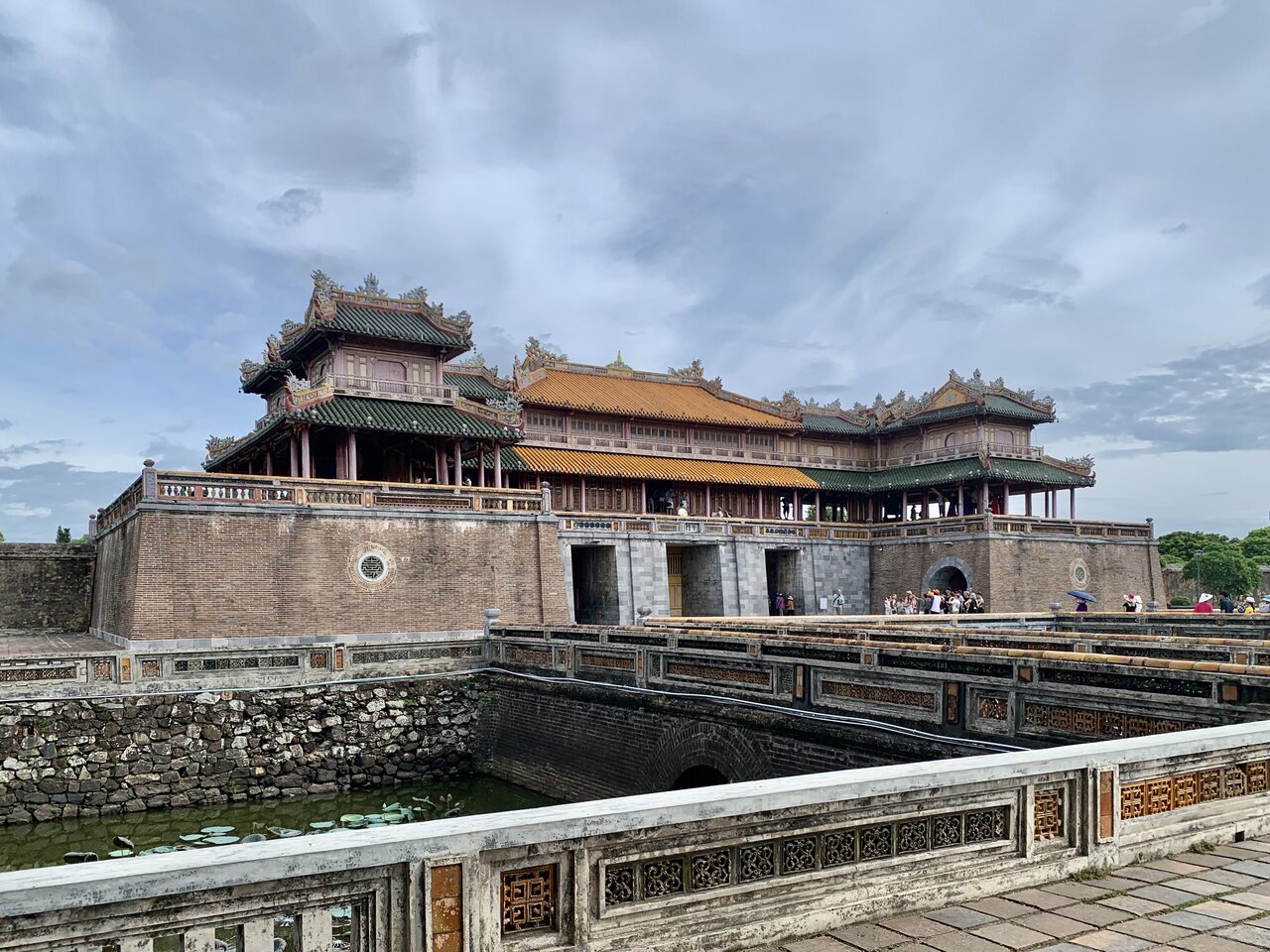
The Nguyen Dynasty. The Nguyen dynasty (1802-1945) was Vietnam's last imperial house. Its founder, Nguyen Anh - survivor of the Tay Son wars that destroyed the old order - reunified Vietnam in 1802 after a thirty-year struggle, taking the reign name Gia Long and the country's modern name, Vietnam, with his capital at Hue, whose vast citadel-palace, the Imperial City, rose on the Perfume River as a miniature Forbidden City.
Under Gia Long and his son Minh Mang (r. 1820-1841) the dynasty built Vietnam's most centralized Confucian state: a scholar-bureaucracy on the Chinese model, legal codes, land registers, and a claim to suzerainty over Cambodia that brought war with Siam. But the same court persecuted the growing Catholic communities - missionaries and converts executed, churches destroyed - giving France its pretext: French and Spanish forces attacked in 1858, and by 1862-1867 the south (Cochinchina) was a French colony; in 1883-1885, after the Sino-French War, France took the north and center as protectorates, leaving the Nguyen emperors crowned figureheads at Hue.
The dynasty's 20th-century emperors reigned under French Indochina: the boy-emperor Ham Nghi, who fled to lead the anti-French Can Vuong resistance (1885-1888) and died in Algerian exile; the collaborationist and the reformist (Duy Tan, deposed for conspiring against France); and the last, Bao Dai - emperor under France, chief of state under Japan's 1945 coup, and finally Emperor Bao Dai of the French-sponsored State of Vietnam, until his rival Ho Chi Minh's Democratic Republic won at Dien Bien Phu.
Nguyen Vietnam left the country its modern name, its borders, and the monuments of Hue - the Imperial City, the royal tombs along the Perfume River, now UNESCO-listed - while its failure to answer the West set the stage for a century of colonialism, war and revolution.
 Britannica: Nguyen Dynasty
Britannica: Gia Long
Britannica: History of Vietnam