 Go Back

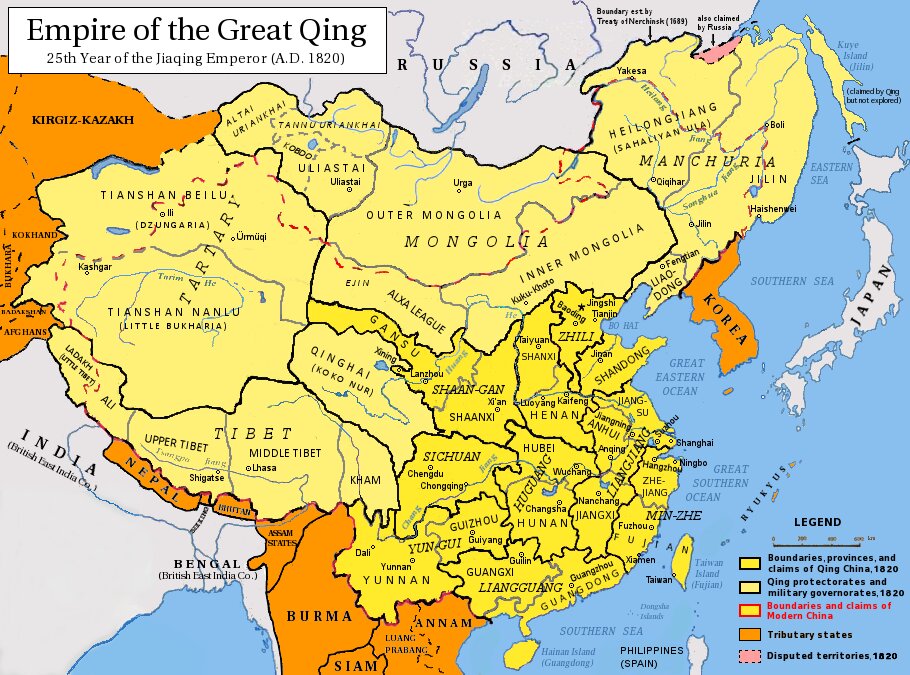
The Qing in Inner Asia. The Qing dynasty (1644-1912) was not only a Chinese dynasty but the last great empire of Inner Asia. The Manchus had made themselves masters of the steppe world before ever taking Beijing: allied with the eastern Mongols from the 1630s, ruling through the banner system, the Lifan Yuan (Court of Colonial Affairs), and the emperor's triple identity - Chinese Son of Heaven, Manchu khan of khans, and patron-bodhisattva of Tibetan Buddhism - they built an empire that by 1760 stretched from Korea to the Pamirs and from Siberia to Tibet.
The conquests came in stages. The Qing-Mongol alliance absorbed Inner Mongolia early; the century-long struggle with the Zunghar (Dzungar) Mongols - the last great nomadic empire - ended under the Qianlong emperor with the destruction of Zungharia (1755-1758, its people decimated by war and smallpox) and the conquest of the Tarim Basin (1759), creating 'Xinjiang', the New Frontier, ruled by a military governor and Muslim begs. Tibet came under Qing protectorate after the interventions of 1720 and 1792 (against the Gurkhas); Mongolia was bound by banners, monasteries and debt; and the northeast - the Manchu homeland - was kept as a reserve.
Qing Inner Asia was an empire of deliberate difference: no assimilation, but separate laws, scripts, religions and elites for Mongols, Tibetans, Uyghurs and Manchus, held together by the person of the emperor. Its 18th-century heyday - Qianlong's 'Ten Great Campaigns', the imperial summer capital at Chengde with its Tibetan-style temples - was the largest, most prosperous continental empire on earth.
The 19th century undid it: the great Muslim revolts (Yaqub Beg's Kashgaria, 1864-1877, crushed by Zuo Zongtang), Russian encroachment (Treaty of Beijing, Ili), and after 1911 the fall of the dynasty itself, when Mongolia and Tibet declared independence and the empire's Inner Asian inheritance fragmented - the core of China's modern territorial claims and of Inner Asia's unfinished national questions.
 Britannica: Xinjiang
 Encyclopaedia Iranica: Chinese Turkestan: Iranian Groups
 Humanities LibreTexts: Qing Dynasty