 Go Back

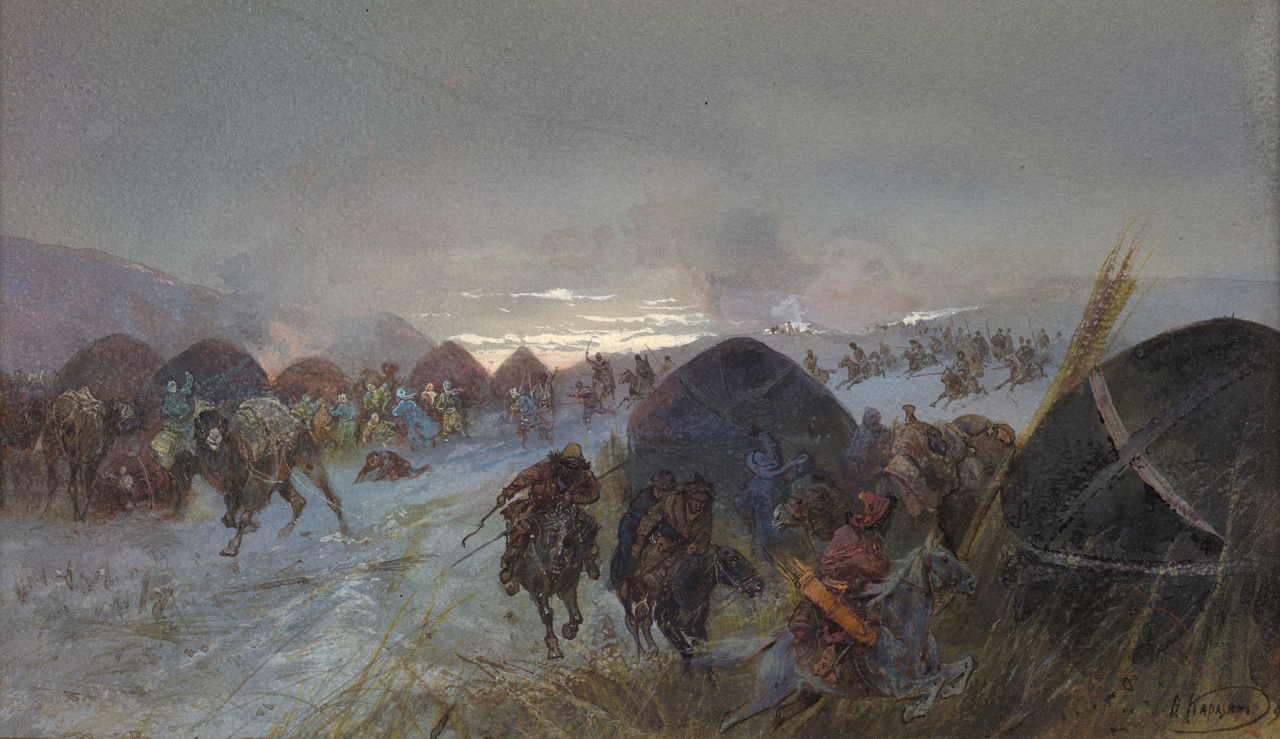
The Russian Conquest of Central Asia. The Russian conquest of Central Asia (1717-1895) turned the map of a continent: in a century and a half, the Tsar's armies absorbed the steppe of the Kazakh khans, the oasis khanates of Bukhara, Khiva, and Kokand, and the Turkmen desert - creating Russian Turkestan and bringing the Russian Empire to the borders of Afghanistan, Persia, and China. It was the Central Asian half of the Great Game.
The steppe came first. Through the 18th and 19th centuries Russia pushed its line of forts deeper into the Kazakh grasslands; the abolition of the Kazakh khanate in the 1820s provoked Kenesary Qasymuly's ten-year rebellion, crushed by 1847. Fort by fort - the Turgay, the Irgiz, Fort Raim on the Syr Darya - the Russians advanced, completing the Syr-Darya Line by 1864.
The main event followed at once: in 1864-1868 the Russians drove south into the settled zone. Tashkent fell in June 1865 after Chernayev's night storm of its walls; Samarkand followed in 1868. The Khanate of Kokand was penned into the Fergana Valley and annexed outright in 1876; the Emirate of Bukhara and the Khanate of Khiva survived only as Russian protectorates. The pattern was the same everywhere: Russian breech-loading rifles and artillery shattering armies many times their size.
The conquest ended in the 1880s-90s with the absorption of the Turkmen lands and the fixing of the Afghan frontier: Russia and Britain, rivals in the Great Game, agreed to leave Afghanistan as a neutral buffer between their empires. Russian rule was shaken but not broken by the great revolt of 1916, when the tsar's decree drafting Muslims for war labor provoked uprisings from the steppe to Fergana, suppressed with terrible violence. The conquest had created a new order - Russian Turkestan, with its railways, cotton and settler towns - that the fall of the empire itself would only reshape.
 Britannica: History of Central Asia - Russian Rule, Silk Road, Empires
 Encyclopaedia Iranica: KHIVA
 The Metropolitan Museum of Art: Central and North Asia, 1900 A.D.–present
 UNESCO Digital Library: History of Civilizations of Central Asia, Vol. 6: Towards the Contemporary Period