 Go Back

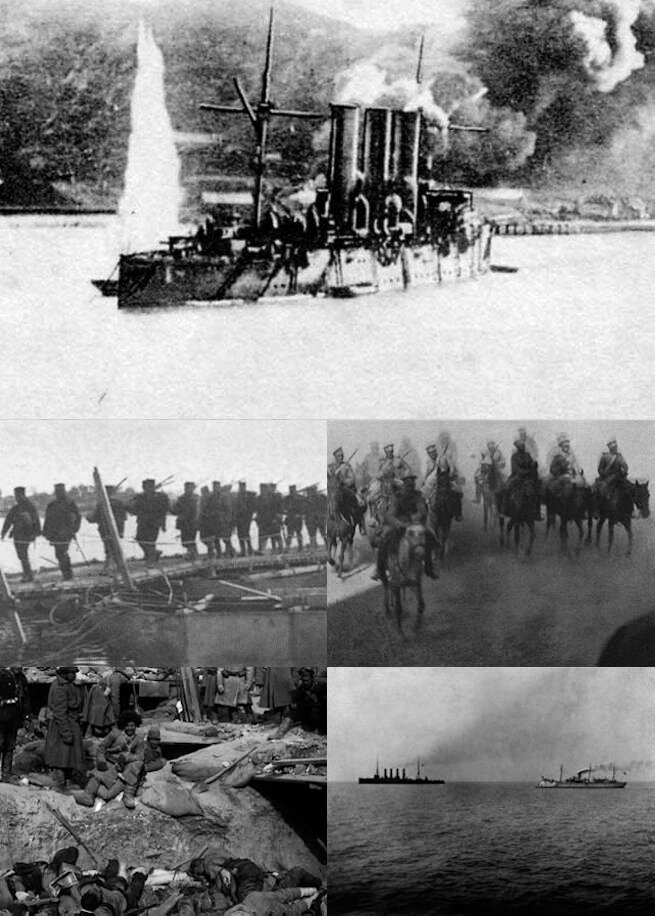
The Russo-Japanese War. The Russo-Japanese War (1904-1905) was the first modern victory of an Asian power over a European empire - and it reshaped the 20th century. Its cause was Manchuria and Korea: both empires' railways, troops and ambitions converged there, and after Russia refused to withdraw from Manchuria as promised and pressed into Korea, Japan - whose diplomacy had failed - struck without declaration, torpedoing the Russian fleet at Port Arthur on 8 February 1904.
The war was fought on a scale the world had not yet seen: the siege of Port Arthur, with its trench lines, machine guns and massed artillery - a preview of 1914 - cost Japan nearly 60,000 men before the fortress surrendered in January 1905. At Mukden (February-March 1905), over half a million men fought the largest battle yet in history to a Japanese victory. Russia's Baltic Fleet, after sailing 18,000 miles around the world, was annihilated in two days at Tsushima (May 1905) by Admiral Togo - losing 21 of 38 ships, one of the most decisive naval victories ever.
Exhausted Japan and revolution-shaken Russia accepted Theodore Roosevelt's mediation: the Treaty of Portsmouth (September 1905) gave Japan Port Arthur, the South Manchurian railway, half of Sakhalin - and a protectorate over Korea, annexed outright in 1910. Tokyo crowds rioted at the 'shameful' peace, which bore no indemnity.
The war's echoes were global: Russia's defeat ignited the 1905 Revolution at home; Japan emerged as the first non-Western great power, its victory electrifying nationalists from India to Egypt and Vietnam; and the Manchurian and Korean prizes fixed the course of Japanese expansion toward 1937 and 1941. Tsushima and Port Arthur remain case studies in every naval and military college.
 Britannica: Russo-Japanese War
Britannica: Treaty of Portsmouth
Britannica: Battle of Port Arthur