 Go Back

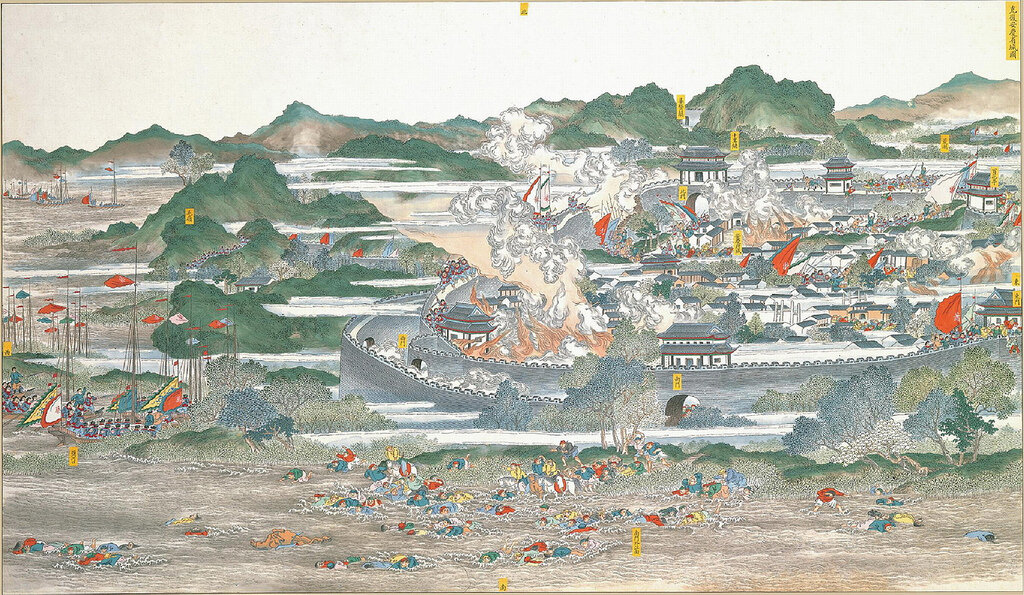
The Taiping Rebellion. The Taiping Rebellion (1850-1864) was the bloodiest war of the 19th century - twenty to thirty million dead - and very nearly destroyed China's Qing dynasty. Its founder, Hong Xiuquan, a failed examination candidate of Guangdong, read Christian tracts and concluded from his fever-visions that he was the younger brother of Jesus Christ, sent to cast down the Qing 'demons' and found the Taiping Tianguo, the 'Heavenly Kingdom of Great Peace'.
From its rising at Jintian (1851), the movement exploded: its God-worshipping converts - disciplined, unqueued, egalitarian in doctrine, communal in property - fought their way north and in 1853 took Nanjing, which Hong made his Heavenly Capital for eleven years. Taiping armies marched to within reach of Tianjin; their proclaimed new order promised land redistribution, equality of women (in principle), and the suppression of opium, footbinding and idolatry - while in practice the Heavenly Kingdom's leaders built palaces and destroyed each other in the horrific Tianjing purge of 1856, when the East King's court slaughtered tens of thousands.
The dynasty, its regular armies useless, was saved by new regional forces: Zeng Guofan's Xiang Army, raised by scholar-gentry to defend Confucian civilization against the Christian heresy, and Li Hongzhang's Huai Army, stiffened by Western-officered units like the 'Ever Victorious Army'. The Qing counterattack strangled the Taiping in the lower Yangzi; Nanjing fell in July 1864, Hong already dead, and the city's sack ended the kingdom.
The Taiping century-shadow is long: it broke the Qing's prestige and shifted power to the regional armies that became warlordism; it devastated China's richest provinces; and both Sun Yat-sen and the Communists later claimed Hong's revolutionary mantle. Its cost remains the benchmark of civil war's horror in Chinese memory.
 Britannica: Taiping Rebellion
Britannica: Hong Xiuquan
Britannica: Frederick Townsend Ward