 Go Back

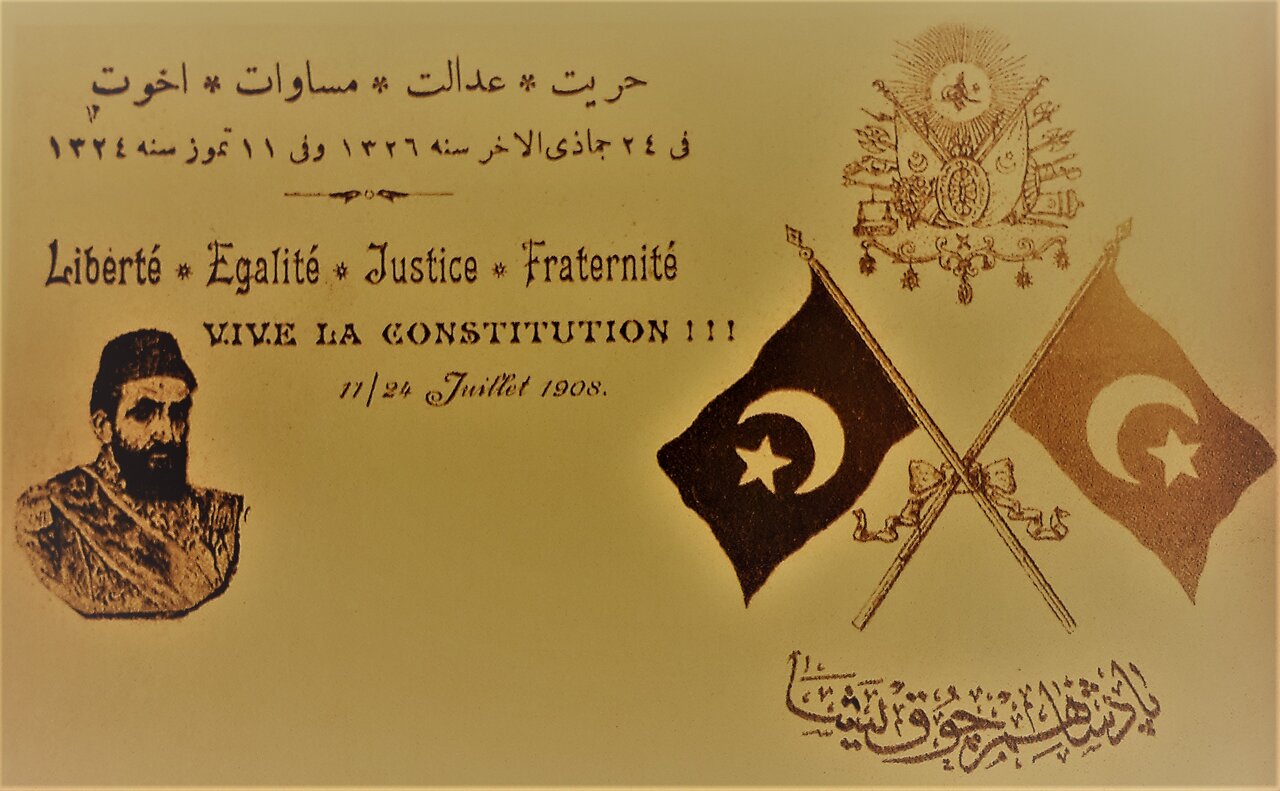
The Young Turks and the Second Constitutional Era. The Young Turk Revolution of July 1908 - army officers of the Committee of Union and Progress (CUP) forcing Sultan Abdulhamid II to restore the constitution he had suspended in 1878 - was greeted with delirious hope: Greeks, Armenians, Arabs, Jews and Turks embracing in the streets of the empire's cities, parliaments and parties reborn, 'liberty, equality, fraternity' the watchwords of the Second Constitutional Era (1908-1918).
The euphoria died fast. The counter-revolution of April 1909 brought Abdulhamid's deposition, but the CUP - after the Action Army restored order - hardened into power; the Italo-Turkish War (1911) cost Libya, the Balkan Wars (1912-1913) cost nearly all of Europe-in-Turkey, including Salonica, the CUP's home - a trauma that radicalized the triumvirate who seized full power in the January 1913 coup: Enver, the war minister and adventurer; Talaat, the interior minister; and Cemal, the navy minister.
The triumvirs led the empire into the First World War at Germany's side (October 1914), gambling for recovery - and presided over its destruction: the Gallipoli victory and the Kut triumph against Britain, but also the Sarikamish disaster, the Arab Revolt, and the Armenian Genocide (1915-1916), the CUP regime's deportation and massacre of a million Armenians - the defining crime of the era. By 1918 the empire was beaten on every front; the triumvirs fled (all three later assassinated by Armenian avengers), and the Mudros armistice opened the empire's partition.
The Young Turks' decade is the hinge of the modern Middle East: it destroyed the Ottoman ancien regime, pioneered mass politics and party dictatorship, perpetrated genocide - and created, in the ruins, the cadres and the trauma from which Ataturk's Turkish Republic and the Arab successor states alike emerged.
 Britannica: Young Turk Revolution
Britannica: Young Turks
Britannica: Bosnian crisis of 1908