 Go Back

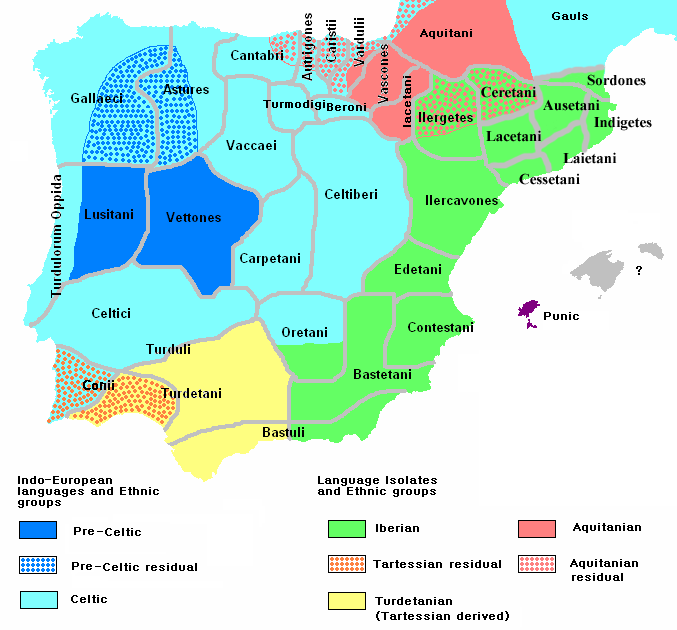
Celtiberian Iberia. The Celtiberians were the Celtic peoples of ancient Spain - tribes of the central Iberian plateau who blended Celtic and native Iberian stock into a culture of their own. Classical writers like Strabo called them Celts outright; their language, written in an adapted Iberian script, is now classified as a Celtic language, and hundreds of their inscriptions survive. From perhaps the 6th century BC they lived in walled hilltop towns (castros and oppida) across the upper valleys of the Tagus, Douro, and Ebro, ruled by a hereditary warrior aristocracy.
They were fighters above all. Celtiberian cavalry and swordsmen were famous - the Romans adopted the Celtiberian two-edged sword and the Spanish throwing spear (the lancea) - and Celtiberian warriors served as mercenaries across the Mediterranean. The dominant tribe, the Arevaci, led from the stronghold of Okilis, became the rallying point of resistance to Rome.
That resistance was ferocious and long. Rome conquered part of Celtiberia in 195 BC, but the tribes rose again and again - in 195-193, 181-179, 153-151, and 143-133 BC - in wars that cost Rome generations of soldiers. In 105 BC Celtiberian warriors even drove the Germanic Cimbri out of Spain. Not until 72 BC, after the Sertorian War, was the whole region finally pacified as part of the Roman province of Hispania Citerior.
Under Rome, Celtiberia Romanized - its towns became Roman cities, its language faded into Latin - but the fierce independence of the mountain tribes never quite died. The Celtiberians left Spain two enduring inheritances: a tradition of guerrilla resistance to empires, and place names and inscriptions that still mark the high meseta where they held out for over a century.
 Britannica: Celtiberian
 Livius: Appian, The Spanish Wars - Livius
 National Geographic: The 2,400-year-old Lady of Baza statue reveals insights into ancient Spain
 BBC: Irish - Tionchar na gCeilteach