 Go Back

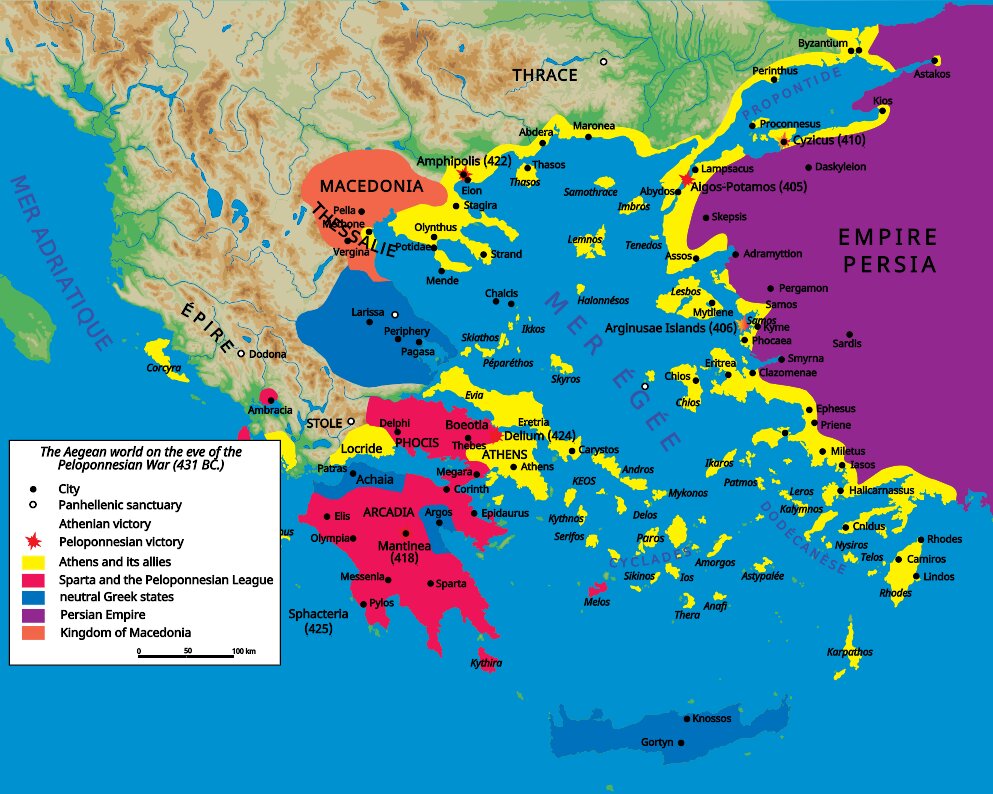
The Athenian Empire (478-404 BCE) grew out of the Delian League, a voluntary alliance of Greek city-states founded in 478 BCE on the island of Delos to continue the war against Persia after the victories of 480-479 BCE. Athens supplied most of the fleet and its generals, while allies contributed ships or, increasingly, annual payments of silver called phoros. Early campaigns under Cimon drove Persian forces from the Aegean and won a major victory at the Eurymedon River around 466 BCE, but Athens soon used league power against league members who tried to leave, turning allies into subjects.
The transformation into empire became unmistakable in 454 BCE, when the league treasury was moved from Delos to Athens. Athenian democracy under Pericles spent the tribute on the city's fleet, on pay for jurors and rowers, and on the great building program of the Acropolis, including the Parthenon. Athens installed garrisons and democratic governments, seized land for Athenian settlers called cleruchs, and required major legal cases of allies to be heard in Athenian courts. Control of the sea brought control of the grain routes from the Black Sea, on which Athens' large population depended.
Rivalry with Sparta and its Peloponnesian League broke into open conflict in 431 BCE, beginning the Peloponnesian War (431-404 BCE). Pericles' strategy avoided land battles with Sparta's superior hoplites and relied on the Long Walls and the fleet, but a plague in 430 BCE killed a large share of Athens' crowded population, including Pericles himself. After ten years of fighting, the Peace of Nicias (421 BCE) gave only a pause. In 415 BCE Athens launched a huge expedition against Syracuse in Sicily, which ended in 413 BCE with the destruction of the entire armada, the war's decisive disaster.
Persian money then rebuilt Sparta's fleet, while Athens' empire began to revolt. Under the general Lysander, Sparta won at Aegospotami in 405 BCE, destroying the last Athenian fleet, and starved Athens into surrender in 404 BCE. The empire was dissolved, the Long Walls demolished, and a Spartan-backed oligarchy, the Thirty Tyrants, briefly ruled the city. Democracy was restored within a year, and Athens later rebuilt much of its naval power through the Second Athenian League of 377 BCE, but it never again dominated Greece. The war weakened all the city-states and opened the way first to Spartan, then Theban, and finally Macedonian hegemony.
 Britannica: Delian League
Britannica: Peloponnesian War
 World History Encyclopedia: Peloponnesian War