 Go Back

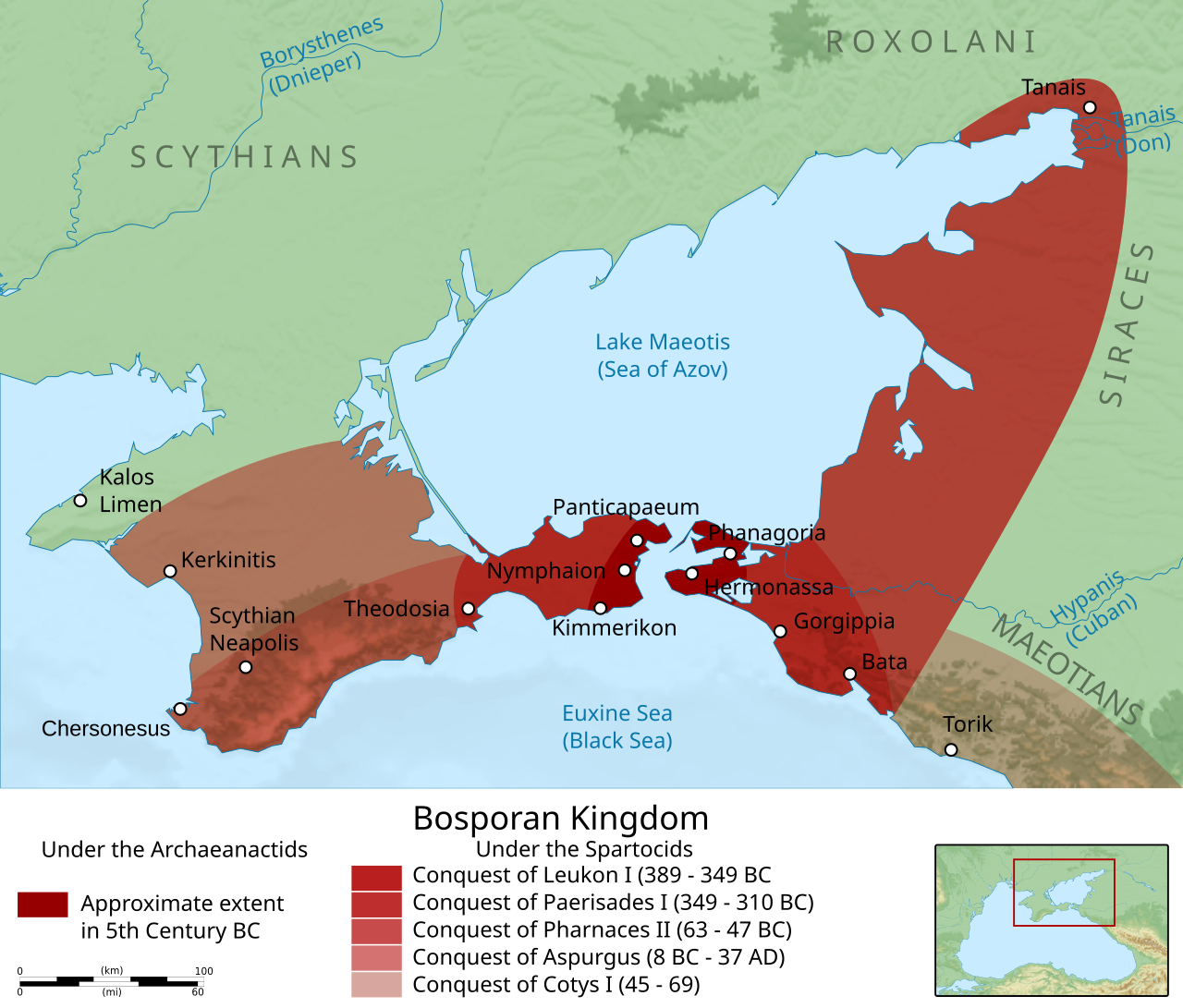
The Bosporan Kingdom. The Bosporan Kingdom was the ancient world's northern frontier - a Greco-Scythian state on the straits of Kerch, between Crimea and the Taman Peninsula, that survived for nearly a thousand years (c. 438 BC - c. AD 527), longer than almost any state of classical antiquity. It grew out of Greek colonies like Panticapaeum that had planted themselves on the Black Sea to tap the riches of the steppe.
Under the Spartocid dynasty the kingdom took its distinctive double nature: its rulers called themselves archons (elected magistrates) to their Greek citizens and kings to their Scythian subjects - a fusion some historians call the first truly Hellenistic state. Its wealth rested on the export of wheat, fish, and slaves: Bosporan grain fed the cities of Greece, and the kingdom was dubbed 'the Jewel of the Black Sea.' Its rich Greek cities - Panticapaeum above all, but also Phanagoria, Nymphaeum, and Gorgippia - ringed the straits on both shores.
Its kurgans - the burial mounds of its Greco-Sarmatian elite - have yielded some of the most spectacular goldwork of the ancient world, now the glory of the Hermitage Museum: Greek vases, Scythian gold, and jewelry showing how completely Greek and steppe cultures had merged on this frontier.
From 63 BC the Bosporan kingdom survived as Rome's longest-lived client kingdom, enjoying a new golden age in the 1st and 2nd centuries AD; King Sauromates II even crushed the Scythians and took all Crimea. It endured the Goths and outlasted the Western Empire before fading in the age of the Huns - a Greek city-world that held the edge of the steppe for a millennium.
 Britannica: Kingdom of the Bosporus
 British Museum: Collections Online
 Encyclopaedia Iranica: SCYTHIANS
Britannica: Kingdom of the Bosporus