 Go Back

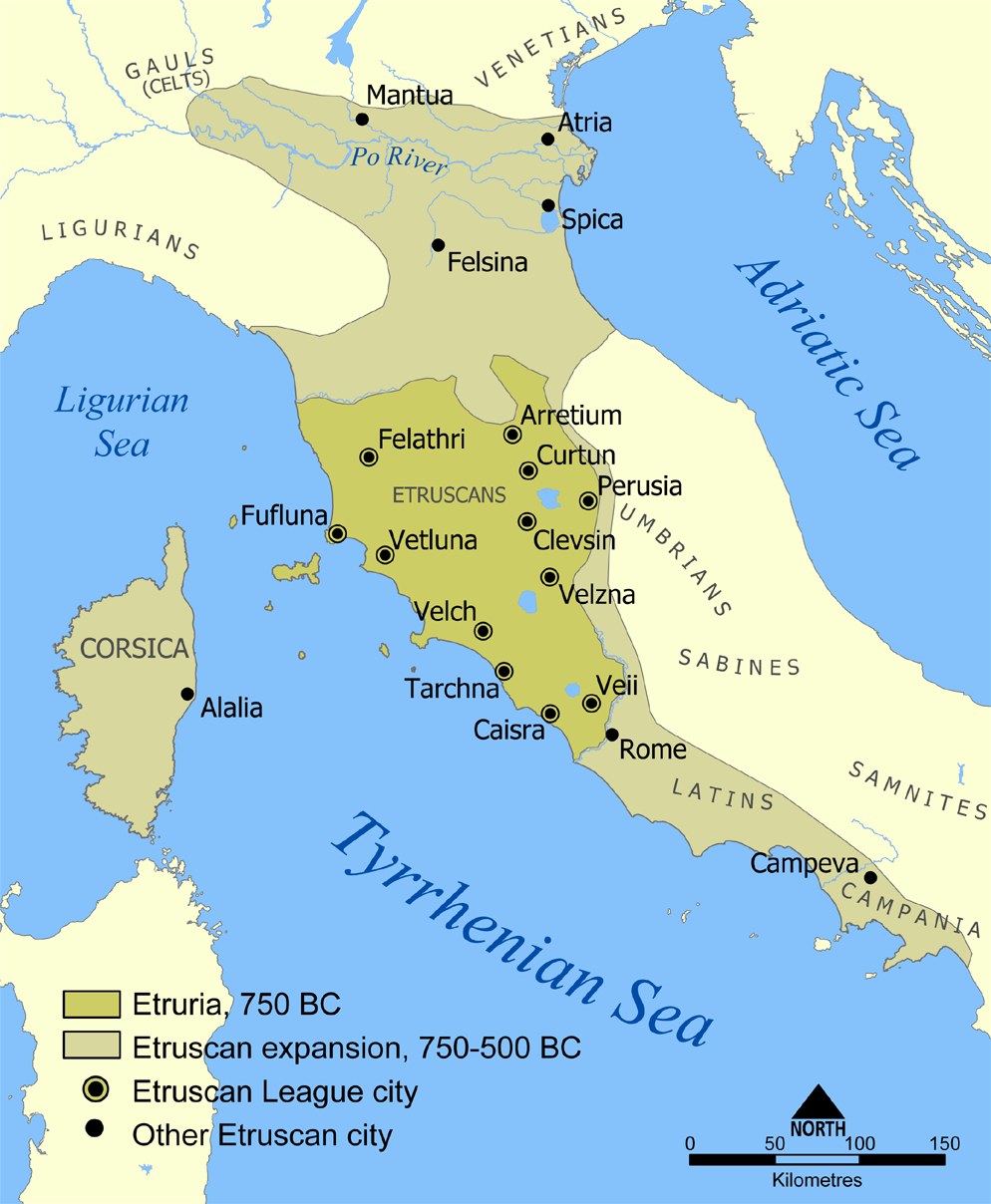
The Etruscans. The Etruscans were ancient Italy's first great civilization - the sophisticated, mysterious people who ruled central Italy before Rome and taught the Romans much of what they knew. From about 900 BC, out of the local Iron Age Villanovan culture, a distinctive Etruscan civilization grew up in Etruria - roughly modern Tuscany, whose very name comes from them - organized not as an empire but as a league of rich, rival city-states: Tarquinia, Veii, Cerveteri, Vulci, and others.
At their height around 500 BC, the Etruscans dominated Italy from the Po Valley to Campania, and even ruled Rome itself - Rome's last kings, the Tarquins, were Etruscan. Their merchants traded with Greeks and Celts, their sailors commanded the Tyrrhenian Sea (which still bears their Greek name), and their elites filled painted family tombs with imported luxuries. They wrote in an alphabet borrowed from the Greeks - yet their language, unrelated to any other in Europe, is still only partly understood, so we see them mostly through their dazzling tombs and through hostile Roman sources.
Rome learned from them and then devoured them. From the Etruscans Rome took the arch, the gladiatorial games, religious divination, the symbols of magistrates' power - and, some say, the toga. But beginning in the late 4th century BC, in the long Roman-Etruscan Wars, the cities fell one by one; by 90 BC the Etruscans were Roman citizens, and by the time of Augustus their language was dying.
The Etruscans vanished into Rome so completely that their own literature is lost. But their influence never died: they stand behind Roman religion, engineering, and statecraft - and so behind the whole Roman Empire. Tuscany's painted tombs remain our window onto the people who made Rome possible.
 Britannica: Ancient Italic people
 World History Encyclopedia: Etruscan Civilization
 Humanities LibreTexts: 2.1: The Etruscans, an introduction
 Livius: Etruscans - Livius