 Go Back

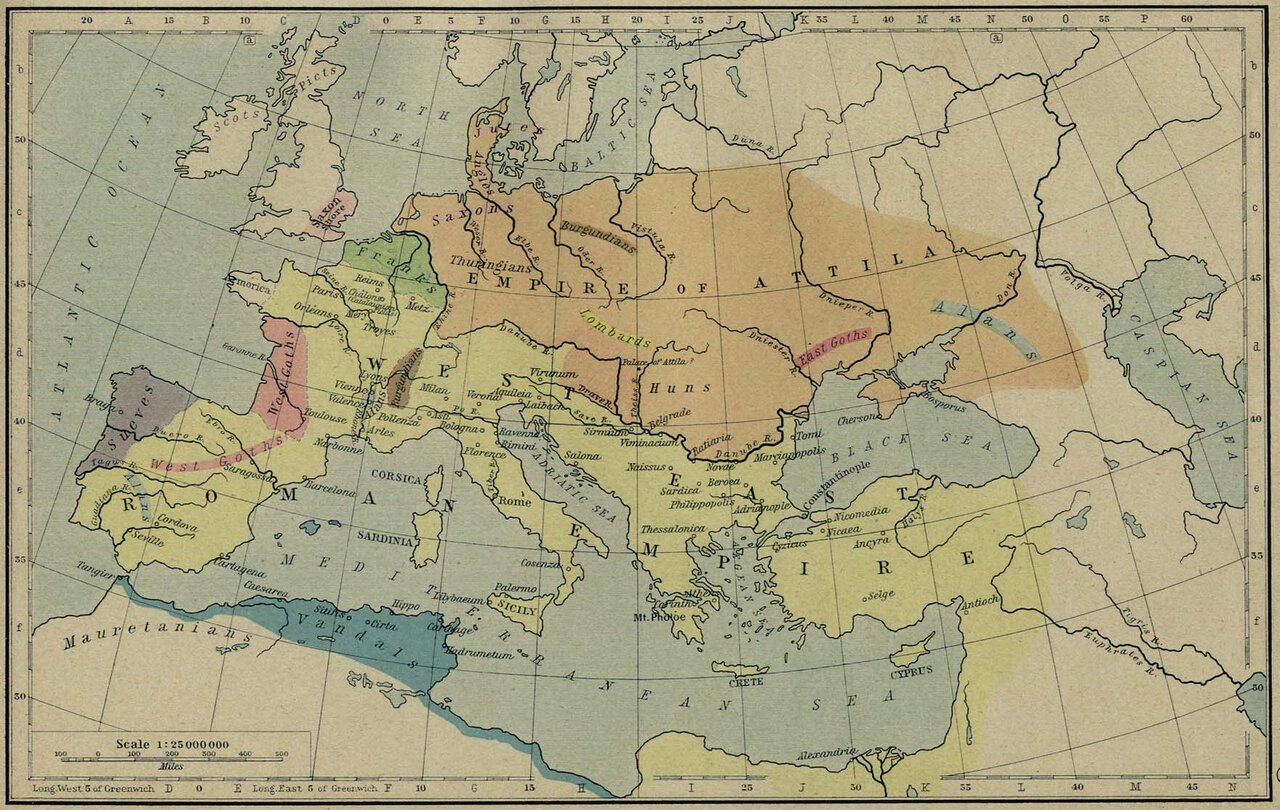
The Huns (c. 370-469 CE) were a nomadic people of the Eurasian steppe who burst into European history around 370 CE, when they crossed the Volga, crushed the Alans, and defeated the Gothic kingdom of Ermanaric near the Dniester. Mounted archers raised in the saddle, they moved with herds and wagons and fought with the powerful composite bow, striking at a speed settled peoples could not match. Their origin is debated: some scholars link them to the Xiongnu of the Chinese sources, others see a new steppe confederation, and their language remains unknown. Their advance pushed Goths, Vandals and other peoples across Rome's frontiers, setting the age of migrations in motion.
For two generations the Huns operated as raiders and as mercenaries for hire by both Romans and their enemies, while subjugating the peoples between the Black Sea and Central Europe. Under King Rua they began extracting regular tribute from the Eastern Roman Empire. In 434 CE power passed jointly to his nephews Bleda and Attila, who soon forced Constantinople to triple its payments. After Bleda's death around 445, Attila ruled alone over an empire stretching from the Caspian to the Rhine, demanding gold, fugitives and market access with the threat of war.
Attila's wars reached their peak in the 440s and early 450s. His armies ravaged the Balkans in 441-443 and 447, destroying cities and advancing to Constantinople's walls, though they never took the city's defenses by storm. In 451 he invaded Gaul, besieging Orleans, before a coalition of Romans under Aetius and Visigoths under Theodoric I met him on the Catalaunian Fields; after enormous slaughter on both sides the Huns withdrew, the only major check Attila suffered. The next year he invaded Italy, sacked Aquileia and Milan, and turned back short of Rome after disease, hunger and an embassy led by Pope Leo I.
Attila died suddenly in 453 CE, on the night of his wedding to a new bride, reportedly from a hemorrhage. His many sons divided the empire and fell to quarreling, and in 454 their subject peoples, led by the Gepid king Ardaric, destroyed Hunnic power at the battle of the Nedao. The remnants were absorbed or pushed back to the Pontic steppe within a generation. The Huns left few monuments and no writings, but their impact was enormous: they shattered the balance of power on Rome's frontiers, accelerated the collapse of the Western Empire, and entered legend from the Nibelungenlied to Hungarian tradition as the archetype of the steppe conqueror.
 Britannica: Hun
 World History Encyclopedia: Huns
World History Encyclopedia: Attila the Hun