 Go Back

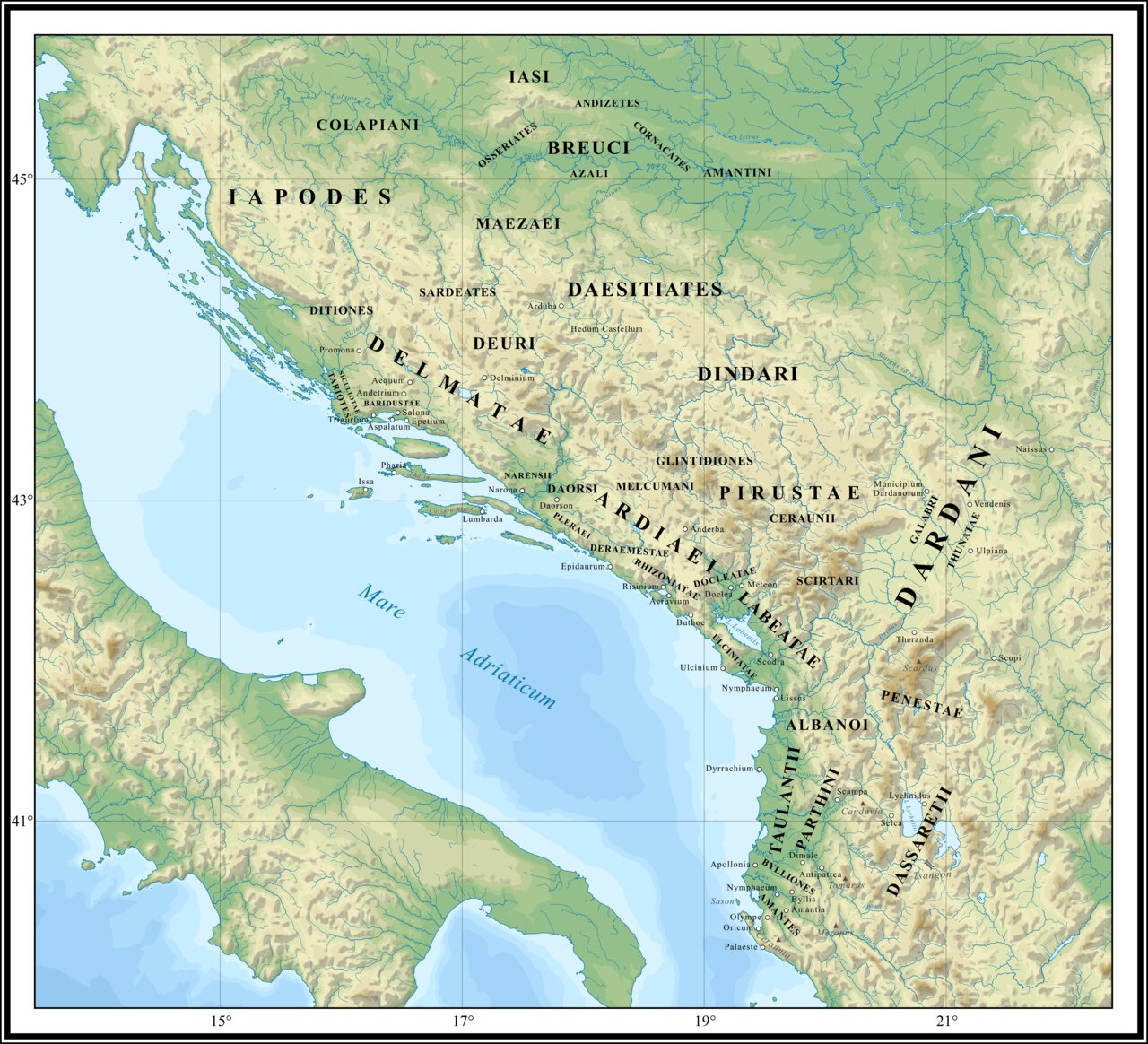
The Illyrians (c. 1000 BCE-168 BCE) were a group of related Indo-European peoples who occupied the western Balkans, from the Danube basin down the Adriatic coast to Epirus. Ancient writers used 'Illyrian' loosely for many tribes, including the Ardiaei, Dardani, Taulantii, Liburni, Dalmatae and Pannonii, who shared languages and customs but never formed a single nation. They lived in hilltop settlements, raised livestock, mined silver and iron, and were famed as warriors and sailors. Greek colonists founded trading towns such as Epidamnus and Apollonia on their coasts in the 7th-6th centuries BCE, through which Greek goods, coins and ideas entered the interior.
From the 5th century BCE some tribes formed short-lived kingdoms. Bardylis of the Dardani defeated the Macedonians and Molossians around 393 BCE and seized parts of upper Macedonia before Philip II crushed the Illyrians in 358 BCE, securing his kingdom's western frontier. Further south, King Agron of the Ardiaei built the strongest Illyrian state in the 3rd century BCE, with a fleet of light, fast galleys called lembi that raided and traded across the Adriatic. His widow Queen Teuta continued the attacks on Italian shipping, which brought her into direct collision with Rome.
Rome's First Illyrian War (229-228 BCE) broke Teuta's power, and the Second (219 BCE) drove out her successor Demetrius of Pharos, giving Rome a protectorate over the Illyrian coast. The kingdom revived under Genthius, who allied with Macedon during the Third Macedonian War; in 168 BCE a Roman praetor captured him at Scodra, and Rome split the Illyrian kingdom into three client republics. Repeated rebellions followed until, after hard campaigns in 35-33 BCE and the Great Illyrian Revolt of 6-9 CE, the whole region became the Roman provinces of Dalmatia and Pannonia.
Under Rome the Illyrians were heavily Romanized: soldiers recruited in the Balkans rose to command armies, and several 3rd-century emperors, including Claudius II, Aurelian, Probus and Diocletian, who retired to a vast palace at Split, were of Illyrian origin. Latin displaced native speech along the coast and in the towns, while older languages survived longer in the mountains. Linguists long linked the Illyrians to the later Albanians, though the exact relationship remains debated. Their hillforts, tumulus graves, silver coinage and distinctive helmets still mark the archaeology of the western Balkans.
 Britannica: Illyria
 World History Encyclopedia: Illyria - Exploring Ancient Albania