 Go Back

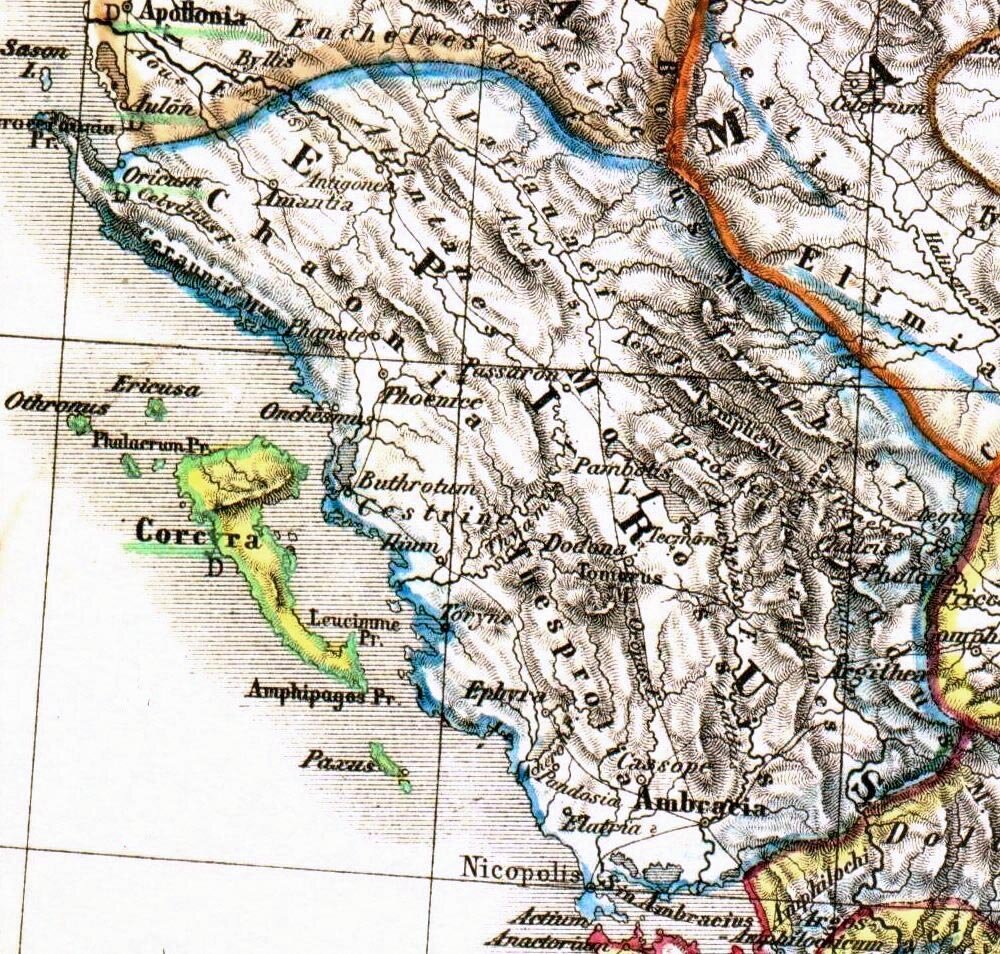
The Kingdom of Epirus occupied the mountainous northwest of Greece, facing Italy across the narrowest stretch of the Adriatic. Its tribes, including the Molossians, Thesprotians and Chaonians, spoke Greek and worshipped at Dodona, home of the famous oracle of Zeus, whose priests interpreted the rustling of a sacred oak. Long organized in loose tribal leagues, Epirus was unified as a kingdom around 430-370 BCE under the Molossian dynasty, which traced its descent from Achilles. King Alexander I (342-331 BCE) expanded his power and died campaigning in Italy, and his sister Olympias married Philip II of Macedon and became the mother of Alexander the Great.
Epirus' most famous ruler was Pyrrhus (reigned 307-302 and 297-272 BCE), a brilliant, restless general trained in the wars of Alexander's successors. Twice driven from his throne, he fought in Egypt and Greece, and in 280 BCE answered the call of Tarentum to lead the Greek cities of Italy against Rome. At Heraclea (280) and Asculum (279) he beat the legions with war elephants and his elite phalanx, but his heavy losses, 'another such victory and we are undone', gave the world the phrase 'Pyrrhic victory'. He then campaigned in Sicily against Carthage (278-276) with initial success before Greek allies turned against him, and returned to Italy only to be checked by Rome at Beneventum in 275 BCE.
Back home Pyrrhus seized much of Macedonia and died in 272 BCE in a street fight in Argos, struck down, the story says, by a roof tile thrown by an old woman. His wars exhausted Epirus, and the monarchy declined through the 3rd century. Around 232 BCE the Epirotes abolished the kingship and reorganized as a federal republic, the Epirote League, governed by elected officials. Caught between Rome and Macedon, the league made the fatal choice of siding with Perseus of Macedon.
When Rome destroyed Macedon at Pydna in 168 BCE, the Senate punished Epirus savagely: Aemilius Paullus' troops systematically sacked seventy towns and carried off, by the ancient account, 150,000 people into slavery. The region never recovered its old importance. Under the Empire, Epirus was a quiet province, though Octavian founded the new city of Nicopolis near Actium to celebrate his victory of 31 BCE. The Epirote example still stood as a warning of what happened to Greek states that chose the wrong side, and Pyrrhus remained the model of the general whose victories cost more than defeats.
 Britannica: Epirus
Britannica: Pyrrhus
 World History Encyclopedia: Pyrrhus