 Go Back

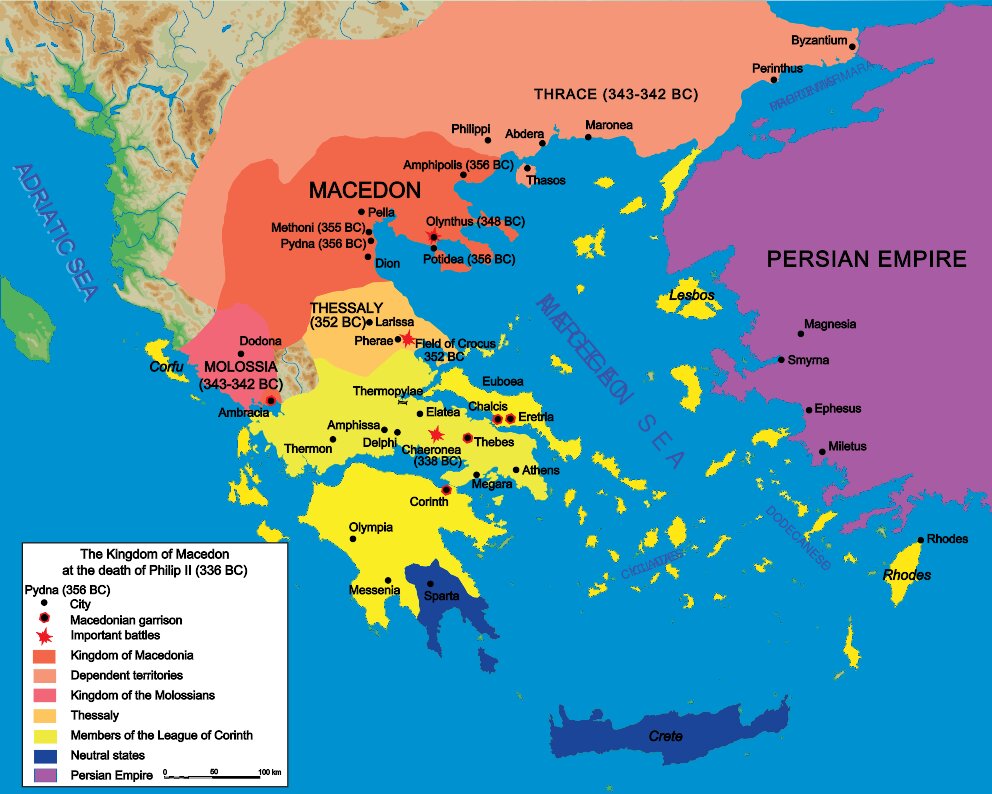
The Kingdom of Macedon (c. 700-168 BCE) occupied the plains and mountains north of classical Greece, ruled by the Argead dynasty, which claimed descent from Argos. Long a frontier kingdom of herders and warriors, Macedon was drawn into Greek affairs by kings such as Archelaus, who moved the court to Pella and patronized Greek artists. Real power came with Philip II (reigned 359-336 BCE), who created a professional army built around the sarissa phalanx and companion cavalry, seized gold-rich Mount Pangaeum, and used war, diplomacy and marriage to dominate Thessaly, Thrace and the Greek cities.
After defeating Athens and Thebes at Chaeronea in 338 BCE, Philip organized the League of Corinth, a Greek alliance under Macedonian leadership, and prepared an invasion of the Persian Empire. He was assassinated in 336 BCE, and his twenty-year-old son Alexander III inherited the project. In thirteen years Alexander conquered Asia Minor, Egypt, Syria, Mesopotamia and Persia itself, reaching the Indus before his army refused to go further. When he died at Babylon in 323 BCE without an adult heir, he left the largest empire the Mediterranean world had seen, and no plan for holding it together.
Alexander's generals, the Diadochi or 'Successors', fought more than forty years of wars over his inheritance. Infantry and fleet, treasury and even the king's corpse became weapons in their struggles, which ended the Argead line entirely. By the settlement reached after the battle of Ipsus in 301 BCE, three great Hellenistic kingdoms had crystallized: the Antigonids in Macedon and Greece, the Ptolemies in Egypt, and the Seleucids in Asia. In these courts Greek became the language of government and culture from the Nile to Central Asia, and cities such as Alexandria, Antioch and Pergamon became centers of learning, trade and royal patronage.
Macedon itself recovered under Antigonus II Gonatas, who secured the throne in 276 BCE and gave the kingdom a stable dynasty. Antigonid kings ruled through alliances and garrisons in Greece while fending off Celtic invasions and Illyrian raiders. Conflict with expanding Rome proved fatal: Philip V was defeated at Cynoscephalae in 197 BCE, and his son Perseus lost the kingdom at Pydna in 168 BCE. Rome abolished the monarchy and divided Macedon into four republics, and after the revolt of Andriscus it became a Roman province in 146 BCE. Macedon's legacy endured in the Hellenistic kingdoms, whose Greek-speaking courts shaped the eastern Mediterranean for centuries.
 Britannica: Macedonia
Britannica: Hellenistic age
 World History Encyclopedia: Wars of the Diadochi