 Go Back

The Late Roman Empire began with Diocletian (reigned 284-305 CE), who pulled the state out of the crisis of the third century by reorganizing the army, provinces and taxation, and by sharing power in the tetrarchy, a system of two senior and two junior emperors. Constantine I (306-337) reunited the empire, granted Christians legal toleration in 313, and founded Constantinople in 330 as a new capital on the Bosporus. The late empire was still populous and wealthy, but it faced persistent pressure on the Rhine, Danube and Persian frontiers, and civil wars repeatedly diverted the field armies that guarded them.
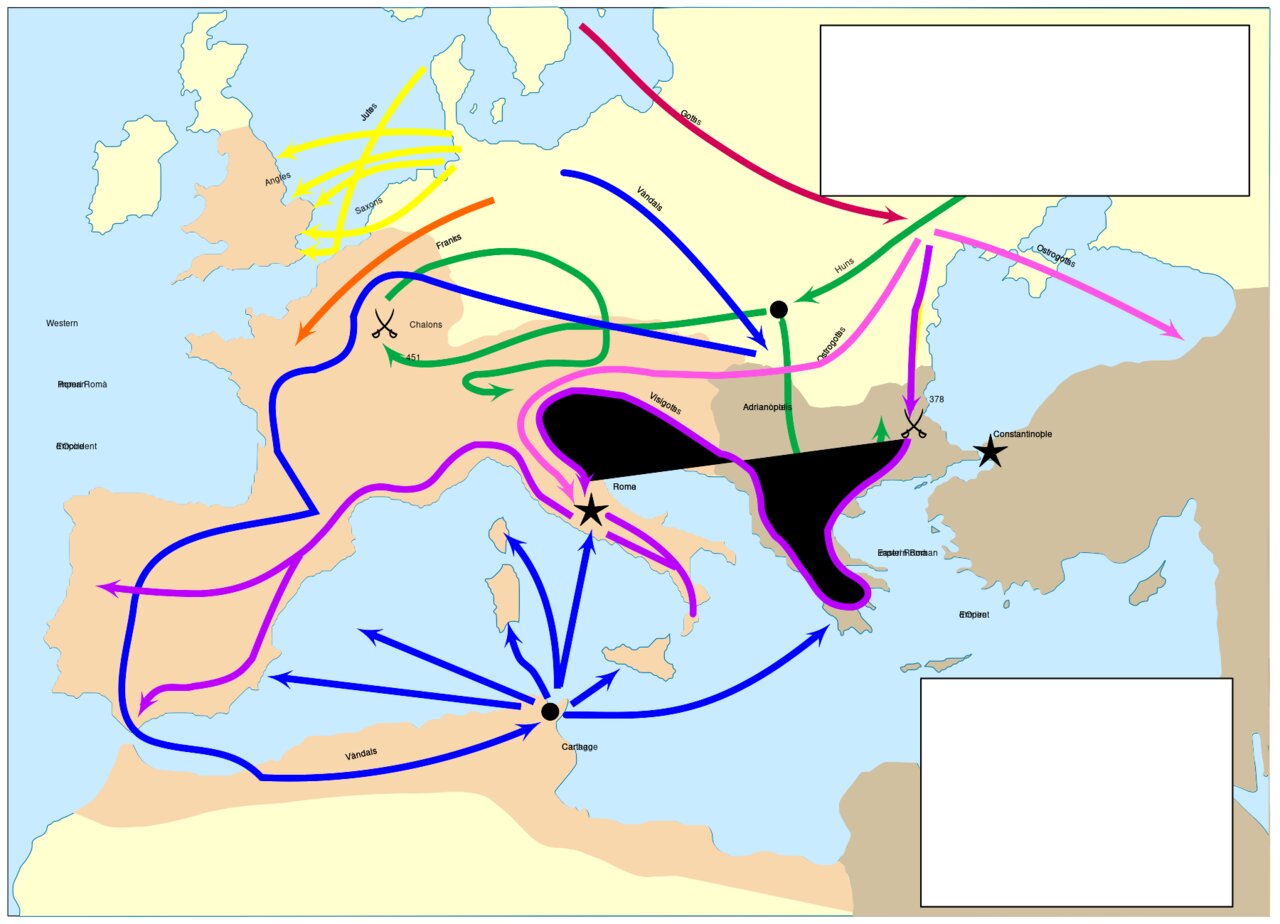
In 376 CE the Goths, fleeing the Huns, were admitted across the Danube by the eastern emperor Valens; mistreated by Roman officials, they revolted and destroyed Valens and his army at Adrianople in 378, a shock from which Roman prestige never fully recovered. From 395 the empire was permanently administered in eastern and western halves. Germanic commanders rose to dominate western politics, and on the last night of 406 Vandals, Suebi and Alans crossed the frozen Rhine and devastated Gaul. In 410 the Visigoths under Alaric sacked Rome itself, and the western court at Ravenna survived largely by bargaining with the warlords who now commanded its armies.
During the fifth century the western provinces were carved into successor kingdoms. The Visigoths settled in Aquitaine and then conquered most of Spain; the Vandals under Genseric crossed to Africa in 429, took Carthage in 439 and built a fleet with which they sacked Rome in 455; the Burgundians and Franks divided Gaul; Angles, Saxons and Jutes occupied a Britain abandoned by the legions. Attila's Huns extracted tribute from both halves of the empire before his death in 453. Emperors in the west became puppets of Germanic generals such as Ricimer, while the east, richer and better defended, held its own.
In 476 CE the general Odoacer deposed the young western emperor Romulus Augustulus and sent the imperial regalia to Constantinople, ruling Italy in the eastern emperor's name. The date conventionally marks the end of the Western Roman Empire, though contemporaries saw Odoacer's Italy and the new kingdoms as still belonging to a Roman world. The Eastern Roman, or Byzantine, Empire survived another thousand years, reconquering Italy, Africa and parts of Spain under Justinian in the 6th century. The barbarian successor kingdoms, meanwhile, preserved much Roman law, administration and Christian culture, and became the foundations of medieval Europe.
 Britannica: Barbarian invasions
Britannica: Byzantine Empire
Britannica: Ancient Rome