 Go Back

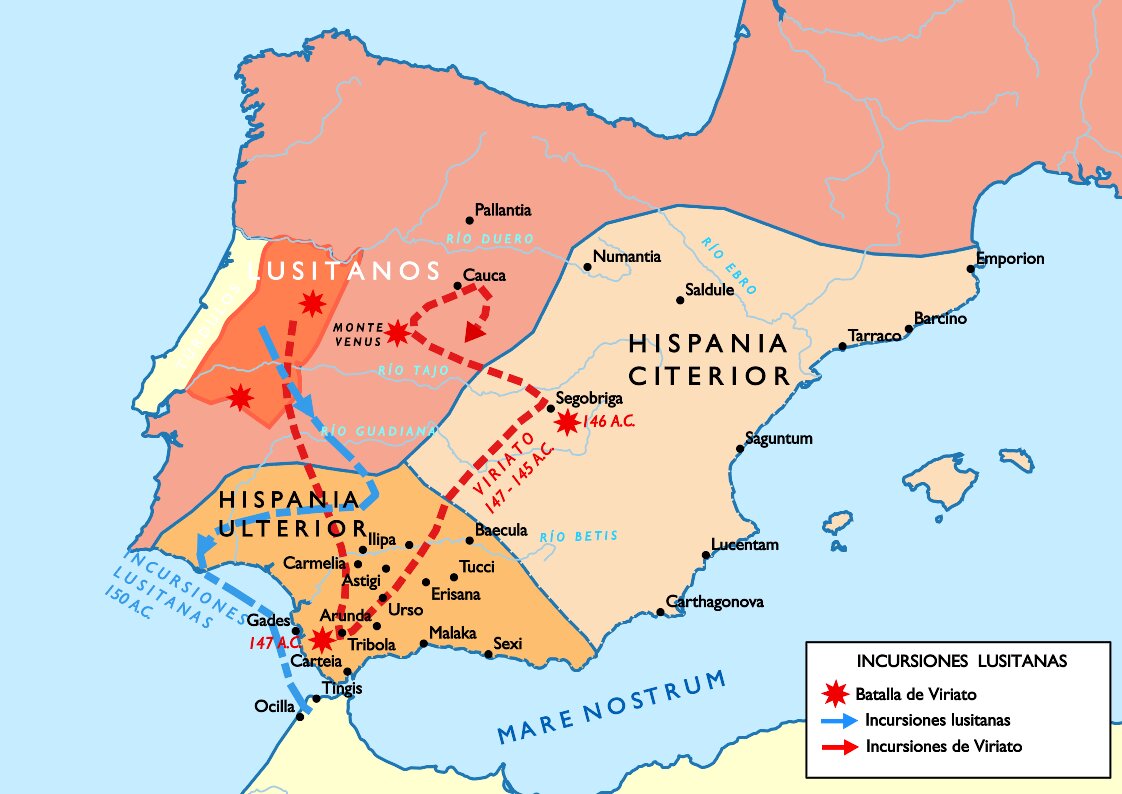
The Lusitanian Wars (155-139 BCE) were a series of hard-fought campaigns between the Roman Republic and the Lusitani, a collection of tribes living west of the Tagus in what is now Portugal. Rome had been in Iberia since the Second Punic War, and its governors squeezed the mountain peoples with raids, tribute demands and land seizures. The Lusitani, cattle-herders and fighters organized in war bands, answered with guerrilla tactics: ambushes in the passes, sudden descents on Roman columns, and rapid dispersal into rough country where heavy legions could not follow.
Open war began in 155 BCE when the Lusitani defeated two Roman armies and crossed into Baetica. Their greatest leader emerged in 147 BCE: Viriathus, a shepherd and hunter who had survived the treacherous massacres ordered by the praetor Galba in 150 BCE. A gifted guerrilla commander, Viriathus won victory after victory over eight years, defeating five Roman commanders, seizing towns, and extending the war across central Iberia by inspiring the Celtiberians to rise as well. At Tribola he trapped a consular army, and Rome was humiliated into recognizing him in 141 BCE as 'a friend and ally of the Roman people'.
That peace was the work of the consul Fabius Maximus Servilianus, whom Viriathus had trapped and then released after negotiating terms. The Roman Senate, however, refused to accept an equal treaty with a guerrilla leader. Fabius' brother and successor, Quintus Servilius Caepio, resumed the war, pressed the Lusitani hard, and finally bribed three of Viriathus' own companions, Audax, Ditalcus and Minurus, to murder their leader in his sleep in 139 BCE. The story goes that when the killers claimed their reward, they were told that Rome did not pay traitors.
Leaderless, the Lusitani surrendered, and Caepio deported survivors to settled communities where they could be watched. The Celtiberian resistance lasted until the fall of Numantia in 133 BCE, and the far northwest was not subdued until Augustus' Cantabrian Wars ending in 19 BCE. Rome then organized the territory as the province of Lusitania, with its capital at Emerita Augusta (Merida). Viriathus became Iberia's enduring symbol of resistance: Roman historians themselves praised his justice, austerity and leadership, and later Portuguese and Spanish tradition honored him as a national hero before either nation existed.
 Britannica: Viriathus
 World History Encyclopedia: Viriathus