 Go Back

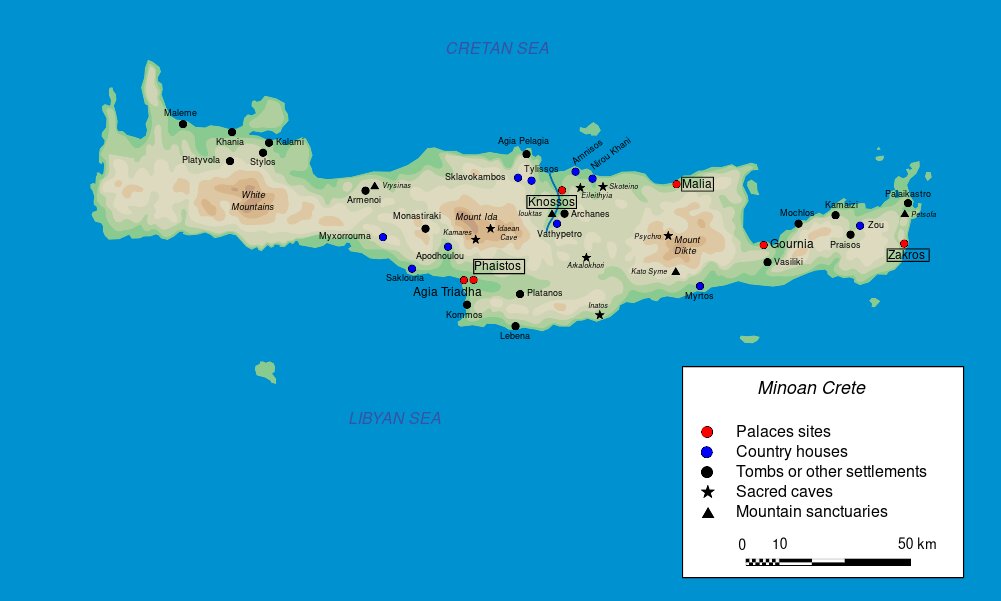
The Minoan civilization (c. 3100-1100 BCE) was Europe's first major literate-age civilization, centered on the island of Crete in the southern Aegean. Named by the archaeologist Arthur Evans after the legendary King Minos, it emerged from farming communities settled on Crete in the Neolithic period and grew into a network of palace-centered towns. Around 1900 BCE the first great palaces appeared at Knossos, Phaistos, Malia and Zakros, marking what scholars call the First Palace Period. The Minoans developed writing systems known as Cretan hieroglyphic and Linear A, which remain largely undeciphered, so their history is reconstructed mostly from archaeology.
Palace society reached its height between about 1700 and 1450 BCE. The rebuilt palaces were large multi-storey complexes with storage magazines, workshops, ceremonial courts and advanced drainage, decorated with vivid frescoes of processions, plants, animals and bull-leaping. The palaces acted as economic hubs: scribes recorded harvests, herds and craft production, and storerooms held grain, oil and wine. Minoan traders ranged across the eastern Mediterranean, exchanging pottery, textiles and metals with Egypt, Syria, Cyprus and the Greek mainland, and Cretan goods and styles spread widely through the Aegean islands.
Minoan religion centered on a principal goddess or goddesses associated with nature, animals and household cult, worshipped at peak sanctuaries, sacred caves and palace shrines. The double axe and the bull were central symbols, and bull-leaping appears both in art and, apparently, in ritual sport held in the palace courts. Society seems to have been comparatively peaceful: Minoan towns lacked heavy fortifications, and art emphasizes ceremony, sport and seafaring rather than warfare. Workshops produced fine stone vases, seal stones, gold jewelry and elegant pottery such as Kamares ware, admired and imitated abroad.
Around 1450 BCE most Minoan palaces and towns were destroyed, a catastrophe still debated by scholars. The huge eruption of Thera (Santorini), dated to the later 16th century BCE, damaged Crete's northern coast and shipping, and may have weakened the palaces, but it did not end the civilization by itself. After 1450 BCE, Greek-speaking Mycenaeans took over Knossos and much of the island, keeping palace records in Linear B, an early form of Greek. Knossos finally collapsed around 1200-1100 BCE amid the wider Bronze Age crisis, but Minoan craftsmanship, religion and seafaring strongly shaped later Greek culture.
 Britannica: Minoan civilization
 World History Encyclopedia: Minoan Civilization
World History Encyclopedia: Minoan Art