 Go Back

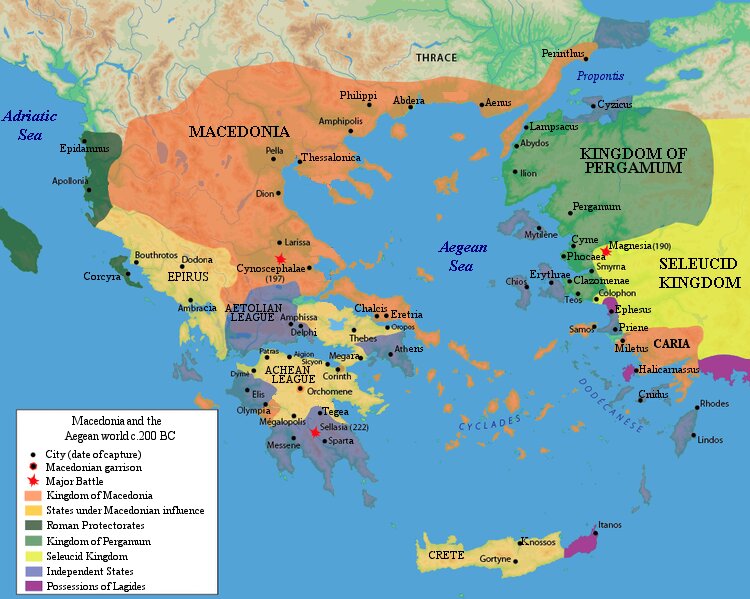
Rome's entanglement with the Greek world (280-31 BCE) began in Italy itself, where Greek colonies of Magna Graecia had flourished for centuries. When Rome pressured the city of Tarentum, its people called in King Pyrrhus of Epirus, who defeated Roman armies at Heraclea (280 BCE) and Asculum (279 BCE) at such cost that his victories became proverbial. Pyrrhus withdrew in 275 BCE, and by 272 BCE Tarentum fell, giving Rome control of the Greek south of Italy. The Punic Wars then made Rome master of Sicily, its first province, with the Greek city of Syracuse captured in 212 BCE despite the defenses devised by Archimedes.
Rome next intervened across the Adriatic, where the Antigonid kings of Macedon and the leagues of Greece struggled for advantage. Philip V of Macedon had allied with Hannibal, and Rome answered with the Second Macedonian War: at Cynoscephalae in 197 BCE the Roman legion under Titus Quinctius Flamininus broke the Macedonian phalanx. Flamininus theatrically declared the 'freedom of the Greeks' at the Isthmian Games of 196 BCE, and Rome defeated the Seleucid king Antiochus III at Magnesia in 189 BCE, forcing him from Asia Minor. Yet Rome's protector role steadily hardened into domination as Greek states appealed to it in their quarrels.
In 171 BCE war resumed against Philip's son Perseus, whose defeat at Pydna in 168 BCE ended the Macedonian monarchy. Rome deported a thousand leading Achaeans, including the historian Polybius, and grew impatient with Greek politics. When the Achaean League fought Sparta and defied Roman orders, a Roman army under Lucius Mummius crushed it and destroyed Corinth in 146 BCE, the same year Carthage fell; Greece was placed under the oversight of the governor of Macedonia. The rich kingdom of Pergamon was willed to Rome in 133 BCE and became the province of Asia, and by the 1st century BCE the whole Aegean paid Roman taxes.
Greece suffered again as a theater of Rome's civil wars: Sulla sacked Athens in 86 BCE after it sided with Mithridates VI of Pontus, and the battles of Pharsalus (48 BCE), Philippi (42 BCE) and finally Actium (31 BCE), off the Greek coast, decided the fate of the Republic. Yet conquest reversed culturally. Greek language, literature, philosophy, art and education captivated the Roman elite, who studied in Athens and staffed their households with Greek teachers and doctors. The poet Horace summed it up: captive Greece captured her savage conqueror. Under the Empire, Greece became the peaceful province of Achaea, its cities honored as the wellsprings of classical culture.
 Britannica: Ancient Rome
 World History Encyclopedia: Achaean League
Britannica: Macedonia
World History Encyclopedia: Titus Quinctius Flamininus