 Go Back

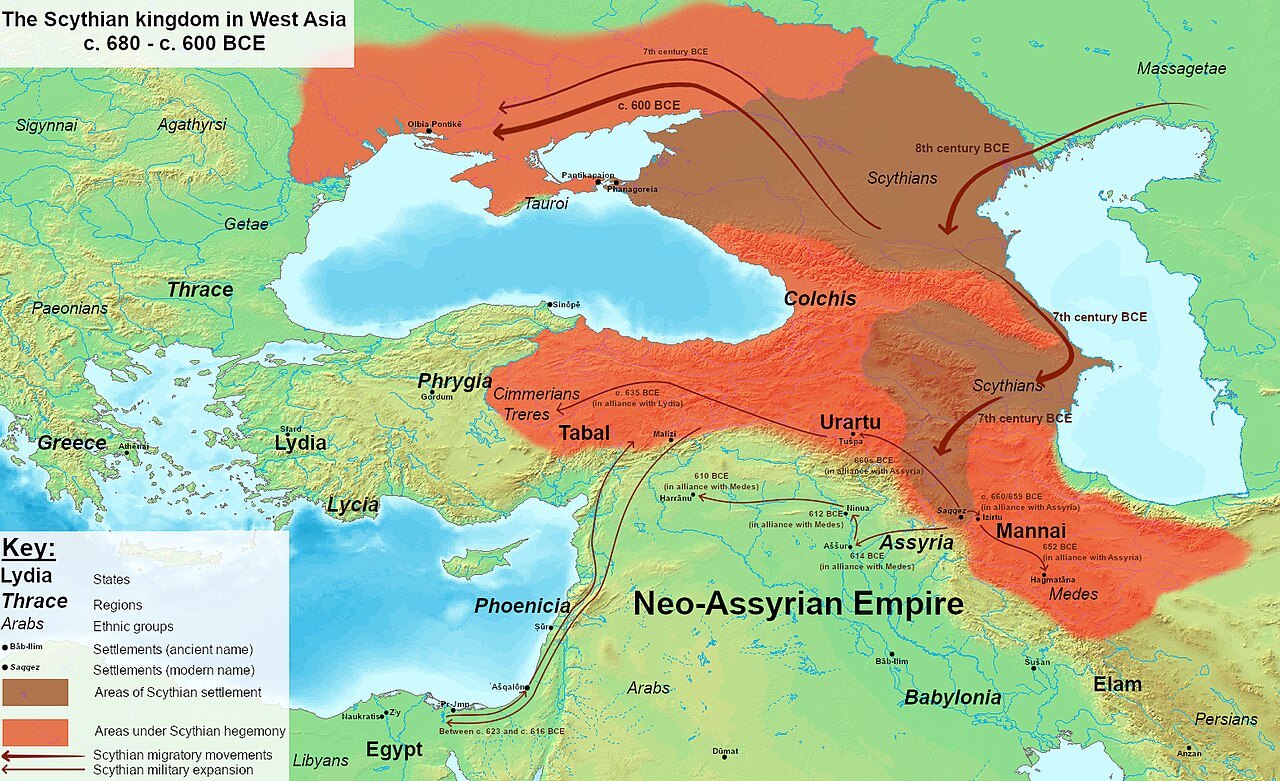
The Scythians. The Scythians were the first great nation of the steppe - the Iranian-speaking horse nomads who dominated the grasslands north of the Black Sea from the 9th to the 3rd century BC and terrified the civilized world. Migrating from Central Asia to the Pontic Steppe (modern Ukraine and southern Russia), they displaced the Cimmerians and built a warrior society in which wealth, war, and status all came from the horse.
The Scythians were the terror of empires. In the 7th century BC they swept over the Caucasus and raided deep into the Near East; in 513 BC the Persian king Darius I invaded Scythia with a huge army - and failed completely, as the Scythians simply vanished into the steppe, drawing the Persians after them until hunger forced retreat. It was a lesson no empire ever forgot: you cannot conquer people who have no cities to take.
Greek colonists on the Black Sea - above all Herodotus, our main source - traded with them, wrote about them, and marveled at them: the royal burials in great mounds (kurgans) filled with gold, the sacrificed horses, the warrior women who may lie behind the Amazon legends. Scythian gold - animal-style art of stags, griffins, and combat - remains among the most spectacular art of the ancient world.
Their end came from their own kin: in the 3rd century BC the related Sarmatians drove the Scythians from the steppe, and the remnants dwindled into small kingdoms in Crimea and on the lower Danube. But their way of war - mounted archery on the open grassland - outlived them for two thousand years: every steppe horde that followed, down to the Mongols, rode in the Scythians' path.
 Britannica: Scythian
 World History Encyclopedia: Scythians
 Encyclopaedia Iranica: SCYTHIANS
 British Museum: Introducing the Scythians